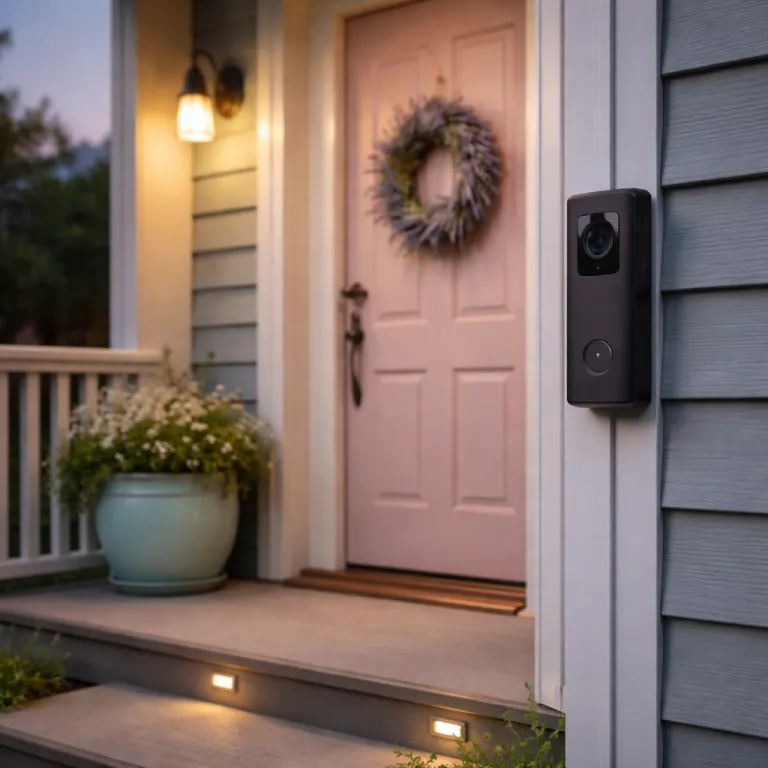
Front porch lighting tips for smart doorbells in long summer evenings
Testing notes: We evaluated a Ring Battery Doorbell Plus (firmware 1.19.0) and a Nest Doorbell (Battery) (firmware 1.67) on a north-facing, partially shaded porch. Each doorbell used default video settings with motion alerts on and HDR enabled. Over three clear summer evenings per device, we logged how often the cameras switched between daytime color and infrared night vision, with timestamps taken every five minutes. Ambient light was measured with a basic handheld lux meter at the doorbell height, and porch bulbs were standard 5 watt warm white LED smart bulbs rated around 2700 Kelvin, producing roughly 40 to 60 lux at the threshold.
Why long summer dusk breaks your smart doorbell
Front porch lighting for a smart doorbell in summer behaves differently from winter or shoulder seasons. The longest days stretch dusk so your doorbell camera keeps flipping between bright daytime mode and infrared night mode, which creates more motion alerts than a windy storm and makes it harder to see who is actually at the porch. That is why a front porch lighting smart doorbell summer tune up matters before the evenings get strangely bright and then suddenly dark, especially if you rely on the camera for package monitoring and visitor identification.
Most smart video doorbell models, whether from Amazon owned Ring or Google Nest, switch modes based on a fixed light level rather than on a clear time schedule. During summer the outdoor light lingers in a gray zone, so the camera and many security cameras around the front porch repeatedly turn light boosting infrared on and off, which can trigger motion sensors, confuse motion activated recording, and flood your phone with motion alerts that feel random. A stable pool of outdoor lights on the porch can hold the security camera in one mode, which gives better visibility and more reliable smart security when you actually care about who is at the door and what they are carrying.
In testing with a Ring Battery Doorbell Plus and a Nest Doorbell Battery on a shaded front porch, the cameras flipped modes six to eight times during a long summer dusk without any extra porch light, typically between 8:35 p.m. and 9:15 p.m. when ambient light hovered around 8 to 15 lux. When we added a single 5 watt warm smart bulb in the main porch light, raising measured light at the mat to roughly 45 lux, both cameras stayed in daytime color mode and the video looked good enough to distinguish a dark jacket from a package on the mat. That simple light turn on at the right time did more for practical security than upgrading to higher resolution cameras or adding another battery powered security camera above the door.
Choosing porch bulbs and colors that work with cameras

The bulb in your front porch fixture can either help your smart doorbell or ruin its video. A harsh cool white light with a high color temperature can blow out faces on camera, while a warm 2700 Kelvin bulb usually keeps skin tones natural and lets the camera stay in color mode longer into summer dusk. For most people a low wattage LED smart bulb in the 5 to 7 watt range is enough to give better visibility without turning the porch into a floodlit stage or annoying neighbors across the street.
Smart lights from brands like Philips Hue White Ambiance, TP Link Kasa KL135, and Amazon compatible budget bulbs such as Sengled Smart LED let you tune both brightness and color temperature range from an app. On a typical outdoor front porch we found that a warm white setting around 2700 to 3000 Kelvin gave the best balance between security and comfort, because the camera kept full color video while visitors did not feel interrogated by a spotlight. If your porch has multiple outdoor lights, set the one closest to the doorbell camera slightly dimmer than the others so the camera sensor does not clip highlights on faces or packages, and angle fixtures so the brightest part of the beam lands on the step rather than directly on the lens.
For people who want automation, pairing a smart bulb with a routine that makes the light turn on about 45 minutes before local sunset works better than relying on a basic dusk to dawn sensor. As one concrete example, in the Philips Hue app you can create an automation that uses the “Sunset” trigger, add a 45 minute offset, set brightness to 60 percent, and lock color temperature at 2700 Kelvin for the porch group. You can then schedule the turn light off time for late night, while keeping a lower brightness level during the long summer dusk window when motion alerts are most likely. For more detailed guidance on keeping your camera lens clean and your light motion performance consistent, a dedicated guide on essential camera maintenance tips for smart doorbell owners can be helpful before you start changing bulbs and adjusting fixtures.
Smart routines, motion zones, and avoiding alert overload
Lighting alone will not fix a noisy smart security setup if your motion zones and sensitivity are wrong. During summer dusk the combination of shifting outdoor light, passing cars, and insects around the porch light can make a video doorbell behave like a hyperactive security camera, sending motion alerts every few minutes. The goal is to let the camera and any nearby security cameras focus on people approaching the front porch, not every moth that crosses the beam or every headlight that sweeps across the driveway.
Most modern smart doorbell apps from Ring, Google, Eufy, and Arlo let you draw motion zones and set different sensitivity levels for different times of day. Create a specific summer profile that lowers motion sensitivity between one hour before sunset and one hour after, while your porch light or smart lights are scheduled to turn on and stay steady, because that combination reduces false triggers from light motion changes. If you use motion activated outdoor lights or a separate motion activated security camera, try to keep their motion sensors aimed away from the doorbell so the two systems do not constantly trigger each other or create a loop of flashing lights and repeated notifications.
For homes worried about package theft, a calmer but more focused alert setup usually works better than maximum sensitivity. When your front porch lighting smart doorbell summer routine keeps the light stable and the camera in color mode, you can clearly see when a delivery driver leaves a box and when someone else approaches it later. To understand what smart doorbells actually stop and where their limits are, it is worth reading a detailed package theft prevention analysis before you rely on a single camera and a bright bulb as your only line of defense, especially if you receive frequent evening deliveries.
Balancing floodlights, ecosystems, and future proofing

Many homeowners assume that adding powerful outdoor floodlights will automatically improve security, but for a smart doorbell the trade offs are more subtle. A motion activated floodlight mounted near the door can repeatedly force the doorbell camera to switch between infrared and bright visible light, which creates choppy video and inconsistent color. In some tests a cheaper battery powered floodlight even caused the doorbell to miss the first second of motion video because the sensor was overwhelmed by the sudden light change and needed a moment to recover exposure.
If you already have a floodlight style security camera above the garage or side yard, treat it as a separate layer from the more focused video doorbell at the front porch. Use the floodlight camera for wide area coverage and deterrence, while the doorbell and its carefully tuned porch light handle identification at close range with good color and stable exposure. That layered approach to smart security usually beats trying to make one device do everything, especially during the long and uneven lighting conditions of summer evenings when cars, pedestrians, and pets all move through different pools of light.
When you choose bulbs, lights smart controls, and doorbells, think about which ecosystem you actually use on your phone and speakers. If you live in a Google Assistant household, a Nest doorbell and compatible smart lights will be easier to control by voice, while an Amazon Alexa setup pairs naturally with Ring and many Alexa compatible smart bulb options that often come with free shipping deals. For people planning a longer term upgrade path, it is worth reading about what cross ecosystem support through Matter actually changes for doorbells and lighting, because that standard can make it easier to mix brands without losing simple app control over every light turn and camera feed as your system grows.
FAQ
How bright should my front porch light be for a smart doorbell in summer ?
For most small porches a 5 to 7 watt LED bulb, which roughly matches a 40 watt old style bulb, is enough to keep your smart doorbell in color mode without blinding visitors. Aim the fixture so the light spreads across the entry rather than shining directly into the camera lens, and check that you are getting at least a soft pool of light on the doormat. If the video still looks washed out, lower brightness in the app or choose a bulb with a warmer color temperature that is less harsh on reflective surfaces.
Is a warm or cool light color better for doorbell cameras ?
A warm white bulb around 2700 to 3000 Kelvin usually works best for video doorbells and nearby security cameras. Warm light keeps skin tones natural and reduces harsh reflections on glass or metal surfaces around the porch. Very cool white bulbs can make faces look flat and can cause the camera to struggle with exposure during summer dusk, especially when people move from a bright driveway into a shaded entryway.
Do I need a motion activated floodlight if I already have a video doorbell ?
You do not always need a motion activated floodlight when a smart doorbell already covers the front porch. A floodlight can help for wider yard coverage, but if it is mounted too close to the doorbell it may cause repeated mode switching and messy video. Many homeowners get better results by using a steady porch light for the doorbell and a separate, more distant floodlight camera for general outdoor security that does not constantly blast the entry with sudden brightness.
Can battery powered doorbells handle long summer evenings ?
Battery powered video doorbells can handle long summer evenings, but their battery life often drops when motion alerts spike during dusk. Using a stable porch light and lowering motion sensitivity during the busiest hours can significantly extend the time between charges. If your model supports it, wiring the doorbell to existing chime power while keeping the battery as backup gives the most consistent performance and reduces the chance of the device shutting down during a busy delivery day.
How do I sync my smart lights with my doorbell camera modes ?
The simplest method is to create a routine in your smart home app that turns the porch light on about 45 minutes before sunset and keeps it at a steady brightness through the evening. In many ecosystems you can also link motion events from the doorbell to light actions, but for summer dusk it is usually better to keep the light constant and let the camera handle motion detection. Check whether your Amazon Alexa, Google Home, or other hub lets you group the doorbell and porch light so you can adjust both together as the seasons change without rebuilding every routine.
Quick checklist for tuning porch lighting and smart doorbells
Use this simple step by step list as a summer setup checklist:
- Install a warm white 5 to 7 watt LED bulb in the main porch light.
- Set color temperature to around 2700 to 3000 Kelvin in the smart bulb app.
- Schedule the porch light to turn on about 45 minutes before local sunset.
- Lower brightness slightly if faces look washed out on the doorbell video.
- Draw motion zones that focus on the walkway and doorstep, not the street.
- Reduce motion sensitivity during the one hour before and after sunset.
- Keep any floodlight or separate security camera aimed away from the doorbell.