
Summary
Editor's rating
Is it worth the money once you factor in subscriptions?
Slim, modern look with a very practical field of view
Power and reliability: wired is good, but the ecosystem still has quirks
Build quality and how it holds up over time
Video, audio, and app performance: decent, but the weak link is software
What you actually get and what it really does
Pros
- Good 1:1 video with tall field of view, handy for seeing visitors and parcels
- Wired power means no battery charging or swaps
- Direct phone call when doorbell is pressed is faster and more useful than a simple push notification
Cons
- App can be slow, glitchy, and notifications are sometimes delayed or inconsistent
- Most smart features locked behind a paid subscription after the trial
- Mixed reports on long-term reliability and only a 1-year warranty

Specifications
View full product page →| Brand | Arlo |
A doorbell camera that looks good on paper, but how is it to live with?
I’ve been using the Arlo Wired Video Doorbell on a normal UK front door setup with existing chime wiring. No fancy network gear, just a regular fibre router in the hallway and a couple of Alexa devices around the house. I went for this one because I wanted a wired model (no battery hassle) and I didn’t really want to lock into Ring or Nest again. On paper the Arlo ticks a lot of boxes: 1:1 video, night vision, 2‑way audio, motion zones, and it can call your phone directly when someone presses it.
Living with it is a bit more mixed. When it works, it really does the basic job well: I see who’s at the door quickly, I can talk to delivery drivers, and I can check parcels on the floor thanks to the tall view. But there are a bunch of small annoyances around the app, notifications, and the whole subscription story that you only really notice after a few weeks. It’s not a disaster, but it’s also not the perfectly smooth experience you’d hope for from a wired doorbell in 2026.
Compared to Ring and Nest I’ve used before, Arlo sits somewhere in the middle. It’s better than some of the cheaper generic brands I’ve tried, especially on viewing angle and feature set. But the software side feels less polished than Nest, and the subscription strategy feels a bit aggressive, closer to Ring. If you go in thinking “I’ll just use it free forever”, you’re probably going to be disappointed by the limited features and motion filtering.
So the short version: the hardware is mostly pretty solid for a home user, but the app reliability and subscription model can be frustrating. If you’re okay fiddling with settings and living with the occasional glitch, it can get the job done. If you want something that just quietly works for years without any quirks, this might not be the safest bet.
Is it worth the money once you factor in subscriptions?
Value is where this doorbell gets a bit tricky. The upfront price is in the same ballpark as Ring and below a Nest setup once you factor in their more expensive subscriptions. On paper, Arlo Secure is cheaper than Nest Aware and roughly similar to Ring Protect, and you get smart detection for people, cars, animals, and packages, plus cloud recording and activity zones. During the free 90‑day trial, it feels pretty good: accurate alerts, fewer false positives, and decent cloud history.
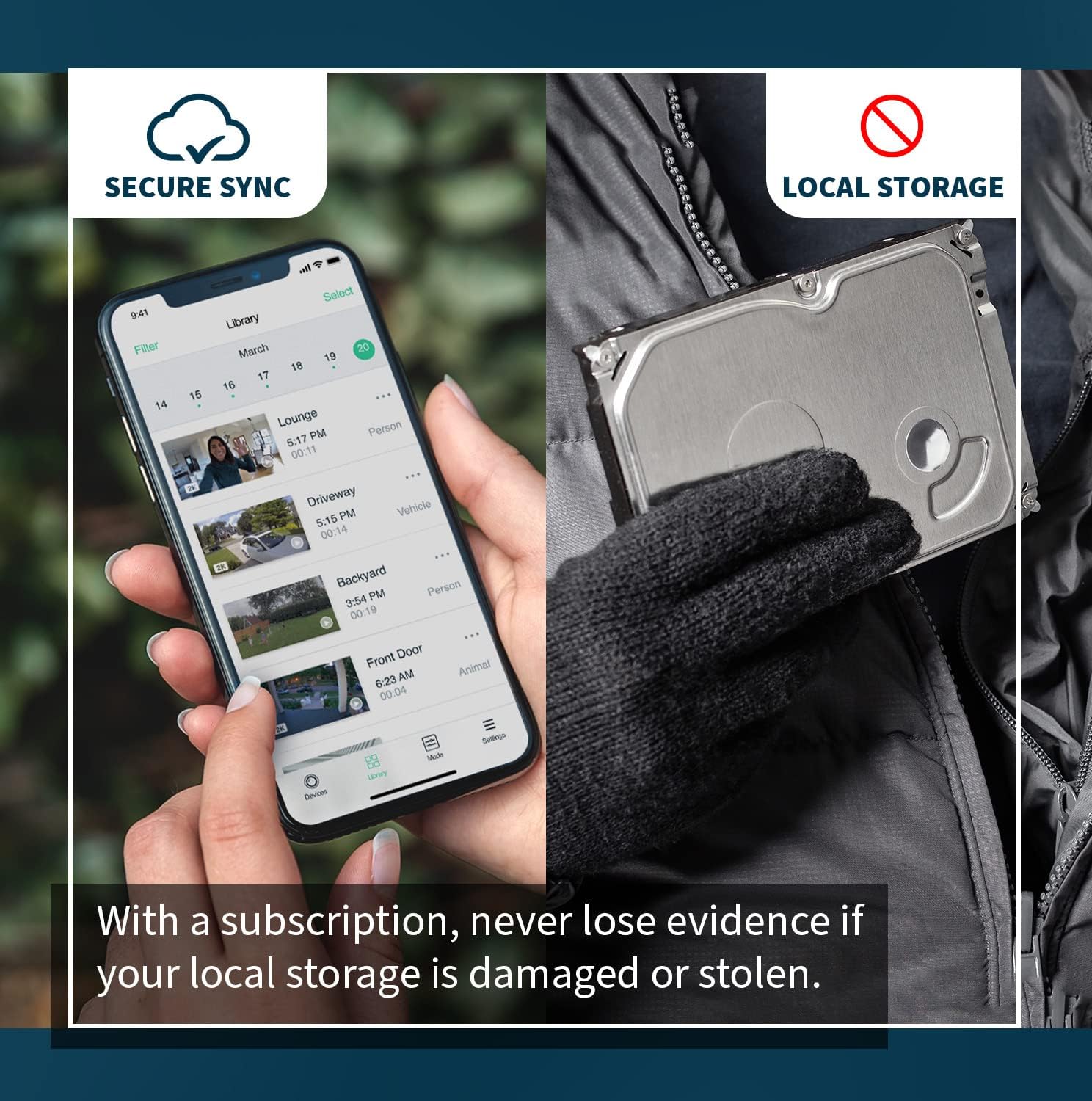
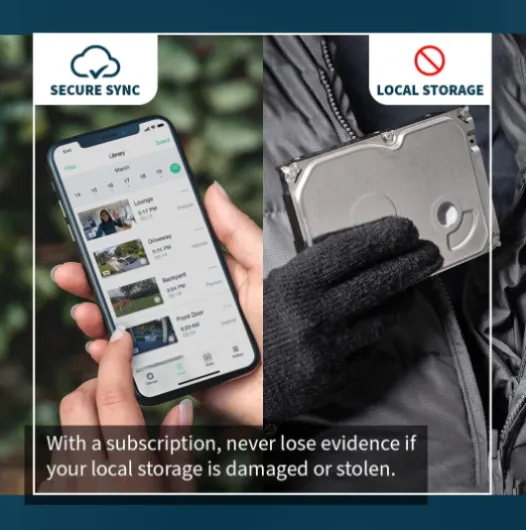
Once the trial ends, though, the free mode is pretty bare-bones. You still get live view, motion alerts, and two‑way talk, but you lose a lot of the smarter stuff – no advanced object detection, limited filtering, and you’re basically stuck with generic motion notifications. That can also hurt practical things like battery life on Arlo’s wireless cameras because they wake up more often, but for the wired doorbell it mainly means more noise in your notifications. You can add a base station for local recording, but that’s extra cost and extra complexity, and most casual users won’t bother.
Several long‑time users are clearly fed up with Arlo’s subscription model, calling it expensive and accusing them of bait‑and‑switch tactics as features shift behind paywalls. I get where they’re coming from. If you buy this expecting a rich feature set without paying monthly, you’re going to feel short‑changed. If you accept from day one that you’re basically signing up for a recurring fee to get the full experience, it’s easier to swallow, but you still have to compare that against what Ring and Nest offer for similar money.
Overall, I’d say the value is decent if you’re okay with the subscription and you want the specific combo of 1:1 video and direct phone calling. If you’re very price‑sensitive or hate subscriptions on principle, this is not great value at all – you’re paying for hardware that only really shines when you keep paying Arlo each month. For someone already in the Arlo ecosystem with other cameras, it makes more sense, since one subscription can cover multiple devices. For a one‑off buyer who just wants a simple doorbell camera, there are cheaper options with fewer strings attached, even if they’re a bit more basic.
Slim, modern look with a very practical field of view
Visually, the Arlo Wired Video Doorbell is pretty straightforward: white body, black camera section, and a round button with a light ring around it. It looks modern without screaming for attention, which I liked. Mounted on a brick wall next to a standard UK door frame, it doesn’t look oversized. If you’re replacing a chunky Ring Pro, this actually looks a bit cleaner. The included angled mount is handy if your door frame is recessed or your entry is at a weird angle, since you can tilt it slightly towards the person instead of filming half the street.
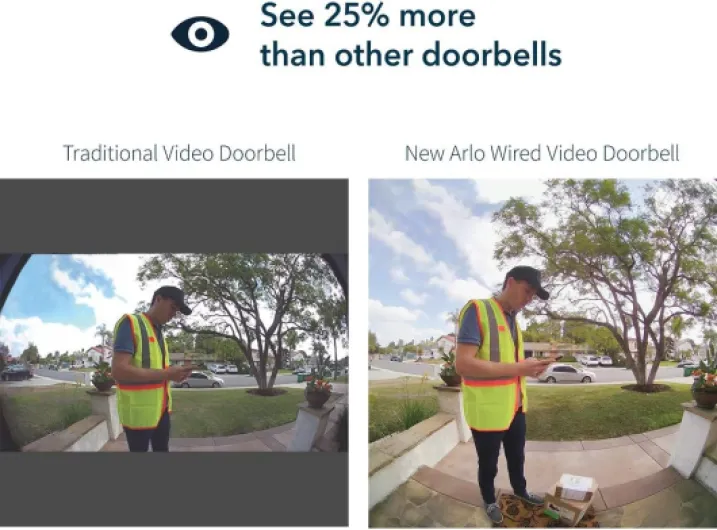
The main design win is the 1:1 aspect ratio with a 180° field of view. In practice, that means you see the visitor from head to toe and also the floor area directly below the bell. For parcel deliveries, this is genuinely useful. I can see boxes left right at the threshold without the camera being mounted super high. Compared to older 16:9 doorbells I’ve used, this feels more natural for a front door – you care more about vertical coverage than wide cinematic shots.
The button lighting is bright enough that visitors understand where to press, even at night. The ring light also doubles as a bit of a status indicator, which is nice for quick checks. It doesn’t look cheap or overly plasticky from normal viewing distance. Up close, you can tell it’s plastic, but that’s expected at this price. There are no fancy finishes or metal frames; it’s just a clean, functional slab.
On the downside, the fisheye effect is noticeable. Faces near the edge of the frame bend a bit, and the perspective looks slightly warped. It doesn’t ruin anything – you still see who it is and what they’re holding – but if you’re picky about image geometry, you’ll spot it. Also, because it’s a tall 1:1 frame, the sides sometimes feel a bit wasted if your door opens onto a wide driveway. For a typical front step with parcels on the ground, though, the design choice makes sense and is more practical than pretty.
Power and reliability: wired is good, but the ecosystem still has quirks
This specific model is wired only, so there’s no internal battery to worry about charging. That’s one of the reasons I picked it. I’ve dealt with Arlo’s battery cameras before, and if the camera is in a busy area, the battery life can be pretty poor. With the wired doorbell, as long as your transformer and wiring are correct, you get 24/7 power and don’t have to climb a ladder every couple of months. In my setup, once the electrician confirmed the voltage was fine, power itself has been stable – no power‑related dropouts or anything like that.
Where things get a bit messy is firmware updates and how they affect reliability. Arlo pushes updates in the background and you don’t really get much control over them. After one update, I noticed night vision quality took a slight hit – more noise and a bit less contrast. It still worked, but you can tell something changed. Other users report more serious issues after updates, like devices disconnecting more often or charging problems on the battery models. With the wired doorbell, you don’t have charging issues, but you are still at the mercy of whatever changes they roll out to the app and backend.
Because there’s no battery backup, if your power or transformer goes, the doorbell is dead – obviously. That’s not unique to Arlo; all wired models are like that. But it’s worth noting if you live in an area with flaky power. A battery‑backed model will at least keep recording during a short outage. Here, if the power is out, you just have no doorbell at all. For me that’s not a big deal, but some people will prefer the flexibility of a battery doorbell even if it means more maintenance.
Overall, on the power side I’d say the wired approach is less hassle day to day than Arlo’s battery cameras, but you’re still dealing with the same ecosystem: automatic firmware updates, cloud dependency for many features, and occasional odd behaviour after updates. The wiring itself is “set and forget” if done right. The software side is where the long‑term reliability question sits, and that’s more about Arlo as a platform than this specific doorbell.
Build quality and how it holds up over time
Physically, the Arlo Wired Video Doorbell feels like typical mid‑range smart home gear: mostly plastic, fairly light, but not flimsy. The IP65 rating is decent for outdoor use – it’s rated against dust and water jets, so normal rain and wind shouldn’t be a problem. Mine has been through several heavy rain days and temperature swings and hasn’t shown any obvious issues like fogging inside the lens or water intrusion. The front still looks clean, and the button ring light works as it did on day one.
That said, long‑term durability is where mixed user reports start to matter. Some people, including one reviewer who had it for a couple of years, mention failures after around the two‑year mark – things like it just dying, or performance declining after multiple firmware updates. Another user mentioned replacing a dead Ring Pro after three years and being happier with the Arlo, at least in the short term. So it’s not like competitors are perfect either. But you should keep in mind that this is not the kind of thing I’d expect to last ten years untouched. With a 1‑year manufacturer warranty, Arlo clearly isn’t promising a super long lifespan.
From a mechanical point of view, the mounting plate and the way it clips on are okay but not bulletproof. If someone really wants to rip it off the wall, they probably can. Arlo talks about theft protection as part of the subscription, which tells you they know this is a possibility. The plastic casing hasn’t yellowed or cracked yet in my use, but that’s also going to depend on how much direct sun you get. In full sun all day, I wouldn’t be shocked if it starts to look a bit tired after a few summers.
So in practice, I’d rate the durability as acceptable but not outstanding. It’ll handle normal outdoor conditions and regular use just fine, but between the short warranty and the history of Arlo hardware having issues after a couple of years, I wouldn’t buy this expecting a decade of trouble‑free service. If you’re okay with the idea that you might need to replace it in, say, 3–5 years, then it’s probably fine. If you want something you fit once and never touch again for ages, I’d consider that a risk.
Video, audio, and app performance: decent, but the weak link is software
On the video side, during the day the picture is pretty solid. The 1080p HD with HDR gives enough detail to recognise faces, read logos on jackets, and check parcel labels if you zoom a bit. Colours are fine – not cinema-level accurate, but clear enough to see what’s going on. The 1:1 view is genuinely practical; seeing the visitor and the floor in one shot is more useful than a wide cinematic look. At night, the infrared kicks in and the image switches to black and white. It’s not razor sharp, but you can still easily tell who’s there within a few metres. Beyond that, it starts to get a bit mushy, which is pretty standard for this price range.
Audio performance is more mixed. When the connection is stable, two‑way audio is clear on both sides and loud enough that delivery drivers actually hear you. But latency can be an issue. On a good day, you’re looking at 1–2 seconds delay, which is fine. On bad days – especially if the app is in a weird state or your phone has been asleep – that can creep higher and the conversation becomes a bit awkward, with people talking over each other. Some users report 30‑second delays; I didn’t see anything that bad consistently, but there were definitely times where the connection took too long to fully spin up.
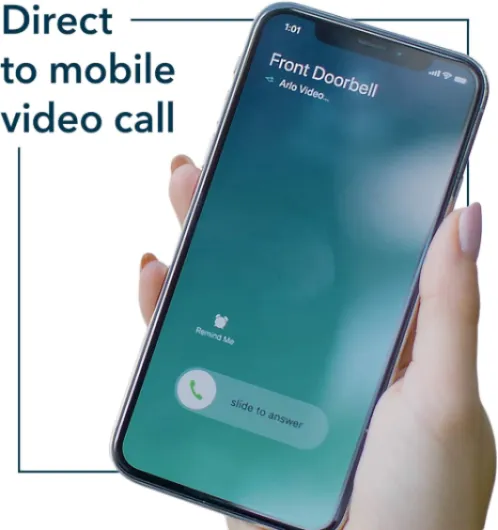
The app and notifications are honestly the biggest weak spot. The Arlo app feels heavy. It takes a while to open, sometimes freezes for a second or two, and every now and then it just needs to be force-closed and reopened. Motion notifications are mostly okay, but there are occasional delays or missed alerts. The direct video call when someone presses the bell is a good idea and usually works faster than a standard push notification, but I’ve had cases where my phone rang well after the person had already walked away. If you share access with multiple family members, weird things happen like some phones ringing, others not, or getting the alert a couple of minutes later.
In terms of Wi‑Fi reliability, the doorbell itself stayed connected most of the time with my router about 3–4 metres away through one wall. But there were a few random disconnections that required a manual restart or, once, a full reset and re‑setup. That’s the kind of thing you don’t want from a front door device. Compared to Nest, Arlo’s overall performance feels a bit more fragile. It gets the job done most days, but if you’re expecting rock‑solid uptime and perfectly timed alerts, you’re likely to be annoyed.
What you actually get and what it really does
Out of the box you get the doorbell unit, a flat mount, an angled mount, a little power kit for your existing chime, and a bag of screws and anchors. No separate chime, no hub, and obviously no transformer if your old doorbell wiring isn’t up to spec. This is very much designed for houses that already have a wired doorbell, not flats with no existing wiring. The unit itself is fairly compact: about 13 cm tall, 4.5 cm wide, and quite slim, so it doesn’t look like a brick on the wall.
Feature-wise, Arlo advertises 1080p HD video with HDR, a 1:1 aspect ratio so you see top-to-bottom including parcels on the ground, two‑way audio, motion detection with zones, night vision, and direct video calling to your phone when someone presses it. There’s also a built‑in siren, though in practice I doubt many people will use that regularly. It’s IP65 water resistant, so it should handle normal rain and dust without drama. It connects over Wi‑Fi, but it’s powered from your doorbell transformer, so no battery to recharge.
Where it gets a bit confusing is the whole subscription side. Out of the box, you get a 90‑day trial of Arlo Secure. With the trial you can do all the smart stuff: detect people, cars, animals, packages, set advanced motion zones, and store video in the cloud. Once the trial ends, without a subscription you’re basically left with live view, motion alerts, and two‑way talk. You can pair it with a base station for local storage, but most people won’t bother with that extra hardware. So yes, it technically works without a subscription, but the experience is clearly designed to push you into paying monthly.
In daily use, the core promise is simple: when someone approaches or presses the bell, your phone rings like a call, you see their face clearly, and you can talk back with minimal delay. When motion happens, you get a notification, tap it, and see what’s going on. That’s the promise. Depending on your network and how patient you are with the app, the reality ranges from quite decent to mildly irritating. The hardware is mostly fine; the app and backend services are where most of the complaints come from.
Pros
- Good 1:1 video with tall field of view, handy for seeing visitors and parcels
- Wired power means no battery charging or swaps
- Direct phone call when doorbell is pressed is faster and more useful than a simple push notification
Cons
- App can be slow, glitchy, and notifications are sometimes delayed or inconsistent
- Most smart features locked behind a paid subscription after the trial
- Mixed reports on long-term reliability and only a 1-year warranty
Conclusion
Editor's rating
Overall, the Arlo Wired Video Doorbell is a pretty solid wired option with good daytime video, practical 1:1 framing, and the nice touch of calling your phone directly when someone presses it. The wired power means no battery headaches, and the tall field of view is genuinely useful for seeing parcels on the ground as well as the person at the door. When the app behaves, it does exactly what you want: you see who’s there, talk to them, and check footage if needed.
The downsides are mostly around software and the business model. The app can be slow, occasionally buggy, and notifications aren’t always as quick or reliable as they should be. Firmware updates sometimes change behaviour in ways that don’t feel like an upgrade. And without an Arlo Secure subscription, the doorbell loses a lot of its smarter features and becomes more of a basic camera with alerts. Add in the mixed reports about long‑term reliability and short warranty, and it’s not the safest long‑term bet.
I’d recommend this to someone who: already has other Arlo gear, wants a wired solution with a tall field of view, and is fine paying for a subscription to get the full experience. If you’re very sensitive to lag, want rock‑solid app performance, or hate ongoing fees, I’d look at alternatives like wired Ring or Nest, or even simpler budget doorbells, depending on which compromise bothers you less.