
Summary
Editor's rating
Value: fair if you accept the subscription, weaker if you want a one-off purchase
Design: compact, neutral, and clearly built for renters
Battery life: acceptable, but heavily depends on how busy your front door is
Durability & weather: built to handle normal weather, but the adhesive is the weak link
Performance: decent video and alerts, but very tied to Wi‑Fi and the app
What you actually get with this 2024 Ring Battery Video Doorbell
Pros
- Very easy and quick installation, especially with the no-drill mount (ideal for renters)
- Clear 1440p video with useful head-to-toe view and decent colour night vision
- Stable app with reliable notifications and simple control of multiple Ring devices
Cons
- Many key features (video history, person/package alerts) require a paid Ring Home subscription after the trial
- Built-in battery means taking the whole doorbell down to recharge, with no backup camera during charging
- Adhesive no-drill mount durability depends heavily on surface and weather, and can’t be reused once removed

Specifications
View full product page →| Brand | Ring |
A wireless doorbell that’s easy… as long as you play by Ring’s rules
I’ve been using this Ring Battery Video Doorbell (2024) with the no-drill mount for a little while, and I’ll be straight: it’s a solid, modern doorbell camera, but you feel that Ring really wants you to pay for the subscription. The hardware itself is decent, the video is clear, and installation was genuinely quick. But a lot of the features they highlight in big letters depend on Ring Home, which is extra. If you go in knowing that, you’ll probably be fine; if you expect everything to work fully out of the box without paying more, you might be annoyed.
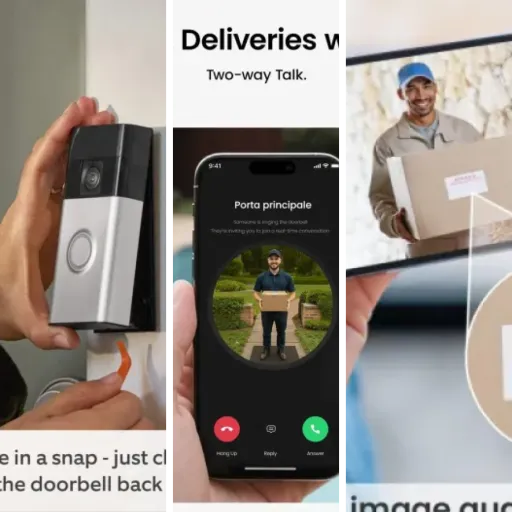
I installed it on a rented flat’s front door where I’m not allowed to drill, so the no-drill mount was the main reason I picked this bundle. The install really did take about 5–10 minutes, including pairing it with Wi‑Fi and the app. No messing with wires, no transformer, nothing. Just stick the mount, slide the doorbell in, and you’re done. For something this kind of user-friendly, that part is a win.
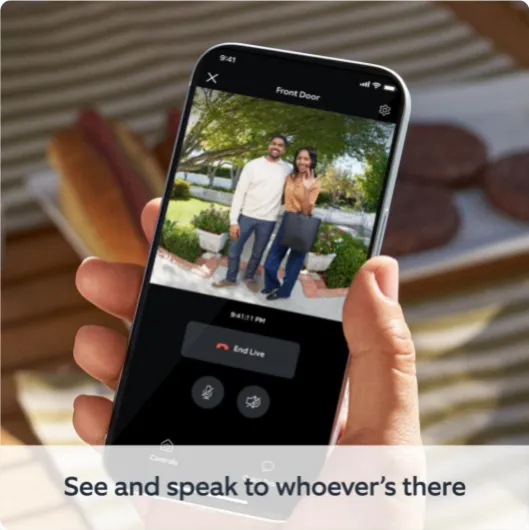
In daily use, it does what you expect: sends a notification when someone is at the door, lets you see and talk to them, and records clips when there’s motion if you have the subscription. The head-to-toe view is actually handy because you can see parcels on the ground and not just people’s faces. At night, the image is still clear enough to recognise who’s there, and the colour night vision is decent for a battery device.
On the flip side, the constant little pushes toward the paid plan are a bit tiring. After the 30-day free trial, some of the “cool” things like extended video history, person alerts, and package alerts become paywalled. So my overall first impression is: good hardware, easy life if you just accept the ongoing cost; a bit frustrating if you want a one-time purchase and forget-about-it solution.
Value: fair if you accept the subscription, weaker if you want a one-off purchase
On the value for money side, this doorbell sits in a slightly tricky spot. The upfront price is reasonable for a branded battery doorbell with head-to-toe view and a no-drill mount included. The hardware, app, and ecosystem are mature, and you feel that in the overall experience. But a lot of the “interesting” features they advertise—like long video history, people and package alerts, and some smart app functions—are tied to the Ring Home subscription, which is sold separately once your 30-day trial ends.
If you’re okay paying a monthly or yearly fee, the value looks better. You get up to 180 days of stored clips, better notifications, and more control. In that case, this doorbell becomes part of a broader Ring ecosystem (cameras, alarms, etc.), and it’s pretty convenient to manage everything in one app. Compared to some cheaper, no-name cameras that come with clunky apps or unreliable servers, paying a bit more for a stable service can make sense.
If you’re the type who hates subscriptions on principle and just wants to buy something once and be done, the value drops. Without the plan, you lose a chunk of what makes it feel “smart” beyond live view and basic alerts. You can still use it, but you’re not really using the full potential of the device you paid for. There are competitors that offer local storage or free basic cloud storage, and if that matters to you, they might be more attractive.
So in pure numbers, I’d rate the value as good but not outstanding. You get what you pay for in terms of reliability and polish, but you should mentally add the subscription cost to your budget if you want the full experience. For renters or people who already use Ring products, it makes sense. For someone looking for a one-time purchase with no ongoing payments, this is less appealing and you might want to look at brands with free storage or SD card options.
Design: compact, neutral, and clearly built for renters
Design-wise, Ring went for something pretty neutral here. The Battery Video Doorbell (2024) is slim enough that it doesn’t look bulky or cheap on the door. The Satin Nickel and Venetian Bronze finishes are more about colour accents than anything else, but both look fine and blend in with most doors or frames. Mine doesn’t scream “security gadget” from the street, which I like; it just looks like a modern doorbell with a camera eye on top.
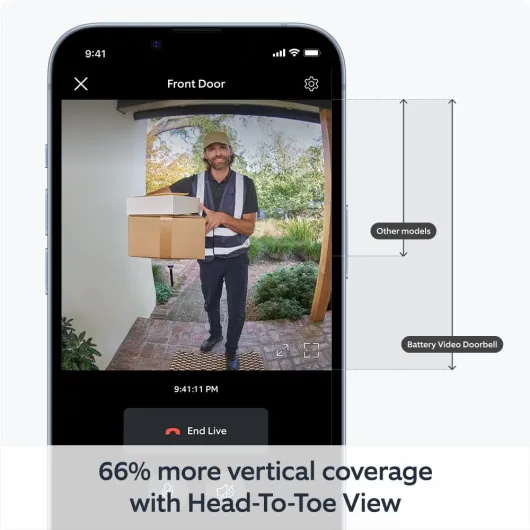
The head-to-toe view is a design choice I actually noticed in daily use. Because the camera is more square (1440 x 1440), the app shows more of the person’s body and the area in front of your door, not just a wide horizontal strip. That means when someone drops a parcel, you can often see it on the ground clearly without them having to hold it up. It’s one of those details you stop thinking about after a few days, but if you’ve used older doorbells with narrower vertical view, this feels more practical.
The no-drill mount is really the star of the design if you’re renting. It’s a plastic plate that attaches via a strong adhesive pad. You screw the standard Ring bracket onto that plate, then slide the doorbell on. It adds a bit of thickness but nothing crazy. What I liked is that it feels sturdy once attached; the doorbell doesn’t wobble when you press the button. The downside is you only get one adhesive pad in the box, so if you mess up the positioning or want to move it later, you’ll need to buy another mount or find compatible adhesive.
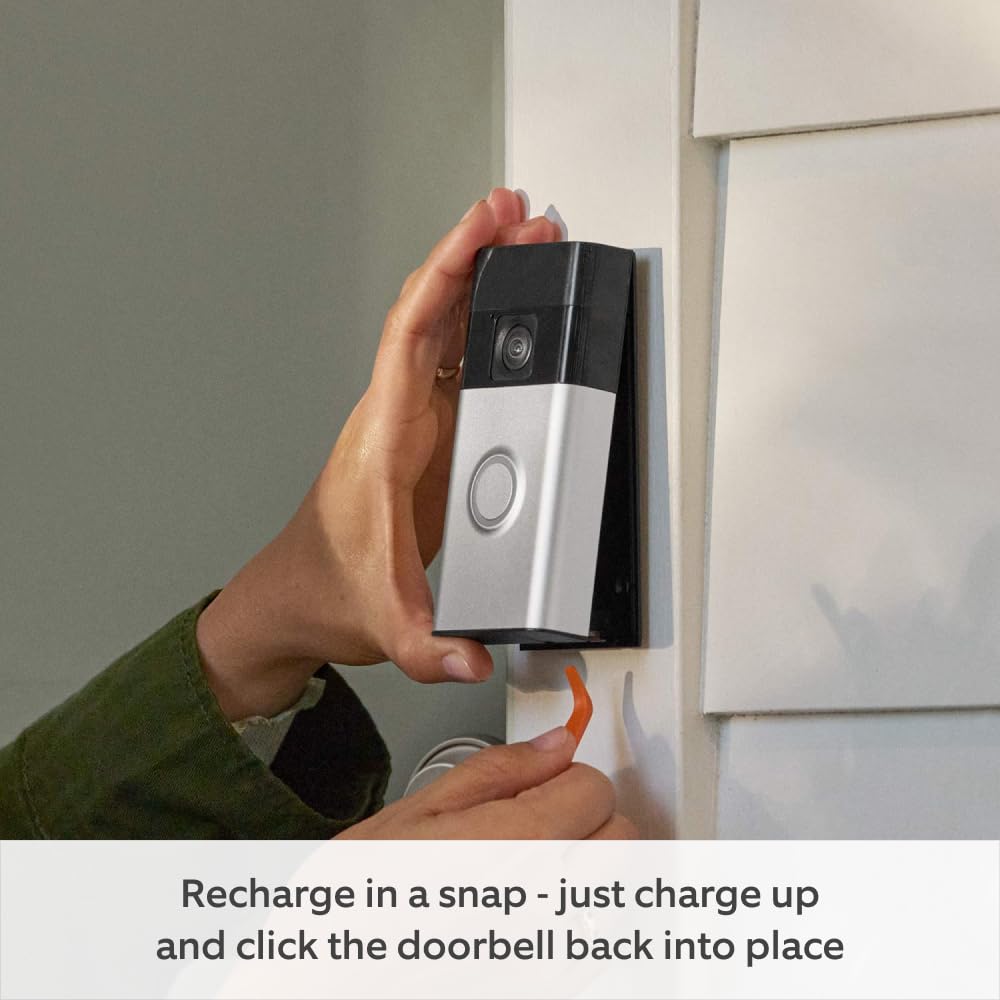
One small design nitpick: the doorbell release mechanism is still a bit fiddly. To remove it for charging, you have to use the tiny included tool (or a similarly thin object) to unlock it from the bracket. It’s not complicated, but it’s not as smooth as just sliding a latch either. Overall, the design is clean and practical, nothing flashy, and clearly thought out for people who want an easy, low-impact install more than some fancy-looking object on their wall.
Battery life: acceptable, but heavily depends on how busy your front door is
The doorbell uses a built-in rechargeable battery, so you don’t swap it like some other Ring models with removable packs. You charge it with the included USB‑C cable, and then you’re done until it runs low again. In theory, that’s simple. In practice, how often you have to recharge really depends on: how many motion events you get per day, how often you use live view, and how strong your Wi‑Fi signal is. More motion, more streaming, weaker Wi‑Fi = faster battery drain.
In my case, on a fairly quiet street with maybe 10–15 motion events a day and occasional live checks, the battery lasted roughly a few weeks before dropping into the low range. I didn’t babysit it with a stopwatch, but it wasn’t dying every few days either. If you live on a busy road, or you use live view a lot, I’d expect shorter life, maybe closer to a couple of weeks. The app shows you the battery percentage, and you get alerts when it’s getting low, so you’re not totally surprised when it needs a charge.
Recharging means physically removing the whole doorbell from the mount, bringing it inside, and plugging it in for a few hours. That’s where the no-drill mount plus built-in battery combo is both good and a bit annoying. Good because you don’t need to touch wiring at all; annoying because your door is effectively “blind” while the unit is charging unless you do it at night or when you’re home. If you’re forgetful or you hate this kind of maintenance, you might want to hardwire it for continuous charging if you can, or accept the occasional downtime.
So from a pure battery standpoint, I’d say it’s fine but not spectacular. It gets the job done for a battery doorbell, but don’t expect to charge it once and forget about it for months, especially if your doorway is busy. If Ring had gone with a removable battery pack here, it would have made life easier because you could keep a spare charged. As it is, it’s okay, just a bit of a compromise between renter-friendly design and long-term convenience.
Durability & weather: built to handle normal weather, but the adhesive is the weak link
The doorbell itself is rated to work between -20°C and 50°C, so on paper it’s ready for most climates. I haven’t had it through a full winter and summer cycle yet, but during rain and a few cold nights it kept working without issues. The casing feels solid enough for a plastic device; nothing rattles, and the button has a firm click. It doesn’t feel like something that will fall apart in a year as long as it’s not abused.
The no-drill mount is where I have more question marks in terms of long-term durability. The adhesive is supposed to be strong, weather-proof, and removable without damaging the surface. On my painted metal door, it stuck very firmly; I tugged at it gently and it didn’t budge. After some rain and temperature changes, it still held fine. But I can easily see that on some surfaces (rough brick, very textured render, dusty paint) it might not bond as well. And if you peel it off, you’re not putting it back on—once it’s removed, you’ll need a new adhesive pad or a new mount.
Security-wise, the mount plus doorbell lock mechanism is okay, but let’s be honest: if someone really wants to steal it, they can probably rip it off with force. Ring does offer theft protection in the warranty, which is nice, but that still means you’re without a doorbell for a while. For a normal residential area, I’m not overly worried, but if you live somewhere with a lot of petty theft, you might prefer a screwed-in mount if your landlord allows it.
In terms of software durability, Ring promises at least four years of security updates after the device stops being sold new. That’s decent for a smart home gadget and reassures me it won’t be abandoned too quickly. Overall, the hardware feels pretty robust, the weather rating is decent, and the only real weak point is the long-term reliability of the adhesive mount, which depends heavily on your door surface and how exposed it is to harsh sun or heavy rain.
Performance: decent video and alerts, but very tied to Wi‑Fi and the app
In daily use, the video quality is good enough to clearly recognise faces and see parcels, both in daylight and at night. The 1440p resolution is sharper than older 1080p doorbells I’ve used, and the colour night vision actually shows some colour instead of just a grainy black-and-white image. It’s still a battery-powered camera, so don’t expect cinema-level smoothness, but for checking who’s at the door or what happened overnight, it’s more than fine.
The motion detection is where things get more nuanced. You can set motion zones and sensitivity, and if you pay for the subscription, you can activate person detection and package alerts. Once I tuned the zones (so it didn’t trigger every time a car passed on the street), it behaved reasonably. Still, the first few days were a bit of trial and error. Sometimes it would alert for someone walking past the edge of the frame, sometimes not. With person alerts on, the notifications were more relevant, but again, that’s behind the paywall after the trial.
Latency-wise, when someone pressed the doorbell, my phone usually rang within 2–4 seconds, which is acceptable. Talking through the two-way audio had a slight delay, but it was usable for telling a delivery driver where to leave a parcel. The noise cancellation is okay; voices are understandable even with some street noise, but there’s still a bit of echo and compression. Not perfect, but it does the job. The main thing is that your Wi‑Fi needs to be stable. When my router was rebooting once, the doorbell obviously went offline, and there’s no local chime backup unless you’ve wired it or bought an extra chime.
Overall, I’d rate performance as pretty solid for a battery Wi‑Fi doorbell. It’s not flawless: you’ll probably need to tweak motion settings, and you’re at the mercy of your internet connection. But when everything is set up properly, it reliably shows you who’s at the door and records clips that are clear enough to be useful. If you’re expecting instant, zero-lag, always-perfect detection, you might be slightly disappointed; if you just want something that mostly works and you’re okay tuning it, this one is fine.
What you actually get with this 2024 Ring Battery Video Doorbell
Out of the box, you get the battery video doorbell, a USB‑C cable to charge it, the mounting bracket, some basic screws and tools, a setup guide, and a Ring sticker. In this specific bundle you also get the no-drill mount, which is basically a plastic plate with a strong adhesive backing that sticks to your door or frame. There’s no chime included, so if you want a traditional indoor chime sound, you either need to wire it into an existing doorbell system or buy a separate Ring Chime or use your phone/Alexa devices as the chime.
The doorbell itself is a compact rectangle, not too chunky, with a camera on top and the round button with the Ring light around it. It runs on a built-in rechargeable battery, which you charge via USB‑C. You can also hardwire it to an existing 8–24 VAC doorbell transformer if you want it to trickle charge and not worry about the battery, but I used it purely battery-powered to see how practical it was for renters or people who don’t want to touch wiring.
On the tech side, it connects to 2.4 GHz Wi‑Fi only (no 5 GHz), and it needs at least around 2 Mbps upload speed according to Ring. In practice, with a mid-range router in a small house, it stayed connected fine, but if your router is far from the front door or you have thick walls, you might need a Wi‑Fi extender. The field of view is 150° horizontal and 150° vertical, and the video resolution is 1440 x 1440, so you get more of a square image that shows the person from head to toe plus packages on the ground.
Feature-wise, the app lets you do live view, talk through the doorbell, and get motion alerts. With a subscription you unlock things like up to 180 days of video history, person alerts, package alerts, and quick replies (pre-recorded messages). There are also privacy zones you can set to block parts of the image from being recorded, which is handy if your door faces a neighbour’s window or a shared hallway. Overall, the package is fairly complete for a basic smart doorbell, but you can feel that some of the “headline” features are locked behind the monthly fee.
Pros
- Very easy and quick installation, especially with the no-drill mount (ideal for renters)
- Clear 1440p video with useful head-to-toe view and decent colour night vision
- Stable app with reliable notifications and simple control of multiple Ring devices
Cons
- Many key features (video history, person/package alerts) require a paid Ring Home subscription after the trial
- Built-in battery means taking the whole doorbell down to recharge, with no backup camera during charging
- Adhesive no-drill mount durability depends heavily on surface and weather, and can’t be reused once removed
Conclusion
Editor's rating
Overall, the Ring Battery Video Doorbell (2024) with the no-drill mount is a practical choice if you’re renting or don’t want to mess with wiring. Installation is genuinely quick, the video quality is clear, and the head-to-toe view plus colour night vision work well in real life. The app is stable, the notifications come through in a reasonable time, and two-way audio is good enough to talk to delivery drivers or visitors without much hassle. For basic front-door monitoring, it gets the job done.
Where it’s less appealing is if you’re trying to avoid subscriptions or constant recharging. A big chunk of the smart functions—extended video history, person and package alerts—sit behind the Ring Home paywall after the 30-day trial. Battery life is okay but not outstanding, and having to remove the whole unit for charging can be a bit of a pain. The adhesive mount is great for renters, but it’s also the main unknown in terms of long-term durability depending on your door surface and weather exposure.
I’d say this doorbell is a good fit for people who: live in a flat or rented house, want an easy, drill-free install, already use Ring or Alexa devices, and don’t mind paying a small ongoing fee for the subscription. If you hate subscriptions, want local storage, or have a high-traffic door where battery life will suffer, you might be happier with a different brand or a wired model. It’s a solid, no-nonsense product, just be clear with yourself about the hidden cost of the subscription and the battery trade-offs before buying.