
Summary
Editor's rating
Value for money versus Ring and other big names
Compact white brick that doesn’t scream for attention
No battery to charge, but your wiring needs to be right
Weather resistance and how sturdy it feels outside
Image quality, AI detection and app responsiveness in real life
What you actually get and how it works day to day
Does it actually make your front door smarter and safer?
Pros
- Sharp 2K 5MP image with useful 4:3 head-to-toe view and good night color mode
- No mandatory subscription thanks to microSD local storage (up to 512 GB)
- Wired power means no battery charging and stable full-time operation
- Includes plug-in chime and angle wedges for flexible installation
Cons
- Requires doorbell wiring or a transformer, no battery option
- Live view in the app can be a bit slow to open and not always instant
- AI motion detection still triggers some false alerts and needs tuning

Specifications
View full product page →| Brand | Tapo |
A wired video doorbell that doesn’t bleed you with subscriptions
I’ve been running the Tapo D130 on my front door for a few weeks, replacing an older battery Ring doorbell that needed constant charging and a paid subscription. I wanted something that just plugs into power, records locally, and lets me see who’s at the door without paying every month. On paper, the D130 checks those boxes: 2K 5MP image, local microSD storage, wired power, and a chime included in the box.
In daily use, it feels like a pretty straightforward, no-frills doorbell. It’s not trying to be a full smart home hub, it’s mainly there to show you who’s outside and send motion alerts. The app is the Tapo one (same as their smart plugs and cameras), so if you already have Tapo gear, it all ends up in the same place, which is handy. If you’re coming from nothing, there is a tiny learning curve but nothing dramatic.
What stood out to me pretty quickly: the picture is sharp enough to clearly see faces and packages, even at night with the spotlight on. The AI detection for people and cars is decent, so you don’t get spammed every time a leaf moves. But it’s not perfect: sometimes it still flags random shadows or a cat as motion, even with tuning. Also, the live view can feel a bit slow to open compared to my old Ring.
Overall, it feels like a practical wired doorbell for people who want to avoid monthly fees and don’t care about super fancy features. It does what it says, has some quirks, and the app could react faster, but for the price bracket it sits in, it’s a pretty solid option if you’re okay tweaking settings a bit at the start.
Value for money versus Ring and other big names
Price-wise, the D130 usually sits noticeably below the big brands like Ring or Nest, especially when you factor in the subscription side. The big plus here is the no mandatory monthly fee thanks to the microSD slot. I dropped in a 64 GB card once, and that’s it. With Ring before, I was paying every month just to keep recordings. Over a year or two, those subscriptions add up, so if you’re on a budget or just tired of paying for yet another service, this is a real advantage.
Compared to my old Ring, the D130’s image quality is at least as good, if not a bit sharper thanks to the 2K 5MP resolution. Night color mode with the spotlight is also something my older Ring didn’t do as well. On the other hand, the Ring app felt a bit faster and more polished, and the notifications were slightly more consistent. So you’re basically trading a bit of app smoothness and ecosystem polish for lower long-term cost and local storage. For me, that trade-off is worth it, but it depends how picky you are about app speed and fancy features.
In terms of features per euro, you get: 2K video, color night vision, AI detection, local storage, wired power, and a chime in the box. That’s a pretty complete package for a mid-range price. There are cheaper no-name doorbells out there, but they often lack proper apps, reliable updates, or decent support. TP-Link (Tapo) is at least a known brand with regular firmware updates and a 2-year warranty, which adds some peace of mind.
So overall, I’d say the value is good to very good if you’re looking for a wired doorbell and don’t want to pay subscriptions. It’s not the slickest or fastest option on the market, but for what you pay, you get a capable device that covers the basics and a bit more. If you’re already deep in the Tapo ecosystem with cameras and plugs, it makes even more sense because everything sits in one app.
Compact white brick that doesn’t scream for attention
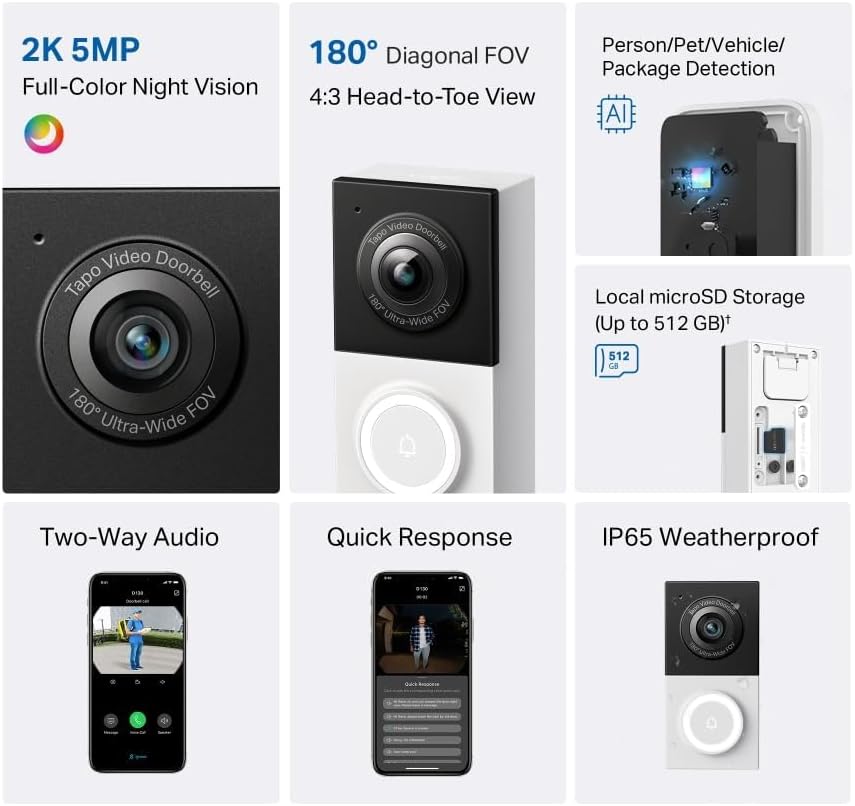
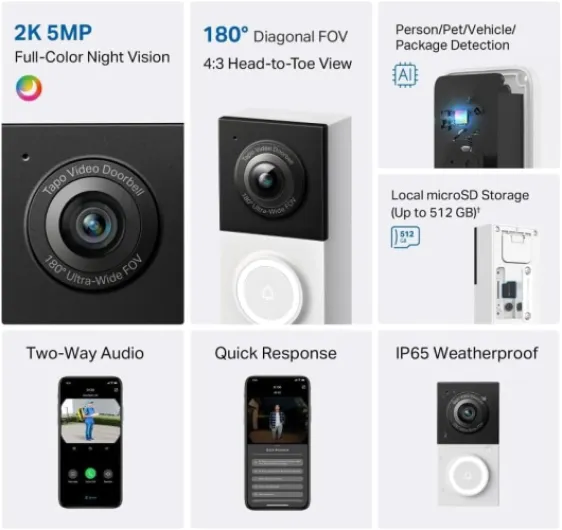
Design-wise, the D130 is pretty low-key. It’s a small rectangular white unit, around 8.5 x 4.2 x 3.2 cm, so it doesn’t take much space on the frame. There’s the camera at the top, a ring-shaped button with a light around it, and that’s about it. No chrome, no fake luxury look, just plastic and a simple front. If you like minimal stuff, you’ll be happy; if you want something that looks premium, this won’t impress you, but it also doesn’t look cheap from a distance.
The build is IP65 water and dust resistant, which matters more than looks anyway. Mine took a few heavy rains and some wind-blown dirt, and it just kept working. No fogging inside the lens so far, and the button still clicks fine. The housing feels reasonably solid when you handle it, though the plastic doesn’t feel thick or heavy. It’s the kind of device you mount and then forget about, which is probably the goal for a doorbell.
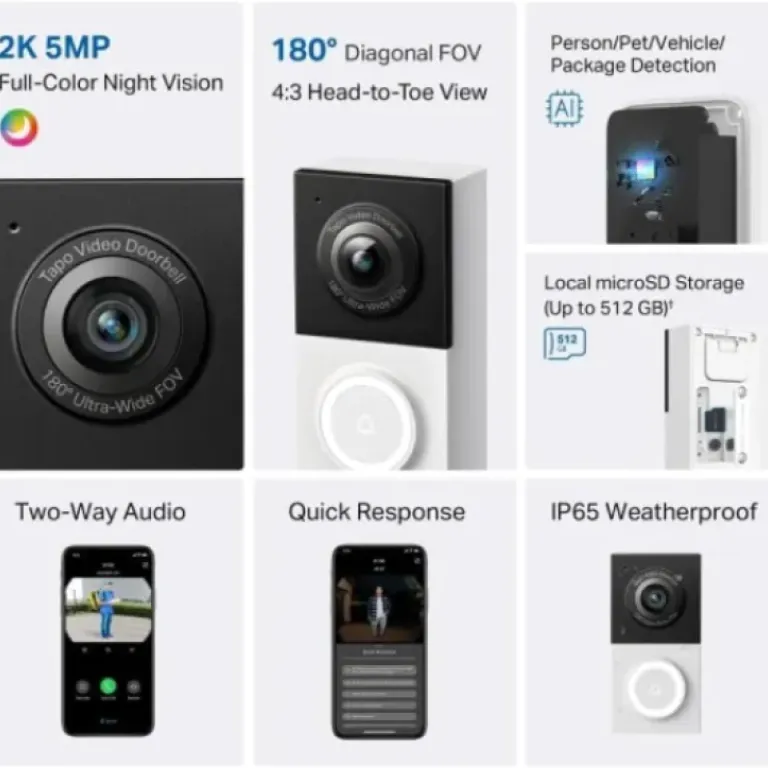
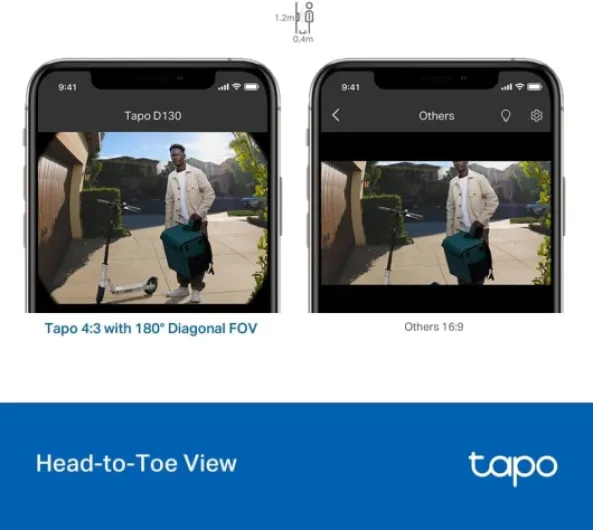
They include angle wedges in the box so you can tilt it sideways or slightly down/up. This is more important than it sounds. The camera has a 180° diagonal field of view with a 4:3 ratio, which is great for seeing people from head to toe and also packages on the ground. But if your door is recessed or off to the side, you’ll absolutely want to use the wedges to aim it properly. Without them, I was mostly filming the wall and half the path; with the wedge, I got the whole doorway and the front step.
One thing I noticed: the LED ring around the button is bright enough to show guests where to press at night, but it’s not blinding. At the same time, the front doesn’t have any obvious tamper-proof screws, so if someone really wants to rip it off the wall, they can, like with most consumer doorbells. In short, design is functional, discreet, and focused on coverage, not on looking fancy. I’m fine with that for a device that just needs to sit outside and work.
No battery to charge, but your wiring needs to be right
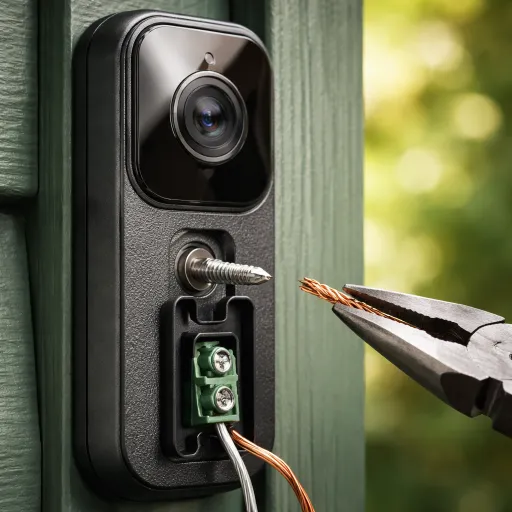
There’s actually no battery inside this thing, which is both its biggest strength and something people sometimes overlook. It runs on corded electric power from your existing doorbell wiring or a compatible transformer. So you don’t have to climb a ladder every few months to take it down and recharge, which was the main reason I ditched my old battery-powered doorbell. Once it’s wired, you can forget about power entirely.
The flip side is: if you don’t have existing wiring, you’ll need to either get an electrician or be comfortable running wires yourself and adding a transformer. That’s extra cost and hassle compared to just slapping a battery doorbell on the wall. In my case, I reused old 12V wiring and it worked straight away. If your wiring is weak or your transformer is too old, you might run into issues like the doorbell rebooting or the chime not working reliably.
Because it’s wired, the camera and spotlight can run at full quality all the time without worrying about saving battery. That’s probably why they can offer 2K 5MP, color night vision, and constant Wi‑Fi connection. The downside is obvious though: if the power goes out, the doorbell is dead. There’s no backup battery, no offline mode. If you live in an area with frequent power cuts, keep that in mind. You’ll still have past recordings on the microSD, but no new ones during the outage.
So on the whole, the D130 is great if you’re tired of charging batteries and your power setup is stable. If you want something you can move around or rely on during power cuts, this is not it. For a permanent front-door install, wired power with no battery fuss is honestly pretty nice once you get it set up correctly.

Weather resistance and how sturdy it feels outside
The D130 is rated IP65, which in simple terms means it’s fine with rain, dust, and general outdoor dirt. Mine has been through several rainy days and cold mornings, and it kept working without glitches. The lens didn’t fog, the button didn’t stick, and the plastic body didn’t show any weird discoloration yet. Obviously, I can’t speak for years of use, but for a few weeks in mixed weather, it behaved like a normal outdoor device should.
The plastic casing itself feels light but not flimsy. When you hold it before mounting, you can tell it’s not some heavy-duty industrial camera, but once it’s screwed into the wall plate, it feels secure. If someone really wants to rip it off, they probably can, just like most consumer doorbells. There’s no metal housing or anti-vandal features. The best protection here is mainly its position (if it’s up high enough) and the fact that it’s recording; not the physical strength of the shell.
The included chime is just a small plug-in unit that stays indoors, so durability there is less of a concern. It’s light, basic, and does the job. I didn’t notice any heat or weird noises from it even after being plugged in continuously. The Wi‑Fi connection between the doorbell and the router stayed stable in my case, which indirectly affects durability because frequent disconnects and reconnects can sometimes mess with devices over time; here, it seemed fine.
Given the 2-year manufacturer warranty, I’d say Tapo is at least somewhat confident in its lifespan. I wouldn’t treat this like a tank, but for a standard home environment—rain, some sun, maybe a bit of snow—it feels up to the task. If you live in a place with extreme heat or salty sea air, I’d keep an eye on it, but for typical European/UK conditions, it looks like it will handle day-to-day weather without drama.
Image quality, AI detection and app responsiveness in real life
The 2K 5MP image quality is probably the main selling point on the spec sheet, and it holds up pretty well in reality. Faces are clearly recognizable, you can read logos on jackets, and license plates are sometimes readable if the car isn’t moving too fast and isn’t too far. It’s not cinema-grade, but for a doorbell, it’s more than enough to see what’s going on. The 4:3 aspect ratio is genuinely useful: you see the person’s face, body, and the package at their feet without needing to tilt the camera too much.
At night, the color night vision with the spotlight actually helps. When motion is detected, the small spotlight kicks in and gives a decent color image instead of the usual black-and-white IR blur. On my street with a bit of ambient lighting, I could still see colors of jackets and cars. If you turn off the spotlight, you can use standard night mode with IR, which is more discreet but obviously less detailed. For a front door, I ended up leaving the spotlight on because it also acts as a tiny deterrent.
The AI detection for people and cars is okay but not perfect. It cuts down on random motion alerts (like trees), but it still triggers sometimes for things like large shadows or a cat crossing very close to the lens. I had to tweak the detection zone and sensitivity in the app to find a balance. After that, most alerts were actually relevant, but expect to spend a few days tuning it. The notification speed is usually a couple of seconds after motion, though sometimes there’s a slight delay if your Wi‑Fi isn’t great.
The weak point for me is the app responsiveness for live view. Opening the live feed can sometimes take 3–5 seconds, which feels long when someone is waiting at your door. It’s usable, but not instant. Once the stream is up, it’s stable, and you can talk via two-way audio, which is clear enough both ways, though there is a small delay. Overall, performance is solid for the price: good image, decent AI, usable audio. Just don’t expect instant live view like a wired CCTV system; this is still a Wi‑Fi camera with a bit of lag.
What you actually get and how it works day to day
Out of the box, you get the Tapo D130 wired doorbell, the plug-in chime, mounting accessories (screws, wall plugs, wedges), and the usual paperwork. No microSD card included, so if you want local recording, you need to buy one separately (it supports up to 512 GB, I used a 64 GB card and that’s already plenty for a few days of clips). The doorbell itself connects to your Wi‑Fi, not to the chime, and everything is controlled from the Tapo app on your phone or tablet.
The doorbell needs a wired power source. It’s not battery-powered, which is both good and bad. Good, because you never have to charge it, and it’s always at full power for the camera and spotlight. Bad, because if you don’t already have doorbell wiring or a transformer, you’ll need to sort that out. In my case, I reused existing 8–24V doorbell wiring and it worked fine. Once powered, the setup in the app took about 10 minutes: connect to Wi‑Fi, link the chime, and update the firmware.
From there, the daily use is simple: someone presses the button, the chime rings inside, and you get a notification on your phone. You tap the alert, and you get the live video plus the option to talk back using two-way audio. It also records motion events and button presses to the microSD (or to Tapo Care cloud if you pay for that, but the whole point for me was local storage). You can scroll through a timeline of events, filter by type, and download clips if needed.
In practice, this feels like a classic video doorbell with a few modern extras like AI detection and color night vision. Nothing flashy, but it covers the essential: see who’s there, talk to them, and keep a record if someone messes with your door or drops a package. If you’re used to other big-brand doorbells, you won’t be lost here. The main difference is you’re more encouraged to use a microSD card instead of paying a subscription, which I personally prefer.
Does it actually make your front door smarter and safer?
In terms of actual usefulness, the D130 does what I wanted: I know when someone is at the door, I can talk to them, and I have recordings if something happens. After a couple of weeks, I had several real-world situations: a courier dropping a parcel and leaving without ringing, a neighbor checking if I was home, and kids playing and running past the door. Each time, the motion detection picked it up, and I could check the clip later without any hassle.
The two-way audio is practical for talking to delivery drivers. The delay is there but manageable. I used it twice to tell a courier to leave the package in a specific spot. They heard me clearly enough, and I could hear them confirm. It’s not like a phone call, more like a walkie-talkie with a short lag, but for basic instructions it’s fine. Indoors, the included chime is nice because you don’t have to rely only on your phone; it’s loud enough to hear across a small to medium-sized home.
For security, it’s more of a deterrent and a record-keeper than a full system. You get motion alerts and video clips, but if someone really wants to steal a package, this won’t physically stop them. That said, the visible camera and the spotlight at night do make people behave a bit better at the door. I noticed couriers tend to place parcels more carefully when they realize they’re on camera. Also, having clips stored locally on the microSD means you still have evidence even if your internet goes down briefly, as long as the power stays on.
Overall, I’d say the D130 is effective as a daily front-door tool: you know who came by, you can respond remotely, and you have a history of events. It’s not perfect—notifications can sometimes arrive a bit late, and AI detection still needs some tuning—but for a mid-range price with no forced subscription, it gets the job done in a fairly reliable way.
Pros
- Sharp 2K 5MP image with useful 4:3 head-to-toe view and good night color mode
- No mandatory subscription thanks to microSD local storage (up to 512 GB)
- Wired power means no battery charging and stable full-time operation
- Includes plug-in chime and angle wedges for flexible installation
Cons
- Requires doorbell wiring or a transformer, no battery option
- Live view in the app can be a bit slow to open and not always instant
- AI motion detection still triggers some false alerts and needs tuning
Conclusion
Editor's rating
The Tapo D130 is a practical wired video doorbell for people who care more about function and long-term cost than having the flashiest brand name. It gives you clear 2K footage, usable color night vision, and decent AI detection for people and cars. The wired power means no battery charging, and the microSD slot lets you store recordings locally without getting locked into a subscription. In daily use, it does the main job: you see who’s at the door, you can talk back, and you have a history of visits and deliveries.
It’s not perfect. The app can feel a bit slow to open the live view, AI detection still needs some tweaking to avoid random alerts, and installation is more involved if you don’t already have doorbell wiring. The design is plain, the plastic is light, and it’s not some armored device. But for the price, and with a 2-year warranty, it’s a pretty solid value if you want a wired setup and you’re okay spending a bit of time tuning zones and sensitivity.
I’d recommend it to: people with existing doorbell wiring, anyone already using Tapo gear, and those who want to avoid monthly fees while still getting decent image quality and basic smart features. If you want a super slick app, instant live view, or you don’t want to deal with wiring at all, you might be happier with a higher-end battery model from Ring or Nest, even if it costs more over time.