
Summary
Editor's rating
Is it worth the money once you factor in the subscription?
Chunky but modern, with some practical quirks
Built‑in battery: convenient until you have to recharge it
Build, weather resistance, and long-term support
Video, motion alerts, and Alexa – solid, but depends on your Wi‑Fi
What you actually get (and what’s oddly missing)
Pros
- Sharp 2K video with 6x zoom and useful head-to-toe field of view
- Easy wireless DIY install with solid Alexa integration
- Mature app, privacy zones, and clear motion/customisation options
Cons
- Built-in, non-removable battery means more hassle to recharge and potential long-term wear
- No USB-C cable or wedge mount included, which hurts value and flexibility
- Key features like video history locked behind a paid Ring subscription

Specifications
View full product page →| Brand | Ring |
A new Ring doorbell that feels half-upgrade, half-sidegrade
I’ve been using Ring doorbells on and off for a few years, so when this new Battery Video Doorbell with "Retinal 2K" came out, I was curious. On paper it looks like a solid step up: higher resolution, 6x zoom, head‑to‑toe view, built‑in battery, simple install, works with Alexa, and a 30‑day subscription trial. In reality, it’s a bit more mixed. Some things are clearly better than the older battery Ring models, but a few decisions are just annoying day to day.
I installed it on a regular UK front door, no existing wiring, just using Wi‑Fi and the built‑in battery. Setup itself didn’t take long, but there are a couple of details that are easy to miss if you’re not used to Ring stuff, especially around charging and the mounting kit. I can see why some buyers on Amazon were confused or frustrated, because the product assumes you already know how Ring works.
After using it for a couple of weeks, I’d say it does the basics well: you get motion alerts, you can see who’s at the door, you can talk to them, and the video quality is clearly better than the old 1080p models when your Wi‑Fi is decent. But there are some cuts: no charging cable in the box, no wedge mount to angle it, and the battery is built‑in instead of swappable. Those sound minor, but in practice they matter.
So overall, it’s not a disaster, but it’s also not some big leap forward. If you already own an older Ring and you’re happy with it, this feels more like a side‑grade unless you really want the 2K video and the taller field of view. If you’re new to video doorbells, it’s a decent entry point, but you need to budget for the subscription and be ready for a bit of DIY fiddling.
Is it worth the money once you factor in the subscription?
Price‑wise, this doorbell usually sits in the mid‑range of the smart doorbell market. It’s not the cheapest thing out there, but it’s less than the high‑end Pro models and wired setups. For what you get – 2K video, 6x zoom, head‑to‑toe view, Alexa integration, and a known brand – I’d say the hardware itself is good but not outstanding value. The missing extras (no charging cable, no wedge kit) make it feel a bit trimmed down for the price.
The real cost question is the Ring subscription. You get a 30‑day free trial, and after that, if you want to keep recorded videos, smart alerts, and longer history (up to 180 days), you need to pay monthly. One reviewer said they’re happy to pay the £4.99 solo plan because they like the extra features, and that’s pretty much the mindset you need to have. If you see the subscription as part of the product cost, it’s fine. If you hate ongoing fees, you’ll feel like you’re only getting half the product without paying more.
Without a subscription, you still get live view, real‑time alerts, and two‑way talk. That’s enough if you just want to answer the door remotely and don’t care about reviewing past events. But honestly, one of the main reasons to have a doorbell camera is to check who came to your door when you were out or asleep. Without recordings, that part is gone, so the value drops quite a bit.
Compared to cheaper brands that offer free local storage or basic cloud recording, Ring isn’t the budget choice. What you’re paying for is the ecosystem: stable app, decent support, Alexa integration, and long‑term updates. If you already have other Ring or Alexa devices, it fits in nicely and the price is easier to swallow. If this is your first and only smart home device and you want to avoid subscriptions, there are better value options out there that don’t lock so much behind a paywall.
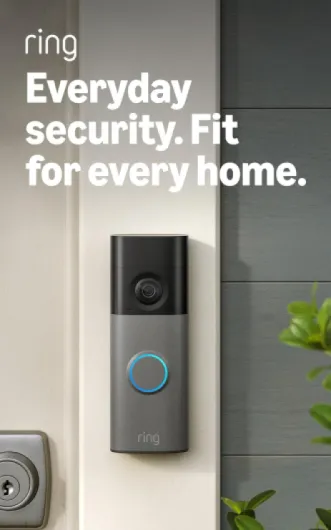
Chunky but modern, with some practical quirks
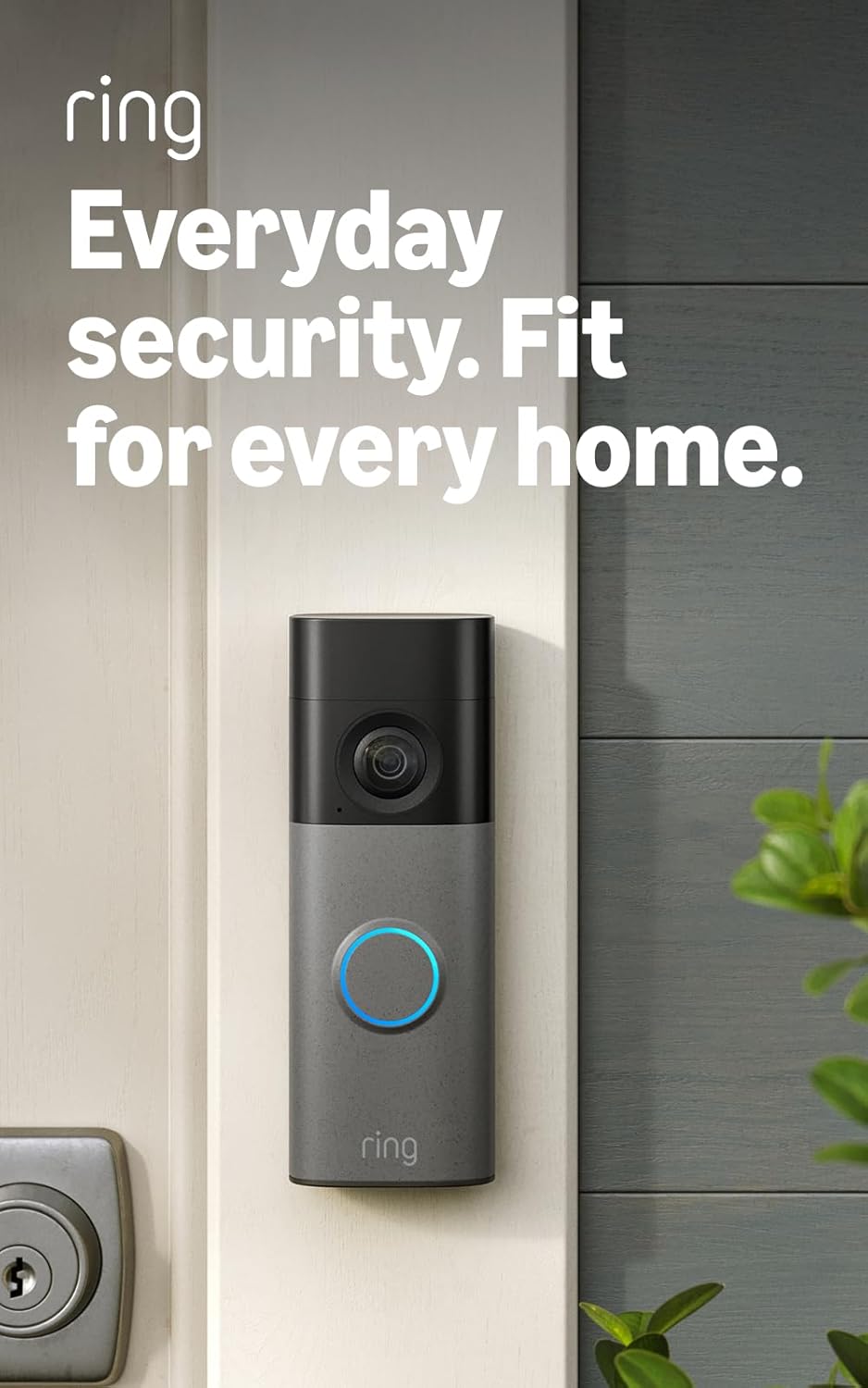
Design‑wise, this is very much a Ring product. Rectangular, camera on top, button with LED ring at the bottom. I tried the speckled grey version, which looks a bit less toy‑like than the older shiny models. It’s still a chunky unit at about 14.7 cm tall and over 5 cm wide, so it stands out on the door frame, but not in a bad way. If you’ve seen any Ring doorbell before, this won’t surprise you. It looks fine, just not discreet.
One thing I liked is the 140 x 140° head‑to‑toe field of view. In practice this means you can usually see parcels left on the ground right under the camera, not just people’s faces. That’s genuinely useful for deliveries. Compared to one of my older 1080p Ring models, the vertical view is definitely better. You see more of the person and what they’re holding, which is what you actually care about most of the time.
However, the lack of an included wedge mount is a pain. If your door opens directly onto the street or a path, you might want to angle the camera slightly so it doesn’t just stare at the opposite wall or catch loads of passing traffic. One of the Amazon reviewers mentioned the field of view being affected, and I understand the complaint. With no wedge, you’re stuck with a flat mount unless you buy something extra. For a doorbell that leans heavily on its camera spec, that’s a weird omission.
The removal tool for taking the doorbell off the mount is small and easy to lose, but it’s necessary if you want to recharge the built‑in battery. That’s another design choice that’s a bit divisive: older models let you pop out a battery pack; here everything is integrated. It keeps the look clean, but it means more faff every time you need to charge, and if the battery ages badly, you’re not just swapping it out easily. So overall design is decent and modern, but not very forgiving if your doorway isn’t standard or you’re a bit clumsy with small tools.
Built‑in battery: convenient until you have to recharge it
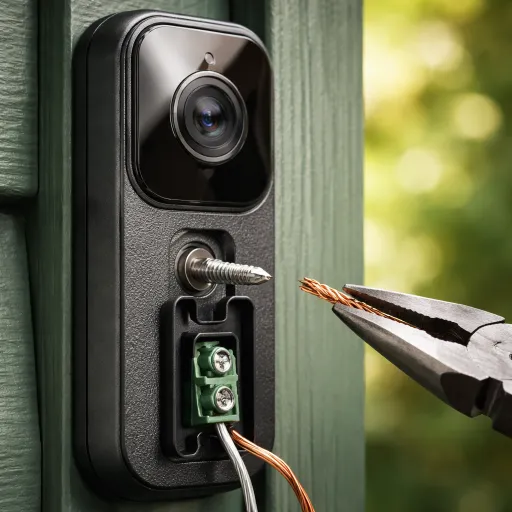
The power side is where things get a bit annoying. This model uses a built‑in lithium‑ion battery that you recharge via USB‑C. You can’t pop the battery out like on some older Ring units. To charge it, you have to use the included removal tool, slide the doorbell off the mounting plate, bring the whole thing inside, and plug it in. That process isn’t hard, but it’s more hassle than just swapping a battery and keeping the doorbell online.
Ring doesn’t give a clear official battery life number because it depends on motion activity, temperature, and settings. In my case, with motion alerts on, a few events per day, and fairly mild weather, the battery estimate in the app suggested I’d get several weeks between charges. After about 2 weeks of use, I was down to around 60–65%, which lines up with roughly a month or so per charge for my usage. If you live on a busy street or have constant motion, expect to charge more often.
Another small but real gripe: there’s no USB‑C cable in the box. It’s not the end of the world since most of us have cables lying around, but when a product is sold as easy DIY and the battery is non‑removable, including a short cable would just be common sense. One reviewer on Amazon originally gave a 1‑star rating partly because they couldn’t even find how to charge it. I can see that happening to someone not used to tech, especially with the sparse instructions.
If you wire it into an existing 8–24 VAC doorbell transformer, you can basically treat it as trickle‑charged and not worry much about the battery. But a lot of people buy this as a fully wireless solution, and in that mode, you need to accept that every month or two you’ll be taking it off the wall and leaving your doorbell offline while it charges. For me, that’s acceptable but not ideal, especially compared to swappable battery designs. It gets the job done, but the convenience could be better.

Build, weather resistance, and long-term support
The doorbell feels solid enough in the hand. The plastic casing doesn’t feel cheap, and once it’s screwed into the mounting plate, it sits firmly against the wall with very little wobble. It’s rated IPX weather resistant and designed to work from about -20.5°C to 48.5°C, which covers pretty much all normal outdoor conditions in Europe. I had it out in a few heavy rain showers and some cold, damp nights, and it didn’t flinch. No fogging on the lens, no weird behaviour from the button.
Ring also promises software security updates for at least four years after they stop selling this model as new. That’s actually important for a camera pointing at your front door. A lot of cheaper brands never mention update timelines, so you’re guessing. With Ring, at least you know you’ll get patches for a while. Whether they’ll keep adding new features is another story, but from a basic security standpoint, it’s reassuring.
There is a one‑year limited warranty with theft protection, which means if someone steals your doorbell, they’ll replace it under certain conditions. That said, you still need to prove the theft and go through their support, so it’s not instant magic. But it’s better than nothing, and I do like that the mounting uses a security screw so you can’t just pull the unit off by hand without the tool or a screwdriver.
Long term, the weak point is likely the built‑in battery. All lithium batteries degrade over time. With a removable pack, you could just buy a new one. Here, if the battery starts holding much less charge after a couple of years, there’s no easy user‑replaceable option. You’ll either live with frequent charging, wire it to a transformer, or replace the whole unit. So durability of the shell and electronics seems fine, but the battery design is a bit of a question mark for people who like to keep devices 5+ years.
Video, motion alerts, and Alexa – solid, but depends on your Wi‑Fi
In daily use, the Retinal 2K video is clearly sharper than the older 1080p Ring I had. Faces are easier to recognise, text on parcels is more readable, and the 6x zoom actually helps if someone is standing a bit further back. But it’s not magic: if your upload speed sucks or your Wi‑Fi signal at the door is weak, the image will still drop in quality. Ring recommends at least 10 Mbps upload, and I’d say that’s realistic. When my network was busy, I saw the resolution step down and the picture looked closer to the old model.
Motion detection is okay out of the box but needs tweaking. The first two days I got too many alerts from cars and people on the pavement. After playing with motion zones and sensitivity in the app, it calmed down and became more useful. The privacy zones are handy if you don’t want to record a neighbour’s window or a shared pathway. Once set, the doorbell just blacks out those areas and doesn’t trigger on them, which is good if you’re trying to stay on good terms with people nearby.
Two‑way talk works well as long as your connection is stable. There’s a tiny delay, but nothing dramatic. I used it a few times with delivery drivers and they could hear me clearly. Sound from their side was also fine, just a bit compressed, which is normal for these devices. One Amazon reviewer said the sound quality was perfect; I wouldn’t go that far, but it’s more than usable for quick chats at the door.
Integration with Alexa is straightforward. I linked it to an Echo Show and an Echo Dot. When someone rings, the Echo devices chime and I can pull up the video feed on the Show with a voice command. That part works smoothly and is actually where Ring still has an edge over a lot of cheaper brands. Overall, performance is pretty solid if your home network is up to it, but if your Wi‑Fi is weak or unstable, you won’t fully benefit from the 2K label and you might get laggy notifications.
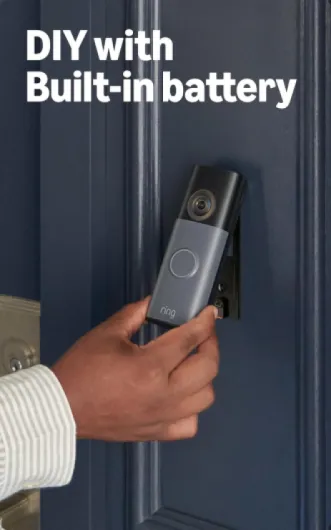
What you actually get (and what’s oddly missing)
Out of the box you get the doorbell itself, a universal mounting plate, screws and wall plugs, the little Ring removal tool, a setup guide, and a Ring security sticker. That’s it. No USB‑C cable for charging, and no angle/wedge kit to tilt the camera. For a new gen product, that feels a bit stingy, especially when earlier Ring bundles often included more bits. If your door frame is at an awkward angle, you’ll either live with a bad view or buy extra accessories.
The setup guide is quite basic. It gets you through scanning the QR code and adding the device in the Ring app, but it’s light on details. One of the Amazon reviewers complained they couldn’t even find the charging port, and honestly, I get it. The port is tucked in and not obvious if you’re not used to this kind of gear. The instructions assume you’ll just figure it out or go hunting in the app help section. For a product targeted at DIY beginners, that’s a bit lazy.
On the app side, once you’re set up, it’s the usual Ring experience: you can tweak motion zones, turn on privacy zones, set alerts, and check live view. It pushes you quite hard towards the subscription. Without a plan, you don’t get video history, just live view and notifications. The device comes with a 30‑day free trial, and after that you’re looking at around £4.99/month for a single device plan in the UK if you want recordings. If you refuse to pay a subscription on principle, this is probably not the right doorbell for you.
Overall, the presentation is decent but feels a bit cost‑cut. It does the job, but you can tell Ring is trimming what’s in the box and pushing accessories and subscription. If you’re okay with that and reasonably comfortable with apps, you’ll be fine. If you’re expecting super clear printed instructions and a full hardware kit, you might be disappointed.
Pros
- Sharp 2K video with 6x zoom and useful head-to-toe field of view
- Easy wireless DIY install with solid Alexa integration
- Mature app, privacy zones, and clear motion/customisation options
Cons
- Built-in, non-removable battery means more hassle to recharge and potential long-term wear
- No USB-C cable or wedge mount included, which hurts value and flexibility
- Key features like video history locked behind a paid Ring subscription
Conclusion
Editor's rating
After living with the new Ring Battery Video Doorbell for a bit, my overall take is that it’s a solid but slightly frustrating product. It does the basics well: clear 2K video (when your Wi‑Fi is good), decent motion detection once you tweak it, useful head‑to‑toe view for parcels, and smooth integration with Alexa. The app is mature, the hardware feels sturdy, and you get proper software update promises and a theft‑protection warranty. For everyday use – answering the door from your phone, talking to delivery drivers, checking who came by – it gets the job done.
On the downside, there are a few design and value choices that hold it back. The built‑in, non‑swappable battery is less convenient than older Ring models, especially since you have to take the whole unit off the wall to charge it and there’s no USB‑C cable in the box. The lack of an included wedge mount is annoying if your doorway isn’t ideal. And the product leans heavily on the subscription: without paying monthly, you lose video history, which is a big part of why people buy these cameras in the first place.
I’d recommend this doorbell to people who already use Ring or Alexa, have decent Wi‑Fi, and don’t mind paying for the Ring subscription to get the full feature set. It’s also fine if you want a clean, wireless install and are okay with charging it every month or two. If you’re upgrading from a recent Ring battery model just for the 2K label, I’d think twice – it feels more like a side‑grade than a huge jump. And if you hate subscriptions or want a doorbell you can easily keep going for 5+ years without worrying about a built‑in battery aging, you should probably look at other brands or a wired model.