
Summary
Editor's rating
Value for money: tempting price, but the headaches reduce the deal
Basic design that looks fine from afar, cheap up close
Build quality and long-term feel: clearly budget, question mark on lifespan
Image, sound, app: it works, but with quirks and random behavior
Installation: fine if you’re handy, painful if you’re not (and watch out for the plug)
What you actually get and what it really does
Pros
- Includes 1 outdoor camera and 2 indoor 7" monitors for a relatively low price
- Wired connection between units avoids WiFi dropouts for the core intercom function
- Local recording on microSD (up to 128 GB) without subscription, basic but functional
Cons
- App and camera reliability are inconsistent, with laggy or missing notifications
- Build quality and finishes feel cheap, outdoor unit doesn’t inspire long-term confidence
- Installation is not beginner-friendly and some units ship with UK power plugs only
- Image and audio quality are just average despite the 1080p claim

Specifications
View full product page →| Brand | QttyElok |
A cheap wired video intercom that looks good on paper… but then you plug it in
I picked up this QttyElok WiFi Home Video Intercom System because I wanted a wired setup with an outdoor camera and two indoor monitors, without paying the price of the big brands. On paper, it ticks a lot of boxes: 1080p camera, two 7" monitors, night vision, recording on microSD, and a Tuya app so you can answer from your phone. For the price, it looked like a decent deal for a basic home entrance system.
Once installed though, the experience is clearly not at the same level as what the product page suggests. You feel pretty fast that it’s a low-cost kit: the software is rough, the setup is not very clear, and the reliability is hit-or-miss. I had several moments where I thought, “If I hadn’t already drilled the wall, I’d probably send this back.” And I’m clearly not the only one if you look at the 1.4/5 rating on Amazon.
I’ve been using it for a little while now at a small house entrance, with the camera right next to the gate and the two monitors inside (one in the hallway, one upstairs). I mainly use it to see who’s ringing and open the gate remotely. I also played with the Tuya app to see what it’s worth compared to a standalone smart doorbell I already own.
To be clear: it works, it turns on, the bell rings, and you can talk to visitors. But between the UK power supply in some packages, the features that don’t really match the description, and the app that’s not very stable, it’s the kind of product that you buy knowing you’re taking a risk. If you want something you install once and forget about, this probably isn’t it.
Value for money: tempting price, but the headaches reduce the deal
On the price side, this kit is clearly positioned as a budget wired intercom with video. For one outdoor camera and two indoor 7" monitors, you pay less than many single-unit smart doorbells from big brands. That’s what attracted me in the first place: for the same money, I get full indoor screens, no subscription, and local recording on microSD. On paper, the value looks strong, especially if you don’t want to be stuck with cloud fees.
But when you factor in the reality—installation hassle, rough software, possible UK power plug, and some features that don’t fully match the promise—the value drops. If you’re a bit technical and you don’t mind spending time tweaking, okay, you might still see it as a fair deal. You get a functional system that can monitor your entrance, talk to visitors, and unlock a gate remotely. But if you’re the type who wants something reliable and straightforward, the hidden “cost” in time and frustration is high.
Compared to big names like Ring or Eufy, you obviously pay less, but you also lose the smooth app experience, better image quality, and support. Compared to other generic wired kits, it’s somewhere in the middle: not the worst I’ve seen, but definitely not the best either. The Amazon rating of around 1.4/5 is harsh but not totally unfair. You feel the compromises everywhere: from the manual to the app to the build quality.
So in my opinion, the value for money is mediocre. It’s not a total disaster if you know what you’re getting into and you catch it at a discount, but at full price I’d seriously consider either paying more for a known brand or looking for a better-rated wired kit. This one can make sense for a DIYer on a tight budget, but for most people, the savings don’t really compensate for the overall experience.
Basic design that looks fine from afar, cheap up close
Visually, the kit looks okay at first glance. The 7-inch indoor monitors have a glossy front with a black frame and touch buttons on the side or bottom (depending on how you mount them). On the wall, they don’t look ugly or bulky. From a distance, it could pass for something more expensive. It’s when you actually touch the plastic and go through the menus that you feel it’s a budget product. The screen bezel is a bit thick, and the buttons don’t have that solid click you get on higher-end gear.
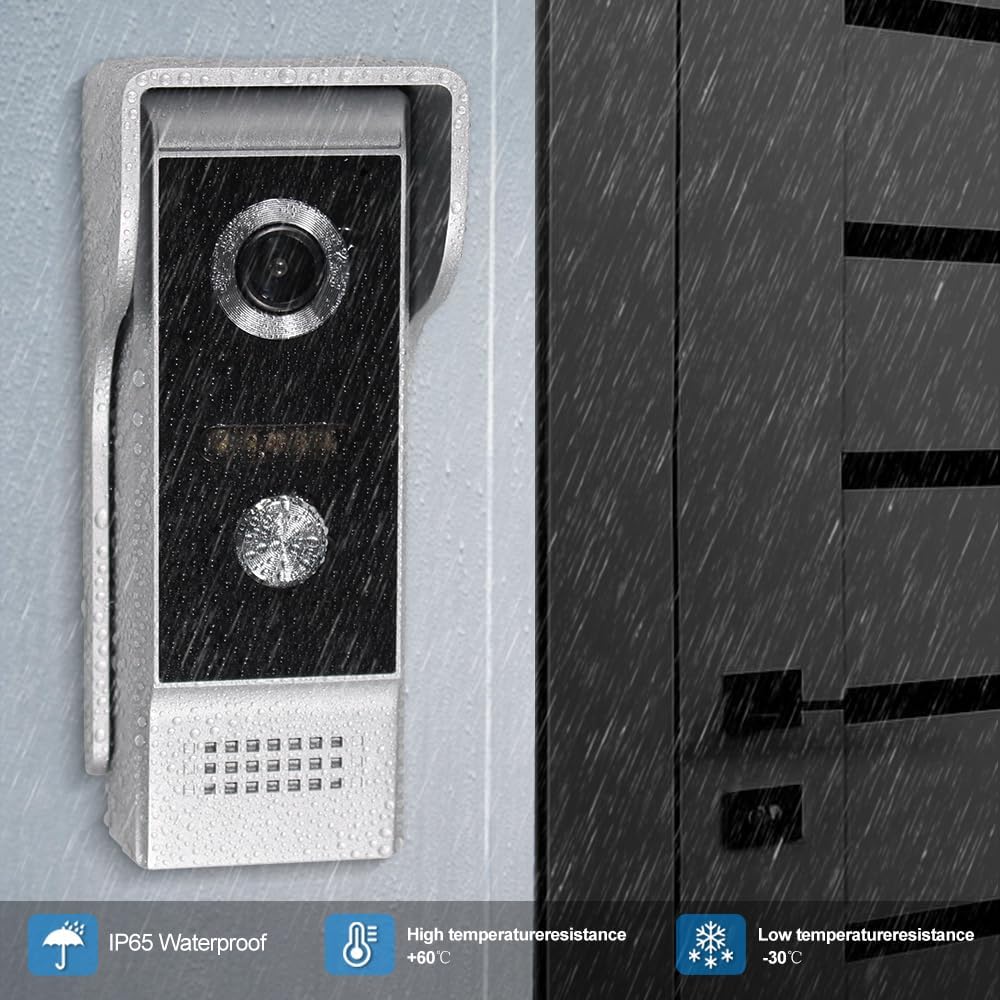
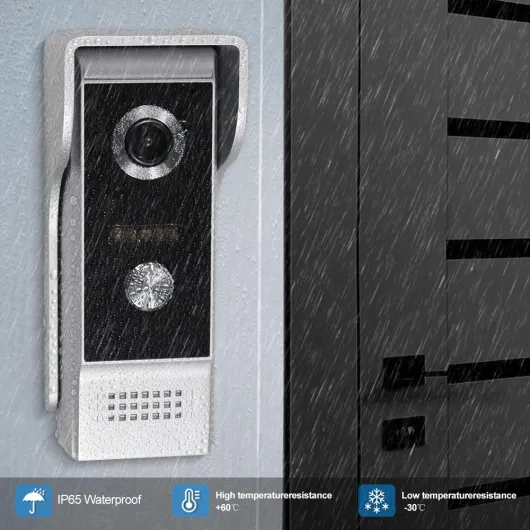
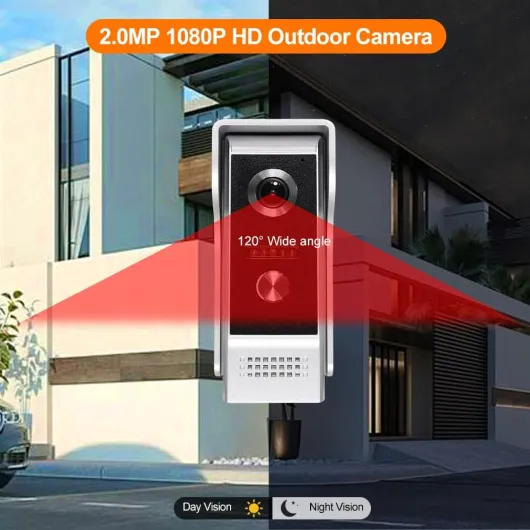
The outdoor unit is more compact than I expected. It’s a simple rectangular block, with the camera at the top, the button below, and the speaker/mic integrated. The IP65 rating is nice on paper, and it does handle rain, but it doesn’t give off a very robust vibe. The front plastic feels a bit thin, and the mounting plate is basic. If someone really wanted to rip it off, it wouldn’t be hard. For a normal home entrance, it’s probably enough, but I wouldn’t put it in a rough environment.
In terms of usability, the design is not terrible: the doorbell button is easy to find and press, even at night, thanks to a little backlight. The camera angle is wide enough so you see the person from about waist up if it’s mounted at a normal height. Indoors, the monitors are large enough that anyone in the house, even older people, can see who’s there. The touch buttons are labeled with icons, but the icons are not always super clear (for example, the settings icon is small and a bit cryptic).
Overall, the design is functional but clearly low-cost. If you’re picky about finishes and want something that feels solid and premium in the hand, this will disappoint you. If you mostly care that it doesn’t look too ugly on the wall and does the job, it’s okay. Personally, I would have preferred a slightly thicker, sturdier outdoor unit and a matte screen frame to hide fingerprints, but for the price bracket it’s about what I expected.
Build quality and long-term feel: clearly budget, question mark on lifespan
I haven’t had the system for years obviously, but even after a few weeks you can get a sense of how it might age. The indoor monitors haven’t shown any obvious issues: no dead pixels, no random reboots, and the touch buttons still respond fine. The plastic hasn’t scratched easily just from normal use, but it does pick up fingerprints. I’d avoid cleaning it with harsh products; a soft cloth is enough. The screens don’t heat up too much, which is good for lifespan.
The outdoor camera is more of a concern. It’s rated IP65, and it has survived some rain without problems, but the casing doesn’t inspire a lot of confidence. The seals around the edges look basic. I wouldn’t mount it where it gets hammered by direct rain and sun all day. If you can, place it under a small overhang or porch. That’s what I did, and so far so good. Still, compared to more solid metal-bodied doorbells, this one feels fragile. If a kid throws something at it or someone bumps it hard, I wouldn’t be surprised if it cracks.
One thing that doesn’t help the feeling of durability is the software stability. When a device behaves inconsistently (camera sometimes doesn’t respond, app doesn’t always connect), you start wondering how it will hold up in a year or two. It’s not like a dumb doorbell that either rings or not; here you rely on electronics and firmware from a small brand. With bigger brands, you at least get updates and some form of support. With this, I wouldn’t count on long-term software fixes.
Overall, I’d say the durability is acceptable for the price, but nothing more. If you need something rock solid for a rental property or a place with a lot of traffic, I’d look elsewhere. For a small home where you’re okay replacing it in a few years if needed, it might be fine. Just don’t expect it to feel robust or reassuring like higher-end intercom systems. It does the job now, but I wouldn’t bet on it still running perfectly five years from today.
Image, sound, app: it works, but with quirks and random behavior
Let’s talk about how it actually performs day to day. The image quality is advertised as 1080p, but on the 7" screens it doesn’t really feel like full HD. It’s more like a decent SD/720p mix: you clearly see who’s at the door, you can spot details like a parcel in their hands, but don’t expect sharp facial detail or license plates in the background. At night, the IR kicks in and you get a black-and-white picture. It’s grainy but usable within about 2–3 meters. Beyond that, it gets blurry and noisy.
The audio is where you feel the cheap side. Indoors, the person is easy to hear, but there is often a slight echo or background hiss. Outside, the speaker is not very powerful. If there’s street noise or wind, the visitor sometimes struggles to hear you unless you speak up. The 2-way audio is functional, but it’s not as clear as on a standalone smart doorbell from a known brand. You can have a basic conversation, but it’s not super comfortable.
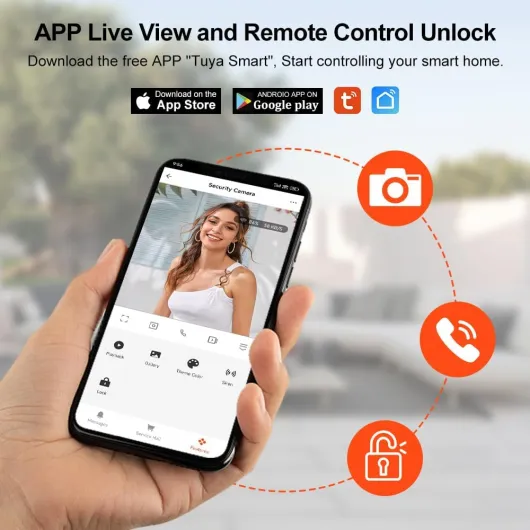
Biggest issue for me: reliability and app performance. I had several times where the doorbell was pressed, the indoor monitors rang, but the Tuya app did not send a notification or took ages to connect to the live view. Once connected, the stream sometimes freezes or lags. It’s okay if you’re at home and mainly use the monitors, but if you count on the app when you’re away, you’ll quickly get annoyed. One of the Amazon reviews mentions “Kamera nach lust und laune funktioniert” (camera works when it feels like it), and I get what they mean. Some days it behaves, other days it’s flaky.
Recording on microSD works, but you have to dig in the menus to find the clips. The system only records when the button is pressed, not continuous recording. For simple proof of who rang the bell, that’s fine. But the whole experience feels a bit rough: the interface is slow, playback controls are basic, and you don’t get the smooth timeline you see on more polished products. In short: it gets the job done at a basic level, but if you’ve used a better doorbell before, you’ll feel the gap immediately.
Installation: fine if you’re handy, painful if you’re not (and watch out for the plug)
Installation is where a lot of people are going to either give up or start regretting the purchase. This is a fully wired system, so you need to run a 4-core cable between the outdoor doorbell and each indoor monitor. If you already have an old intercom system and can reuse the existing cable, it’s not too bad. In my case, I had to drill through an exterior wall and run about 10 meters of cable through the hallway. Not rocket science, but definitely not plug-and-play. If you’re not comfortable with drilling and basic wiring, you’ll probably need help.
The manual is… okay at best. The diagrams show where to connect each wire, but explanations are short and sometimes translated oddly. You don’t really get a step-by-step for pairing with WiFi and the Tuya app. I had to try several times before the app recognized the monitor. Also, the system uses its own 15V power adapters, not a standard doorbell transformer. And that’s where one Amazon review is spot on: some units come with a UK power plug, which is useless in France or most of Europe unless you have an adapter. That’s the kind of detail that makes the product feel sloppy.
The promise of up to 100 meters of cable is nice, but keep in mind: the longer the cable, the more chance of signal loss or interference, especially with cheap wire. I used about 10 meters of Cat6, and it works fine. If you go further, I’d avoid the really thin, no-name cable. Once wired, the doorbell and monitors recognized each other quickly. The basic functions (ringing, talking, unlocking) worked right away. The headache was more on the WiFi/app side, where you have to put the monitor in pairing mode, connect to your network, then link to Tuya. Expect to spend a bit of time there.
In summary: if you’re a bit handy, it’s manageable, but don’t expect a clean, guided installation like with the big brands. If you’re not into DIY and you thought you were buying a simple plug-in system, you’re going to be disappointed. This kit is more for someone who’s willing to run cables and tinker a bit than for someone who wants a quick upgrade in 30 minutes.
What you actually get and what it really does
In the box, you get: one outdoor camera/doorbell unit, two 7-inch indoor monitors, two power adapters, a short paper manual, and some basic screws and mounting hardware. No microSD card is included, even though recording is one of the main selling points, so you’ll need to buy that separately (up to 128 GB supported). The whole system is wired: the camera connects to the monitors with a 4-core cable (RVV4, Cat5 or Cat6). There’s no battery, no wireless between doorbell and screens, only WiFi for the app connection.
On the feature list, they promise: 1080p image, 120° wide angle, IR night vision, 2-way audio, live view on the indoor screens and via the Tuya Smart app, remote unlock, and automatic recording when someone presses the doorbell. In practice, most of that exists, but not always as polished as you’d hope. For example, the resolution looks closer to decent 720p than a clean 1080p you’d expect today, especially on the monitors. The picture is usable, but don’t expect crisp detail like a mid-range Ring or Eufy.
The two monitors are basically clones: same menu, same options, same ringtones. You can adjust volume and choose between about ten ringtones, which is fine. The interface looks like those old-school Chinese DVR menus: functional but not very friendly. You get icons for monitoring, history, settings, etc. It works, but it’s not intuitive at first. I had to poke around and cross-check with the manual several times.
One important point: the seller claims one doorbell can connect to up to four monitors. That’s true on paper, but you only get two screens in this kit. If you plan to expand later, you’ll need to find compatible monitors from the same manufacturer, which is not guaranteed in a year or two. And given the overall quality and support level, I wouldn’t rely too much on future upgrades. For a simple two-screen setup though, the package is complete enough to get going, assuming you’re okay doing a bit of DIY wiring.
Pros
- Includes 1 outdoor camera and 2 indoor 7" monitors for a relatively low price
- Wired connection between units avoids WiFi dropouts for the core intercom function
- Local recording on microSD (up to 128 GB) without subscription, basic but functional
Cons
- App and camera reliability are inconsistent, with laggy or missing notifications
- Build quality and finishes feel cheap, outdoor unit doesn’t inspire long-term confidence
- Installation is not beginner-friendly and some units ship with UK power plugs only
- Image and audio quality are just average despite the 1080p claim
Conclusion
Editor's rating
After using this QttyElok WiFi Home Video Intercom System for a while, my feeling is pretty clear: it’s a budget solution that works at a basic level, but with a lot of compromises. The idea is good: one outdoor camera, two indoor monitors, wired connection for stability, local recording, and a Tuya app on top. In practice, the image is just okay, the sound is average, the app is unreliable, and the whole thing feels a bit unfinished. It does what it says in the most minimal way, and not always consistently.
I’d say this kit is for people who are handy, on a tight budget, and fully aware they’re buying a low-cost Chinese system with limited support. If you’re ready to run cables, fiddle with the settings, maybe add a plug adapter, and accept that the app will sometimes be moody, then you can get a functional video intercom for not much money. For a small private entrance where you mainly use the indoor screens, it can be acceptable.
If you want something reliable, easy to install, and pleasant to use every day, I’d skip this one. The poor Amazon rating isn’t random; there are too many small annoyances for a product that you’re supposed to trust for home access. Personally, I’d rather pay a bit more for a simpler, more solid system, even if it means only one screen or fewer features on paper. Here, the promise is nice, but the execution clearly lags behind.