
Summary
Editor's rating
Value for money: attractive price, but you feel where they cut corners
Design: looks modern enough, but clearly budget gear
Build quality and durability: feels sturdy enough but not pro-grade
Video, audio and unlock: decent performance with some quirks
Installation and setup: you’ll probably swear at the cables
What you actually get in the box and how it works day to day
Pros
- Wired multi-occupant system with up to 12 monitors, good for small buildings or shared houses
- Decent video quality and usable night vision on a 7-inch screen
- No dependence on Wi‑Fi, apps or subscriptions – everything is local and offline
Cons
- Installation is quite involved and the manual is not very clear, especially for multi-unit setups
- Audio quality is only average and can be hard to hear in noisy outdoor environments
- No smartphone app, no cloud features, and overall interface feels dated and basic

Specifications
View full product page →| Brand | ANJIELO SMART |
A wired video intercom for people who want something simple and shared
I installed this ANJIELO SMART wired video apartment intercom kit in a small building setup: one main entrance and several flats. The version I tried is the one with 1 outdoor doorbell and 6 indoor 7-inch monitors. So it’s clearly aimed at a small block of flats, a big house with several floors, or a home with offices inside. It’s not really a casual single-family doorbell, it’s more for when several people need to answer the same front door.
What pushed me to try this instead of the usual Wi‑Fi video doorbells was the wired connection and shared monitors. I didn’t want to rely only on phones and apps, and I wanted something that keeps working even if Wi‑Fi is down or if visitors don’t like being filmed by a cloud camera. Here, everything goes through cables and the screens inside the flats. It’s a bit old-school, but in a good way for reliability.
Right away, I’ll say: it’s not plug-and-play like a simple smart doorbell. You need to run 4‑wire cable between the outdoor unit and each monitor, and you need to be at least a bit comfortable with basic wiring. If you’re renovating or building, it’s fine. If your walls are finished and you hate drilling, you’ll probably swear a bit during installation. I had to pull cable along the stairwell and do some patching after.
After a couple of weeks of use, my general feeling is: it gets the job done for video + audio + door unlock, but it feels like a no-brand system from China, which it basically is. Some things are decent (image quality for the price, night vision, basic reliability), and some things clearly show where they saved money (interface, sound quality, documentation). If you expect a polished experience like Ring or Nest, you’ll be disappointed. If you just want a practical wired system for several occupants, it can work, as long as you accept a few compromises.
Value for money: attractive price, but you feel where they cut corners
When you look at what you get – 1 outdoor camera + 6 indoor 7-inch monitors, wiring capability for an electric lock, night vision, and multi-occupant support – the price is quite competitive compared to big-name systems. If you tried to assemble the same thing with high-end brands (multiple screens per flat, wired, with unlock), you’d easily pay a lot more. So on pure specs per euro, this ANJIELO SMART kit looks like a good deal.
But once you use it, you notice where the savings are. The user interface is basic, the documentation is weak, the audio quality is just okay, and the small details (like cables included, clear mounting accessories, proper labeling) are not on the same level as more expensive systems. Also, there is basically no ecosystem: no app, no integration with other devices, no cloud features. For some people that’s fine, but if you compare it to smart doorbells that send notifications to your phone, this will feel limited.
For a small building where you just want a simple, local intercom with video and unlock, and you’re ready to either do the wiring yourself or pay an electrician, I think the value is pretty solid. You get multiple screens, so each flat or each floor can have its own monitor, which is handy. There’s no subscription, no hidden costs, just the hardware and the cables you buy. The Amazon rating around 3.4/5 matches my feeling: it’s not junk, but it’s not polished either. It sits right in the middle.
If you’re a single-family home and you just want an easy doorbell, honestly, I’d skip this and get a simpler Wi‑Fi video doorbell. The cost of installation and the lack of mobile notifications don’t make sense for that scenario. But if you specifically want a wired multi-occupant system and you’re on a budget, this kit is worth considering, as long as you accept some compromises in finish and ease of use. In that niche, the price/performance ratio is decent, even if nothing about it feels premium.
Design: looks modern enough, but clearly budget gear
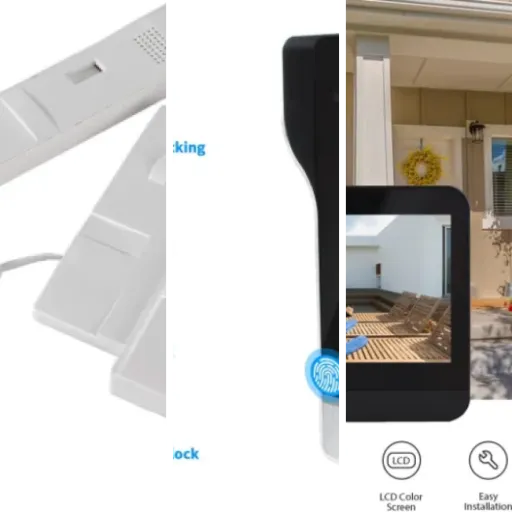
On the design side, the system is pretty straightforward. The indoor monitors are slim, about 205 x 108 x 22 mm, with a glass front and touch keys. On the wall, they look okay, a bit like a cheap tablet stuck there. The bezels are not super thin, and the interface looks dated, but from a distance it doesn’t scream “toy”. For a stairwell or a hallway, it’s totally acceptable. It’s not stylish décor, but it’s not ugly either. The 7-inch size is a good compromise: big enough to see faces clearly, small enough not to dominate the wall.
The outdoor unit is made from aluminum alloy with a flush-mount design and a small rain cover. Dimensions are 275 x 125 x 45 mm, so it’s bigger than a typical smart doorbell but in line with building intercom panels. Once it’s embedded in the wall, it looks fairly solid. The finish is basic brushed metal, nothing fancy. The camera window and IR LEDs are visible but not too flashy. There’s one main call button and a small speaker grille. Everything is functional, not pretty. If you’re used to sleek Ring or Nest designs, this will feel a bit old-school.
What I liked is that the buttons are clear and simple. No guessing where to press to answer or unlock. Even older people in the building got it after one explanation: the phone icon to answer, the key icon to open. The touch keys on the monitors respond decently well, even for slightly wet fingers, though not perfect. The on-screen menus, on the other hand, feel clunky. The fonts and icons look like early 2000s devices, and the menu structure is not very intuitive. Once you’ve set up date, time and basic settings you rarely go back into menus, so it’s not a big deal in daily use, but the first configuration is a bit annoying.
In short, the design is practical and neutral. It blends into a generic hallway or stairwell without drawing much attention. If you’re looking for something stylish for a designer house, this is not it. But if you just want something that doesn’t look like a toy and doesn’t scare visitors, it does the job. You can tell they focused on function and cost rather than aesthetics, and that’s exactly how it feels in real life.
Build quality and durability: feels sturdy enough but not pro-grade
In terms of materials, the outdoor doorbell unit is made of aluminum alloy, with IP65 waterproof rating and an operating temperature from -30° to 60°C according to the specs. I obviously didn’t test it in all climates, but I did mount it outside exposed to rain and some temperature changes. So far, no water intrusion, no fog in the camera, and the buttons still respond fine. The panel doesn’t flex or creak when you press it, which is reassuring. It feels more solid than cheap plastic doorbells, even if the finish is a bit rough around the edges.
The indoor monitors have a glass front panel and plastic body. On the wall, they feel reasonably sturdy. You can press the touch keys without any wobble or flex. I wouldn’t slam them or let kids hit them with toys, but for normal use they seem fine. Over a few weeks, I didn’t notice any dead pixels, flickering, or overheating. The power adapters stay slightly warm but not hot. The only small concern is the glossy glass: it collects fingerprints and dust, and over time it might get micro-scratches if people constantly touch it with rings or dirty fingers.
Long-term, what will matter is the quality of the connectors and the wiring. The screw terminals on the back of the devices are decent but nothing special. If you tighten them properly and avoid pulling on the cables, they should last. I’d definitely avoid bending the cables repeatedly near the connector, because the strain relief is minimal. For a building that will be in use for years, I’d take the time to do clean, labeled wiring in a junction box rather than twisting wires in the wall and hoping for the best.
Compared to more expensive professional intercom brands, you can feel that this is a more budget product. The metal is thinner, the plastics are lighter, and there is no brand reputation to fall back on. But so far, for a few weeks of daily use with several people ringing and unlocking, it’s holding up fine. I wouldn’t put it in a vandal-prone public entrance, but for a small apartment building or private gate, it seems adequate. If you want something bombproof for heavy traffic, you should probably look at pro brands, but for normal residential use, this feels acceptable for the price.
Video, audio and unlock: decent performance with some quirks
On the performance side, the two main questions are: can you see who’s at the door, and can you hear/talk clearly enough. The camera is 1.0MP with 960p resolution and a 90° field of view. In practice, the image is good enough to recognize faces at the door from about 0.5 to 2 meters. It’s not super sharp like 1080p or 2K doorbells, but you can clearly see if it’s your delivery guy, a neighbor, or someone you don’t know. The 7-inch screen helps a lot here: even with average resolution, the size makes it comfortable to view.
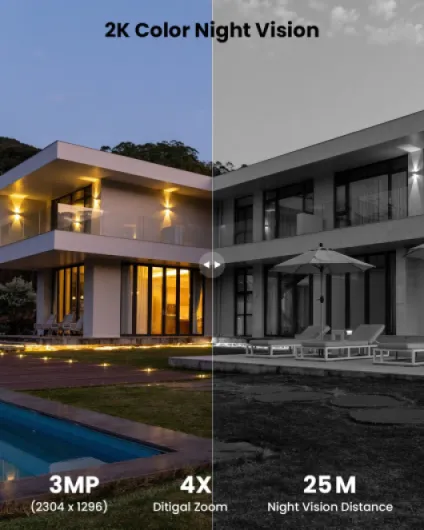
Night vision is one of the better points. The IR LEDs kick in automatically when it gets dark, and the picture remains quite readable. Faces are a bit washed out and contrasty, but for identification, it’s perfectly fine. The claimed 10 meters of night vision is optimistic; I’d say you get a usable view up to 4–5 meters in front of the door. Beyond that, you just see vague shapes. But for a door entrance, that’s enough. There is no color night vision despite what some specs suggest; it’s basically standard black-and-white IR.
Where the system struggles more is audio quality. Inside, the speaker is loud enough, maybe even a bit too loud on default settings, but the sound is slightly tinny and sometimes there’s a small echo. Outside, if the street is noisy (cars, wind), the person might have to repeat themselves. It’s usable, you can have a conversation, but it’s not crystal clear. I had a couple of visitors who didn’t realize they had to speak close to the microphone, so their voice was faint. Once people know to stand near the panel and talk normally, it’s okay. Latency is low, so at least it doesn’t feel like a walkie-talkie with delay.
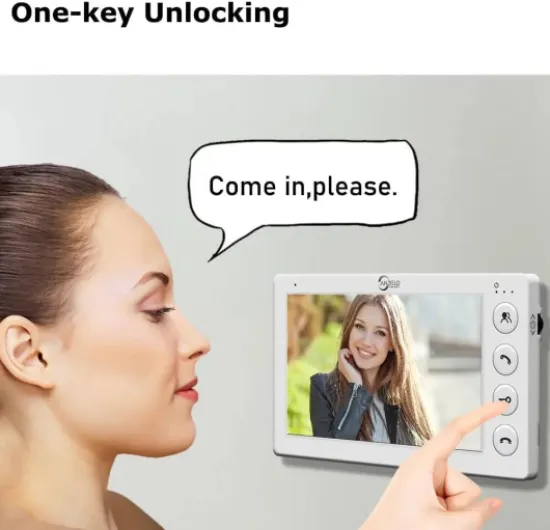
The unlock function works well once wired to an electronic lock and a power controller. Press the key icon and the door opens with a clear click. I didn’t have any missed unlocks or weird behavior. The only small annoyance: there’s no confirmation beep or light on the screen when you unlock, apart from the relay click, so at the beginning you’re not sure if it worked, especially if you don’t hear the lock from your flat. Over time you get used to it. Overall, performance is okay for the price: video is decent, night vision is useful, audio is average but workable, and unlock is reliable. Just don’t expect hi-fi sound or super crisp image.
Installation and setup: you’ll probably swear at the cables
Let’s be honest: this is not a quick DIY gadget you slap on the wall in 10 minutes. It’s a proper wired intercom. You need to run a 4‑wire cable from the outdoor unit to each monitor, and if you’re using an electric lock, you also need to install a separate power controller and run cables to the lock. In my case, in a small building with three floors, I had to fish cable through conduits and along stairwells. If you don’t already have low-voltage wiring in place, plan at least a full afternoon, maybe a day, and some drilling and patching.
The manual is the weak point. It’s short, with basic diagrams, and the translation is so-so. It shows the principle of the 4-wire connection and how to connect power and lock, but it doesn’t go into much detail for multi-unit setups. I had to do some trial and error to understand exactly which terminals to use for each monitor and how to avoid crosstalk. If you’ve ever wired an intercom before, you’ll manage. If not, you might want to call an electrician or a handy friend. The product is capable, but the documentation doesn’t really hold your hand.
Once everything is wired, the configuration is relatively simple. You set time and date, adjust volume and brightness, and that’s about it. There’s no app, no Wi‑Fi pairing, no firmware update nonsense. In one way, that’s refreshing: you don’t depend on servers or accounts. But it also means there is no remote access from your phone. So you need to decide what matters more to you: simplicity and local control, or smart features. For this building use, I actually liked the fact that it just works without internet.
The last installation detail: the package includes a 5m cable, which is basically useless for a real building unless the distances are tiny. In reality, you will have to buy your own 4‑core cable in the right length and quality. So factor that into the budget. Also, think about future maintenance: once the walls are closed, adding or changing monitors is more hassle. If you’re in the middle of a renovation, this system makes more sense. If the building is finished and nicely painted, run surface-mounted trunking or be ready to repaint. Overall, installation is doable but clearly the part where many people will get frustrated.
What you actually get in the box and how it works day to day
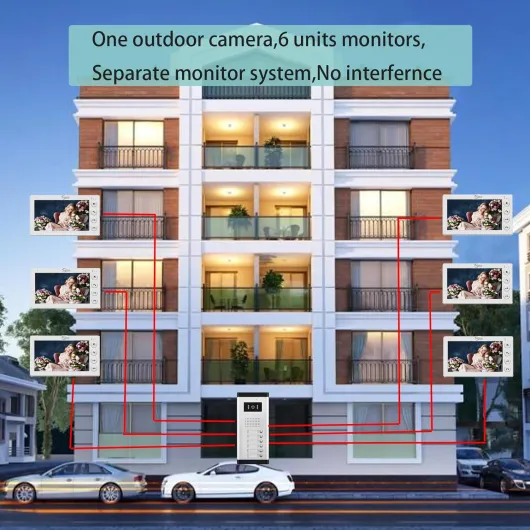
This kit is built around a simple idea: one outdoor camera/doorbell at the building entrance and up to 12 indoor monitors. In my case, there were 6 monitors. Each monitor is a 7-inch screen with touch keys on the side, powered by a DC 15V 1.2A adapter. The outdoor unit has a 1.0MP camera, 3.6mm lens and 90° viewing angle, with IR LEDs for night vision and IP65 waterproof rating. Everything communicates through a 4-wire cable, which carries power and signal.
In practice, here’s how it works: a visitor presses the call button on the outdoor panel, the selected indoor monitor rings, and the screen turns on showing the video. You can talk to the person thanks to the two-way audio, and if you’ve wired it to an electric lock with a separate power controller, you can unlock the door with one button from the monitor. If you don’t touch anything, the monitor times out and shuts off automatically after about 60 seconds. You can also manually activate the camera from inside to see outside without anyone ringing, which is actually pretty useful.
The system is sold as supporting 2/3/4/5/6/8/10/12 units, meaning you can choose how many indoor monitors you need. Each one is supposed to be independent, so one flat’s monitor doesn’t interfere with the others. In my test, that part was mostly true: each screen rings separately and you can talk independently, but if several people try to use the system at the exact same time, there is a bit of confusion and some delays. Don’t expect advanced apartment routing like big professional intercoms where you dial flat numbers. This is more basic: one outdoor panel, multiple screens that can be assigned or shared.
The documentation says it supports Wi‑Fi and MOV video format, but in reality this particular kit behaves like a classic wired intercom with no app and no cloud features. So don’t buy it thinking you will get push notifications on your phone. It’s more like an offline, closed system. For some people (like me for this use case), that’s fine and even preferable for privacy and simplicity. Just be aware of it. Overall, the feature list is decent on paper: video, audio, unlock, night vision, outdoor monitoring, multi-unit support. The execution is average but usable for daily life if your expectations are realistic.
Pros
- Wired multi-occupant system with up to 12 monitors, good for small buildings or shared houses
- Decent video quality and usable night vision on a 7-inch screen
- No dependence on Wi‑Fi, apps or subscriptions – everything is local and offline
Cons
- Installation is quite involved and the manual is not very clear, especially for multi-unit setups
- Audio quality is only average and can be hard to hear in noisy outdoor environments
- No smartphone app, no cloud features, and overall interface feels dated and basic
Conclusion
Editor's rating
After living with this ANJIELO SMART wired video apartment intercom for a bit, my opinion is pretty clear: it’s a functional, budget-friendly multi-screen intercom that does what it says – video, two-way audio, and door unlock for several occupants – but it’s rough around the edges. The image quality is good enough to recognize people, night vision works, and the wired connection keeps it stable and independent from Wi‑Fi and apps. For a small building or a big house split into several units, it covers the basic needs.
On the other hand, you feel the compromises. Installation is not trivial, the manual is vague, audio is average, and the overall finish is more “generic Chinese hardware” than polished brand product. There’s no smartphone app, no cloud recording, no fancy features. If you want modern smart-home integration and a super smooth user experience, this is not the right product. But if your priority is a simple, offline, multi-occupant intercom that doesn’t rely on the internet and you’re okay with some DIY or hiring an electrician, it can be a sensible choice.
I’d recommend it mainly for: small apartment blocks, shared houses, or office flats where several people need to answer the same entrance and cost matters more than polish. I’d tell single-family homeowners or people who want phone notifications to look elsewhere. Overall, it’s decent but nothing more, and the price is what makes it interesting.