
Summary
Editor's rating
Value for money: where it shines and where it cuts corners
Design: compact bullets with a wide field of view
Battery life: what the 240-day claim looks like in real life
Build quality and how it handles weather and issues
Video quality, motion alerts, and daily use
What you actually get in the box and how it all fits together
How well it actually secures your place
Pros
- Four 2K wireless cameras with 166° wide angle and color night vision included in one kit
- Local 32 GB storage on the homebase with no mandatory subscription fees
- Good battery life for typical home use, with optional solar panel support to reduce charging
- Responsive app with quick alerts, people-only detection, and camera-to-camera event syncing
- Customer service reported as fast and helpful for replacing faulty units
Cons
- Homebase only supports up to 5 devices, limiting expansion for larger setups
- Motion-based recording only, no true 24/7 continuous recording like wired NVR systems
- Need to physically take cameras down to recharge if not using solar panels, which can be annoying for high-mounted units

Specifications
View full product page →| Brand | aosu |
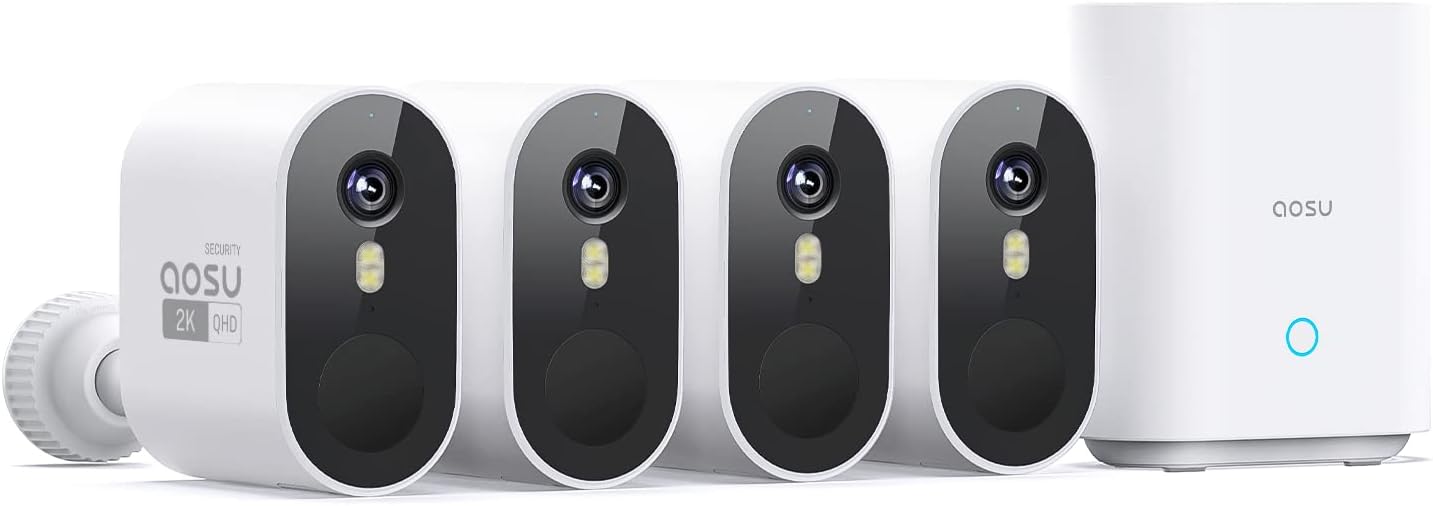
A 4-camera kit that actually feels made for normal people
I put this AOSU 4-camera wireless kit around my house for a few weeks to see if it was just another overhyped security system. Short version: it’s a pretty solid setup for someone who wants reliable cameras, clear video, and doesn’t feel like paying a monthly fee just to see recordings. It’s not perfect, but it does the job without turning into a new hobby you have to babysit every day.
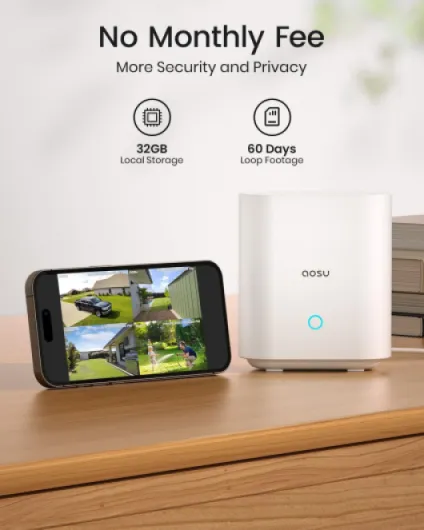
What pushed me to try it was the combo of local storage, battery power, and 2K video. I was tired of cloud-only systems that nag you for subscriptions, and I didn’t want to run cables or deal with PoE switches. This one comes with a homebase that has 32 GB built in, which AOSU says covers about four months of loop recording. For a normal house, that’s decent.
In daily use, the thing that stood out most is how quick the app and alerts are. When someone walks up to the door, my phone pings within a couple seconds with a preview image, so I can decide if I need to open the live view or just ignore it. The human-only detection helped cut down on useless alerts, especially with pets and cars around.
If you want a fully pro, wired system with 24/7 continuous recording, this is not that. This is more for people who want a wire-free, straightforward system they can set up in an afternoon and forget about most of the time. For that use, it holds up pretty well, and the price-to-features ratio is hard to complain about.
Value for money: where it shines and where it cuts corners
For what you pay, this AOSU kit offers a lot of boxes ticked: four cameras, 2K resolution, color night vision, local storage with no mandatory subscription, a homebase, and a decent app. Compared to some big-name brands that charge you monthly just to access recordings, having free local storage out of the box is a big plus. If you want cloud, you can pay for it, but the system is fully usable without it.
Several reviewers said it was better value than their previous systems, and I tend to agree. You’re getting four cameras with long battery life and wide coverage, which for many homes is everything they need. You don’t have to buy SD cards, you don’t have to wire anything, and you don’t have to commit to ongoing fees. For a typical homeowner looking to upgrade from a single doorbell cam or old 1080p cameras, this feels like a straightforward step up.
On the downside, the 5-device limit per base is a real constraint if you want to scale up. Needing a second base and maybe a second app account is clumsy. Also, you’re not getting continuous 24/7 recording like a wired NVR system; this is motion-based recording, which is fine for most, but not ideal if you want full-time footage. And like most battery cams, heavy activity zones will reduce the battery life, so you might be climbing the ladder more often in those spots.
Overall, in terms of value, I’d say this kit is good bang for the buck for someone who wants a simple, subscription-free system with decent quality and four cameras out of the gate. It’s not the top of the line, but for the price and what it includes, it feels like money well spent rather than a trap for ongoing fees.

Design: compact bullets with a wide field of view
The cameras are small white bullet units that don’t scream “industrial security,” but they’re still obviously cameras. They’re not stylish decor pieces, but they look fine on most houses. Each camera has a 166° ultra-wide-angle lens, which is very wide in practice. Mounted at the corners of the house, I could cover large sections of yard and driveway without having to crank them to weird angles.
The mounting system is simple: a screw-in bracket with a ball joint. Once it’s screwed to the wall, you slide the camera on, then adjust angle and tighten it. This is basic but it works. I had no issue pointing them exactly where I wanted, and if you change your mind later, you can loosen and reposition without tearing everything down. Just note: because of the wide angle, objects at a distance look a bit smaller, but that’s normal with such a wide field.
The homebase is a small white box that sits near your router. It’s not huge and doesn’t take much space. There are status LEDs on it, but you’re not really interacting with it daily. Once it’s set up, you mostly forget it’s there. I didn’t hear any annoying fan noise or anything like that; it just sits silently doing its job.
In terms of weather, I had mine up through some heavy rain and wind and didn’t see any condensation or water issues. The Amazon reviews mention people using them in hot climates and storms as well. They’re clearly built with outdoor use in mind. Overall, the design is practical, not fancy: compact cameras, easy angle adjustment, wide coverage, and a discreet base that hides near your router.
Battery life: what the 240-day claim looks like in real life
AOSU advertises up to 240 days of battery life per charge, based on 40 events per day with 10-second clips. That’s a very controlled scenario. In real use, battery life depends heavily on where you place the cameras and how much motion they see. One Amazon reviewer said after more than a month they were still at 89%, which is quite good. Another mentioned needing to recharge after about six weeks, but they had three dogs constantly triggering the backyard cameras, which explains the difference.
From my side, with moderate traffic (front door deliveries, a couple of cars in the driveway, some yard activity), the cameras drained slowly enough that I wasn’t stressing about it. You can check each camera’s battery level in the app, so you have time to plan a recharge instead of getting caught with a dead camera. The fact that the system supports optional solar panels is a big plus if you have one or two high-traffic spots; you can stick a panel there and more or less forget about charging that unit.
Charging is done via USB (included cables), and you have to take the camera down to charge it unless you’ve mounted it within reach. For some people that’s annoying, for others it’s a non-issue. Since the batteries are built-in, you can’t just swap a spare; you need to plan a few hours of downtime per camera when you recharge. On the other hand, the higher battery capacity on this model (3.5x some older AOSU models) means you’re not climbing a ladder every few weeks like with some cheap cameras.
Overall, I’d say battery life is strong as long as you’re realistic. If you’re in a quiet area, you might get close to the marketing claims. If your cameras watch a busy street or a dog run, expect to recharge more often, but still on a manageable schedule. It’s not magic, but it’s definitely better than a lot of budget wireless cameras I’ve tried before.
Build quality and how it handles weather and issues
Physically, the cameras feel solid enough for the price. They’re not heavy metal tanks, but they don’t feel like flimsy toys either. The casing is tight, and after rain and wind, I didn’t see any water ingress or fogging. One reviewer mentioned the system surviving a three-day monsoon-style storm in Arizona with no issues, which is a decent sign that they can handle rough weather.
Since the cameras are battery-powered and sealed, there aren’t many moving parts to fail. Most of the long-term risk is in the battery wearing out over years or the electronics failing. One Amazon user did have a camera stop charging after about three months. The upside is that they contacted AOSU, and the company replaced the camera quickly after a short email exchange. Another user had a homebase fault after a couple of months; again, support diagnosed it and sent a new base without hassle.
This kind of customer service backup matters a lot with this type of gear. You’re putting these things outside, exposed to heat, cold, and rain, and there’s always a chance one unit dies early. Knowing the brand actually responds and replaces faulty units quickly is reassuring. I wouldn’t say the build is bulletproof, but for the price point and the category, it’s decent, and the support fills in some of the gaps.
Overall, I’d rate durability as good but not indestructible. The hardware seems up to normal residential use, and the real safety net is that AOSU’s support appears responsive based on several user stories. If you want something to survive vandalism or heavy abuse, you probably need a higher-end commercial system. For normal home use in regular weather, this kit holds up fine.
Video quality, motion alerts, and daily use
On performance, this kit is pretty solid for a 2K battery system. The 2K resolution (2048×1536) is enough to clearly see faces within a normal distance and read license plates if the car isn’t flying by. During the day, the picture is sharp and colors look natural. At night, the color night vision with the spotlight on is actually useful: if the camera triggers and the light kicks in, you get color detail instead of a washed-out black-and-white blob.
Motion detection is where a lot of these systems can be annoying, but here it’s handled reasonably well. You get people-only detection if you want, which helped cut down alerts from trees and cars in the background. The app sends a push notification with a quick preview image, so you can see if it’s a delivery guy, a neighbor, or just your dog. You can tune motion zones, though it’s not as pixel-perfect as some more expensive brands, but good enough for a normal home.
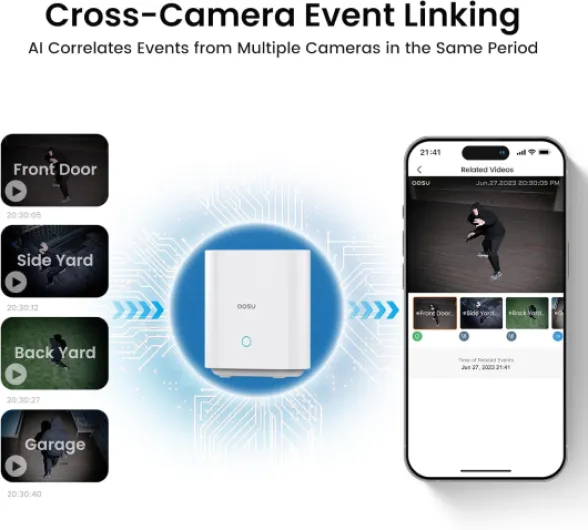
There’s also camera-to-camera track & sync. In practice, that means if someone walks around your house and gets picked up by multiple cameras, the app lets you jump between those clips for the same time period. It’s not magic, but it does save time scrolling through separate timelines. For checking an incident, it’s a nice touch and not something you see on many budget-friendly kits.
Latency on live view is acceptable. Over Wi‑Fi on my phone, I usually had a delay of about 1–2 seconds, which is normal. Audio is clear enough to understand people, and the two-way talk works, though there’s a small delay. For warning someone off or telling a delivery driver where to leave a package, it does the job. Overall, performance is good for home use: strong enough detail, decent night vision, and alerts that arrive quickly enough to matter.
What you actually get in the box and how it all fits together
Out of the box, you get four bullet-style cameras, the homebase, four mounting brackets with screws, four charging cables, an Ethernet cable, power adaptor, and a basic manual. No weird surprises. The homebase is the brain of the system: it connects to your router via Ethernet, stores the footage locally on its built-in 32 GB storage, and talks to all four cameras over Wi‑Fi. You manage everything through the AOSU app on your phone or tablet.
The system runs on your existing Wi‑Fi (2.4 GHz and 5 GHz) but the cameras themselves talk primarily to the base, not directly to the router, which helps with reliability. The cameras are fully battery-powered, so no power cables at all, just screws to mount them. AOSU says the battery can last up to 240 days with their lab scenario (40 events per day, 10 seconds each). In real life, with pets or a busy street, expect less, but still decent.
The app is where you live day-to-day. You can see all cameras on one screen, check the timeline per camera, change detection sensitivity, switch between people-only detection or all motion, and use two-way audio. There’s also a one-tap mode where you can flip multiple cameras between active and standby when you leave or come back, which is actually handy if you don’t want constant alerts while you’re in the yard.
Overall, the presentation is pretty straightforward: four wireless cameras + one hub + simple app. No DVR box jungle, no separate hard drive to buy. If you want cloud storage, it’s optional and paid, but you genuinely don’t need it to use the system. For a home user who just wants to set it and forget it, the package makes sense and doesn’t feel overcomplicated.
How well it actually secures your place
From a pure security standpoint, this kit covers the basics well. Four cameras with 166° lenses give you enough coverage to handle the usual house: front door, driveway, backyard, and a side or back door. Being able to see all cameras on one screen in the app makes it easy to quickly scan your property. The local storage on the homebase means that even if your internet drops for a bit, recordings are still captured as long as the base is powered.
The smart alerts are the part that actually makes it useful day to day. Getting instant notifications for people coming, passing, or staying lets you react quickly. I liked that you can decide whether you want just recording or also an alarm from the camera. If you’re in a quiet neighborhood, you might leave the siren off. If you’ve had package thefts or people snooping around, turning it on can be a decent deterrent.
The two-way talk and voice-changing feature are a bit of a mixed bag. Two-way talk is genuinely useful: you can tell delivery drivers where to leave stuff or shout at someone trying your gate. The voice-changer is more of a bonus; it works, but it’s not something I see myself using often. Still, it’s there if you want to sound less recognizable.
One limitation: the base only supports up to 5 devices total. So if you plan to add more cameras plus a doorbell, you’ll hit that limit fast. One Amazon reviewer mentioned they had to consider buying another base and using a second app account, which is clunky. For a regular house, four cams plus maybe one doorbell is fine. If you’re trying to fully cover a big property, this system will start to feel limited. For normal home use though, it’s effective enough to know what’s going on and have usable video if something happens.
Pros
- Four 2K wireless cameras with 166° wide angle and color night vision included in one kit
- Local 32 GB storage on the homebase with no mandatory subscription fees
- Good battery life for typical home use, with optional solar panel support to reduce charging
- Responsive app with quick alerts, people-only detection, and camera-to-camera event syncing
- Customer service reported as fast and helpful for replacing faulty units
Cons
- Homebase only supports up to 5 devices, limiting expansion for larger setups
- Motion-based recording only, no true 24/7 continuous recording like wired NVR systems
- Need to physically take cameras down to recharge if not using solar panels, which can be annoying for high-mounted units
Conclusion
Editor's rating
If you want a wireless home security setup that doesn’t lock you into subscriptions, this AOSU 4-camera kit is a solid option. You get 2K video, wide 166° coverage, color night vision with a spotlight, and local storage on the homebase. The app is easy enough for non-techy people, motion alerts are quick, and battery life is respectable as long as you’re not monitoring a super busy area. The ability to see all cameras at once, sync events between cameras, and use two-way audio covers most home security needs.
It’s not perfect. The base only supporting five devices is limiting if you’re trying to build a larger system, and if you need continuous 24/7 recording or pro-level features, this won’t replace a wired NVR setup. You’ll also have to deal with taking cameras down to recharge them from time to time, unless you invest in solar panels for the busiest spots. But between the no-mandatory-fee local storage, decent build quality, and positive reports about AOSU’s customer service when something fails, it feels like a fairly safe buy for regular home use.
I’d recommend this kit for people who want to cover a standard house (front, back, sides) with minimal hassle, and who care more about practical security and cost control than fancy advanced features. If you’re planning a big multi-building setup or need full-time recording for legal reasons, look at a wired system instead. For most homeowners who just want to know who’s around their property and have usable footage when something happens, this kit gets the job done without being a headache.