
Summary
Editor's rating
Value for money: strong if you hate subscriptions
Design and build: chunky but reassuring
Battery life: okay if quiet, annoying if busy
Durability and reliability: feels solid, no major issues so far
Video quality and detection: strong camera, some app quirks
What this Reolink doorbell actually offers
How well it works day-to-day as a door guard
Pros
- Good 2K video quality with a useful head-to-toe 1:1 view
- Local SD storage up to 256 GB and no mandatory subscription
- Flexible setup (battery or wired) with solid smart detection and a decent app
Cons
- Phone only gets push notifications, not a proper call-style ring when pressed
- Battery life can be short on busy doors if used purely wireless
- Chime not included, and some features are reduced when used with an NVR

Specifications
View full product page →| Brand | Reolink |
A doorbell for people who are tired of subscriptions
I picked up the Reolink Wireless 2K Doorbell mainly because I was fed up with subscription fees on my old Ring. I already had a couple of Reolink cameras around the house, so this looked like the logical move: same app, local SD storage, no forced cloud plan. On paper it ticks a lot of boxes: 2K video, battery or wired, 2.4/5 GHz Wi‑Fi, smart detection, and proper local recording up to 256 GB.
After a few weeks of use, I’d say it’s a pretty solid doorbell, but not perfect. Some things are clearly better than Ring/Eufy (especially the app controls and the fact you can run it cloud-free). Other bits feel a bit half-baked, mainly how the phone “ring” works and the battery life if you stay fully wireless. It does the job as a security camera at the door, but as a classic “video doorbell that rings your phone instantly”, it’s not as smooth as I expected.
In daily use, the strong points for me are the picture quality, the person/vehicle/package detection, and the flexibility in installation. I tested it first purely on battery, then wired it to an old chime transformer to see the difference. Both setups work, but the experience isn’t exactly the same, especially around battery drain and how often you tweak settings.
If you’re coming from Ring or Eufy, the Reolink feels more like a normal IP camera with a button on it than a super polished “phone-rings-like-a-call” doorbell. Whether that’s a problem depends on what you expect. If your priority is no monthly fee and decent control over your footage, it’s pretty good. If you mainly want slick, phone-call-style alerts, there are some compromises.
Value for money: strong if you hate subscriptions
Price-wise, this Reolink doorbell sits in the mid-range for video doorbells. It’s not the cheapest thing out there, but when you factor in no mandatory subscription and the ability to just throw a cheap microSD card in and be done, the total cost over a couple of years looks quite good. With Ring or some Eufy setups, you end up paying a few pounds a month just to properly access recordings – that adds up fast.
For the money, you’re getting: 2K video, dual-band Wi‑Fi, local storage, smart detection, battery or wired option, and a decent app. What you’re not getting in the box is a chime, and you’re not getting a super polished phone-call-style ringing experience. If you have to buy a separate chime on top, the overall price creeps up, but it’s still reasonable compared to paying a subscription for years.
Compared to Eufy, I’d say the Reolink is better on app flexibility and detection tuning, and similar on video quality. Compared to Ring, Reolink wins on ongoing cost and local control of your data, but Ring still has the edge on polish and the “doorbell as a service” feel (especially the phone interface and ecosystem). So it really depends what you value more: ongoing convenience or long-term cost and control.
If you’re already in the Reolink ecosystem with an NVR or other cameras, the value is even stronger because it just plugs into what you already use, and you don’t have to juggle multiple apps. If this is your first security device, you’ll still get good value, but you need to be okay with the fact that, as a doorbell, it’s slightly more utilitarian. In short: good value if you care about no subscription and local storage; less attractive if your priority is the slickest user experience possible.
Design and build: chunky but reassuring
Physically, the Reolink doorbell is a tall, narrow, black unit – about 16 x 4.8 x 2.9 cm. It’s not tiny, but on a standard UK door frame it looks fine and not out of place. The front layout is simple: camera up top, button at the bottom with a light ring around it. It looks like a security device, not a piece of decor, which I actually prefer because it’s obvious to visitors and delivery drivers what it is.
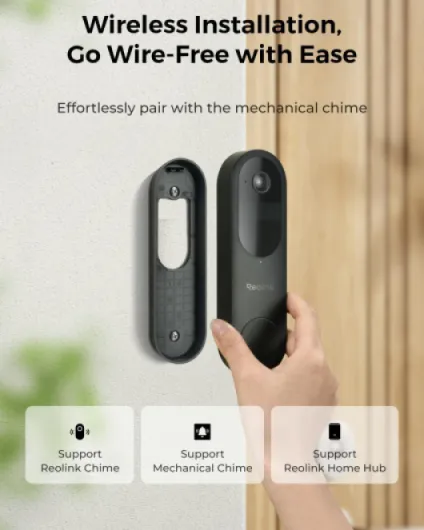
The build quality feels solid. The plastic doesn’t feel cheap or hollow, and once it’s locked into the mounting plate it doesn’t wobble. The included wedge plate is useful if your door is recessed or you need to angle the camera a bit toward the path. I used the wedge because my door is set back from the street, and it gave a better view of people walking up. The IP65 rating seems realistic: it’s seen rain and wind and I haven’t noticed any moisture inside the lens or weird fogging.
One thing I paid attention to was how easy it would be to steal. The doorbell is held on by a small release mechanism that uses a special tool included in the box. It’s not impossible to remove if someone really wants it, but it’s not something you can yank off in two seconds either. As long as you don’t lose that tool, removing it yourself for charging or SD card access is straightforward. If you do lose it, you’ll be swearing a bit.
In terms of day-to-day interaction, the button has a clear click and the light ring gives a good visual confirmation that it’s been pressed. At night, the ring is visible but not blinding. It’s a functional, no-nonsense design: nothing fancy, but it looks decent next to a typical uPVC or composite door and doesn’t scream “cheap gadget”. If you like ultra-minimal Apple-style design, this isn’t that, but it’s practical and feels like it can take some abuse from weather and visitors.
Battery life: okay if quiet, annoying if busy
I tried the doorbell in two configurations: fully on battery for the first couple of weeks, then wired to my existing doorbell transformer while still having the internal battery as backup. The battery life really depends on how busy your front door is and how aggressive your motion settings are. With moderate traffic (postie, a couple of deliveries, and family going in and out), I was seeing around 2–3 weeks before it dropped below 25–30%.
Some reviewers talk about almost a month with 50% left; that’s possible if your door is fairly quiet and you dial down motion sensitivity. On the flip side, if you live on a busy street or you leave motion on a wide area, it can drain in under a week. One Amazon review mentioning about a week of life on battery alone matches what I’d expect in a high-traffic setup. The constant recording of short motion clips and live views adds up quickly.
Charging is via USB-C, which is at least convenient. You do, however, have to physically unclip the doorbell from its mount to bring it inside or plug in a power bank. That’s where the little removal tool comes in again. If you’re forgetful, you’ll either end up with a dead doorbell or constantly telling yourself “I’ll wire this properly next weekend”. For me, the battery-only mode is fine as a short-term solution or for testing, but long term I’d say: if you have any way to power it from existing doorbell wiring, do it.
Once I wired it, the whole battery topic basically disappeared. The doorbell stayed topped up and I didn’t have to think about charging at all. So my honest opinion: as a pure battery doorbell, it’s decent but not outstanding. If you want totally hassle-free use and you have a busy door, I’d either wire it or consider the PoE version if you’re already invested in Ethernet runs. The wireless battery mode is more of a convenience option than a perfect long-term solution for heavy use.
Durability and reliability: feels solid, no major issues so far
In terms of durability, I don’t have long-term years of data yet, but after some weeks of typical British weather (rain, wind, a bit of cold), it’s holding up well. No water ingress, no random reboots, and the housing still looks new. The IP65 rating seems meaningful, and the doorbell doesn’t feel like it’ll fall apart if someone knocks it by accident or if a parcel bashes into it.
The mounting system is reasonably robust. Once the bracket is screwed into the wall or frame with the included hardware, the doorbell slides on and locks with that small tool-release mechanism. I gave it a few firm tugs to see if it would rattle or move and it stayed put. Unless someone comes with tools and actually tries to remove it, it should stay where it is. It’s plastic, so if someone went at it with a hammer, obviously it’ll lose, but that’s true for most doorbells in this category.
On the software side, stability has been decent. The doorbell stayed connected to my Wi‑Fi (I tested both 2.4 and 5 GHz) without constant dropouts. There were a couple of times where the live view took a few seconds longer than I’d like to start, but nothing that felt like a full crash or freeze. Firmware updates are handled via the app; I did one update during my test period and it went through without drama. If you already have Reolink cameras, it behaves just like another camera in the system, which is kind of the point.
Overall, I’d say the reliability is pretty solid for the price bracket. It doesn’t feel fragile, and the connection has been stable enough that I trust it to actually record when something happens. Obviously, long-term durability (2–3 years plus) is still a question mark, but based on my experience and other Reolink gear I own, I’m not too worried. It’s not premium metal construction, but for a plastic, battery Wi‑Fi doorbell, it feels up to the job.
Video quality and detection: strong camera, some app quirks
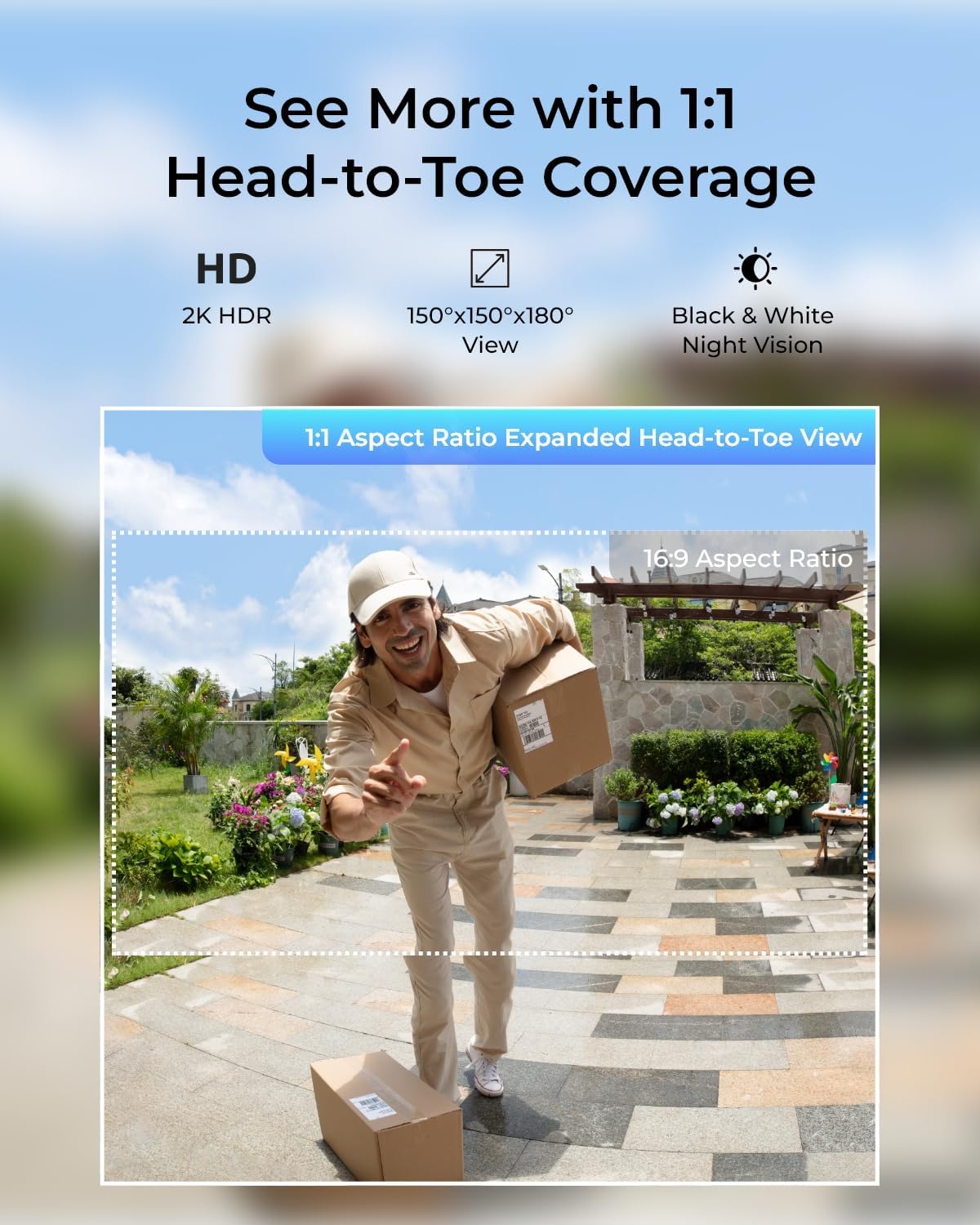
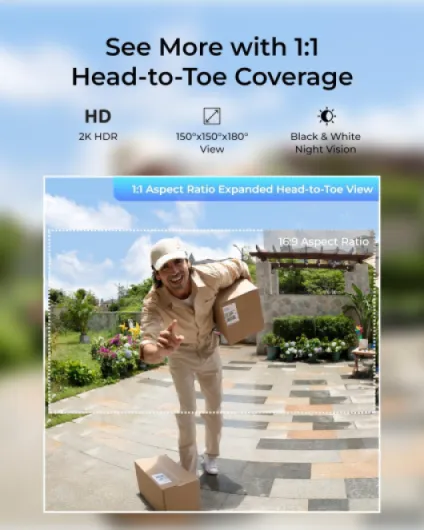
On the video side, I’m happy with it. The 2K resolution is genuinely useful – you can clearly see faces, read logos on jackets, and check packages on the ground. The 1:1 aspect ratio is actually more useful than I expected: you see people from head to toe plus the doorstep, so you don’t have to angle the camera weirdly just to see parcels. Compared to a 1080p Ring I used before, the Reolink footage is sharper and the vertical view is more practical for door use.
At night, the infrared night vision does a good job. The image is black and white but quite clean, and you can still identify faces easily if they’re reasonably close. I didn’t have any major issues with glare from nearby lights, though if you have a bright porch light directly in frame you might see some blooming. Noise levels are acceptable; you can tell it’s night footage, but it’s not a grainy mess.
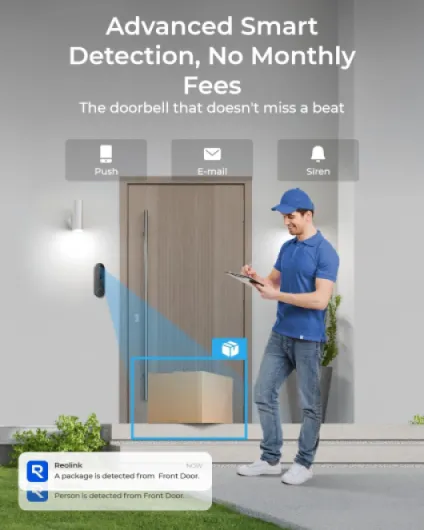
Motion and smart detection are one of the better points. You can set detection zones and tweak sensitivity, and the person/vehicle/package tags in the history are actually accurate most of the time. I had far fewer false alerts from passing cars than with my previous doorbell, especially after I adjusted the zones. For a house on a moderately busy road, that’s a big deal. The app lets you quickly filter to just people or just parcels, which makes checking if the courier came much faster.
Now the weak spot: how it behaves as a “doorbell” on your phone. When someone presses the button, your phone gets a push notification rather than a proper full-screen call-style ring. You have to tap that notification to open the Reolink app and connect. There is a setting for “rich notifications”, but the proper picture preview requires their cloud service. If you’re used to Ring popping up like an incoming call, this feels like a step down. Also, if you integrate it with an NVR, some functions (like richer notifications) get more limited, which is a bit annoying if you want everything in one system.
What this Reolink doorbell actually offers
On the spec sheet, this thing is fairly complete. You get a 4 MP sensor with 2K (2048p) video, a 1:1 aspect ratio so you see the visitor from head to toe and the floor in front of the door, dual-band Wi‑Fi (2.4 and 5 GHz), and local storage on microSD up to 256 GB. It’s IP65 rated, so fine for rain and general UK weather, and it can run either on its internal battery or off 8–24 V AC doorbell wiring. There’s also two-way audio, infrared night vision, and the usual motion detection features.
In practice, the main functions I used daily were: motion alerts, live view when somebody was at the door, talking back through the mic, and scrolling through the event history. The app lets you filter clips by person / vehicle / parcel, which is actually handy when you want to quickly check if the courier came. You also get options for quick replies (pre-recorded messages) if you don’t want to talk live.
One thing that’s good to understand: there’s no chime included in the box. You either use your existing wired chime (if compatible/wired correctly) or buy a separate Reolink chime or a third-party option. Also, the way the phone “rings” is basically via push notification, not a full-screen incoming call interface like some people are used to with Ring. You have to tap the notification to jump into the app and see/talk.
Overall, the feature list is strong for the price range: no forced cloud subscription, good resolution, decent smart detection, and flexibility on how you power it. But it’s important to know what it doesn’t do as nicely (like the phone call behavior) so you’re not expecting something it can’t deliver. If you look at it as a smart camera for the front door with a bell button rather than a perfect phone-ringing intercom, it lines up better with what you actually get.
How well it works day-to-day as a door guard
As a front door security camera, the Reolink works well. It reliably records people walking up, tags them correctly most of the time, and keeps the clips on the SD card or NVR without you having to pay anyone monthly. When I’m at work or upstairs, the motion alerts come through quickly enough that I can usually catch the courier before they walk away. The two-way audio is clear enough to tell them where to leave a parcel or to tell someone you’re on your way to the door.
The Reolink app is also one of the better ones I’ve used. You can access all your Reolink cameras in one place, including this doorbell, and the layout is logical. Setting up detection zones, changing sensitivity, and browsing recordings is straightforward. I like that each clip in the history shows a small icon (person, car, parcel) so you don’t have to guess what triggered it. Live view loads reasonably fast on decent Wi‑Fi, especially on 5 GHz.
Where it feels slightly less effective is the traditional “doorbell” experience. If my phone is in another room or on silent, I’m relying on the physical chime more than the app. And because the phone doesn’t ring like a voice call, there’s a higher chance I’ll just see the notification too late. That’s exactly what one of the one-star reviewers complained about, and I think they’re right to call it out. If you absolutely want your phone to behave like a ringing intercom every time someone presses, this solution might frustrate you.
So in plain terms: as a camera with alerts, it works well; as a doorbell that behaves like a phone call, it’s weaker. If you pair it with a proper indoor chime and you’re okay with just push notifications on the phone, you’ll probably be satisfied. If you’re expecting a Ring-style call interface every time, you may feel like you’ve only got half the experience. For me, the security side matters more than the fancy call UI, so I can live with it, but it’s worth being clear about that trade-off.
Pros
- Good 2K video quality with a useful head-to-toe 1:1 view
- Local SD storage up to 256 GB and no mandatory subscription
- Flexible setup (battery or wired) with solid smart detection and a decent app
Cons
- Phone only gets push notifications, not a proper call-style ring when pressed
- Battery life can be short on busy doors if used purely wireless
- Chime not included, and some features are reduced when used with an NVR
Conclusion
Editor's rating
Overall, the Reolink Wireless 2K Doorbell is a solid choice for people who care more about local recording and no subscriptions than fancy UX details. The video quality is good, the 1:1 view is actually useful for seeing both faces and parcels, and the smart detection does a decent job of cutting down on pointless alerts. As a front door security camera that also happens to have a button, it does its job well enough.
Where it falls short is mainly around the “doorbell” experience on your phone. It behaves more like a camera sending notifications than a doorbell that properly rings your phone like a call. If that detail matters a lot to you, you might be annoyed. Battery life is also very usage-dependent: fine for quieter doors, but can feel short if you have a lot of motion and rely purely on battery. Wiring it in basically fixes that but takes a bit more effort.
I’d recommend this to people who already have Reolink gear, who want to avoid monthly fees, or who see this mainly as part of a broader DIY security setup. If you just want the smoothest, most polished doorbell experience with instant phone ringing and don’t mind subscriptions, you might be happier sticking with Ring or similar. For everyone else, this is pretty good value and gets the basics right, as long as you accept its limitations up front.