
Summary
Editor's rating
Value: where it beats Ring and Nest, and where it doesn’t
Design: simple plastic block that does the job
Battery and power: what 210 days really means
Durability and weather resistance
Performance: image quality and detection in real life
What you actually get with the Tapo D235
Pros
- 2K 5MP video with 180° view gives clear, wide coverage including doorstep parcels
- No mandatory subscription thanks to microSD local storage and free AI detection
- Flexible power options: long-life battery, wired, or both with battery backup and 24/7 recording when wired
Cons
- Tapo app is a bit clunky and some notification texts are awkward
- Smart display integration (Google/Alexa) is less polished than Ring/Nest and can be fiddly to set up

Specifications
View full product page →| Brand | Tapo |
Finally ditched Ring and Nest for this
I’ve been through a few smart doorbells over the last years: started with Ring, then tried a Google Nest, and both ended up annoying me with subscriptions and half-baked features. I picked up the Tapo D235 because I already use a few Tapo plugs and cameras, and I was curious if a cheaper, no-subscription doorbell could actually replace the big brands. I wired it in where my old Nest was and kept the battery as backup, then let it run for a couple of weeks before giving an opinion.
First impression: it’s not perfect, but it’s genuinely solid for the price. The 2K video is clearly sharper than the 1080p cameras I had before, and the 180° view is very wide. The app is familiar if you already use Tapo, and setup was quick. I didn’t have to fight with it to get it on Wi‑Fi, which is already a win compared to some older Ring stuff I had. The included chime is loud enough for a normal house and doesn’t feel like an afterthought.
In daily use, the main difference I noticed versus Ring/Nest is how it handles storage and notifications. Local microSD storage is a big plus, and the AI detection for people/vehicles/pets is decent. You still get the odd useless alert, but it’s not constantly pinging you for every leaf that moves. The app is not the prettiest thing ever, and some menus feel a bit clunky, but once you’ve tuned your settings, you mostly forget about it. It just records and rings when someone is at the door.
If you already live in the Tapo ecosystem, this doorbell fits right in. If you’re coming from Ring or Nest, you’ll probably miss one or two fancy features like facial recognition or super polished notifications, but in exchange you stop paying a monthly fee and you get pretty good image quality and coverage. For me, that trade-off is worth it. It’s a good, practical option if you want smart features without getting locked into a subscription.
Value: where it beats Ring and Nest, and where it doesn’t
On value, this is where the Tapo D235 starts to make real sense. The price usually sits lower than comparable Ring and Nest models, and the big difference is no mandatory subscription. You can stick a microSD card in the back and have local recording, including motion events and even 24/7 recording if wired, without paying a monthly fee. Tapo does offer a cloud plan, but it’s optional and cheaper than what Ring and Nest charge. If you’re tired of paying just to see your own door footage, this alone makes the D235 attractive.
What you get for the money is solid: 2K video, 180° view, full-color night vision, free AI detection, included chime, Alexa/Google support, and hybrid battery/wired power. Compared to my old Nest, I lose some polish (like nicer app design and facial recognition), but I gain freedom from subscriptions and get wider coverage. Compared to Ring, I’d say image quality and field of view are on par or better, and again, I’m not stuck paying for cloud just to have useful recordings.
On the downside, the app interface feels a bit clunky in places. It works, but some settings are buried, and the wording of some notifications (like “Person moving is at the front door”) is awkward. Also, integration with Google/Alexa is good but not perfect. For example, some people struggle to get the video to auto-pop up on their smart display when the doorbell rings. So if you’re expecting a super polished smart home experience with every little feature working flawlessly, you might be slightly disappointed.
Overall, though, if you look at the full picture — hardware, features, and long-term costs — the D235 offers good value for money. It’s not the cheapest doorbell on the market, but you’re not paying for a logo and then getting milked by monthly fees. If you want a competent smart doorbell that you can buy once and just use, this is a strong candidate. If you absolutely need things like facial recognition, ultra-slick app design, or deep integration with a specific ecosystem, you might want to stay with Ring/Nest and accept the higher running costs.

Design: simple plastic block that does the job
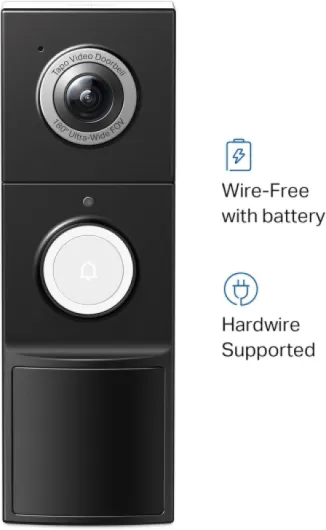
Design-wise, the Tapo D235 is pretty straightforward. It’s a tall, narrow black rectangle (about 15 x 5 x 3.8 cm) with the camera at the top, a small light/LED area, and a large round button at the bottom. It doesn’t scream “premium gadget”, but it doesn’t look cheap or toy-like either. Mounted next to the door, it blends in well enough. If you’re used to Ring and Nest’s more rounded designs, this one feels a bit more utilitarian, but that’s not a big deal to me.
The 180° lens is very obvious on the front; you can tell it’s a wide-angle as soon as you see the glass. The button has a clear ring light around it so visitors know where to press, even at night. When the spotlight kicks in for night color vision, it’s bright enough to light up the immediate area without blinding anyone. It’s not pretty, it’s just practical. If you care about aesthetics more than function, you might find it a bit plain, but at least it doesn’t look tacky.
On the back, you have the contacts for wiring and the slot for the microSD card. The battery is internal, so you’re not swapping cells; you recharge it via the port when needed, or keep it wired so you almost never think about it. The mounting plate system is standard: screw the plate to the wall, then slide the doorbell on. They include angled brackets if you need to tilt it towards your path or gate, which is handy if your door is in a corner or people come from one side.
In daily use, the design choice that matters most is the huge field of view. The fisheye effect is visible in the image, but in a doorbell context, that’s a good trade-off. You see the floor right in front of your door (for parcels) and you still catch people approaching from the side. Compared to my old Nest, I get more head-to-toe coverage and less guessing about where a package was dropped. So yeah, not a design piece you brag about, but it’s built to show you as much as possible, and that’s exactly what you want here.
Battery and power: what 210 days really means
Tapo advertises up to 210 days of battery life with the 10,000 mAh battery, which sounds huge on paper. In reality, like with every battery-powered camera, it depends a lot on how busy your front door is and how aggressive your detection settings are. If you live on a quiet cul-de-sac and only get a few visitors a day, you might get close to that number. If you’re on a main road with constant foot traffic and you record every motion event in high quality, don’t expect seven months. Realistically, for an average suburban setup, I’d expect something like 2–4 months on battery before needing a recharge.
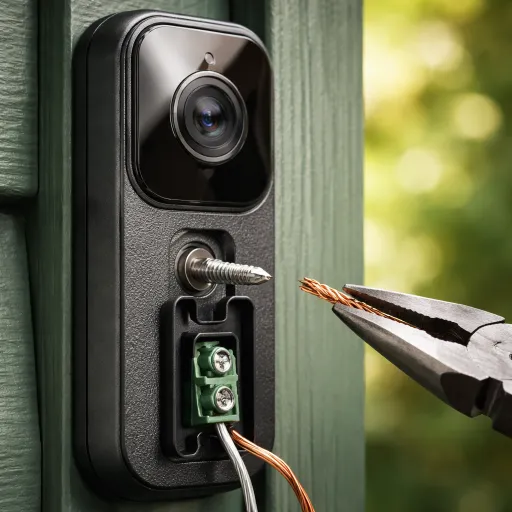
Personally, I wired mine into the existing doorbell transformer (around 12V AC) and treat the battery as a backup. This way, I don’t really think about charging at all. The wired setup also unlocks 24/7 continuous recording and pre-roll, which is great if you like to scrub through a timeline rather than only rely on motion clips. When the mains goes down, it falls back on the internal battery and keeps recording to the SD card, which is a nice safety net if you care about security during power cuts.
Charging is done via the port on the doorbell, so if you run it battery-only, you’ll probably have to unmount it to charge indoors unless you have an outdoor socket nearby. That’s a bit of a hassle, but it’s the same story with most battery doorbells. The upside is that there’s no separate battery pack to lose; the downside is you can’t just swap a spare in and out. For most people, charging every few months is acceptable, but if you hate ladders, consider wiring it if you can.
Overall, on the power side, flexibility is the main strength here. You can go full wireless if you’re renting or don’t want to touch any wiring, or you can wire it and forget about battery life while getting continuous recording. Just don’t take the 210-day figure as a guarantee; see it as “under ideal conditions”. Compared to Ring and Nest, it’s on the same level or a bit better in terms of endurance, and the hybrid wired + battery backup setup is genuinely practical.
Durability and weather resistance
The D235 is rated IP66, which in plain terms means it can handle heavy rain and dust without complaining. I’ve had it mounted outside in typical UK weather: rain, wind, a bit of cold. So far, no water ingress, no fogging of the lens, and no random reboots. The plastic housing doesn’t feel luxurious in the hand, but once it’s on the wall, that doesn’t really matter. It’s tight and solid enough that I don’t worry about it falling apart after the first winter.
The front button has a decent click and the ring light still looks the same after being poked with wet fingers and gloves. The spotlight and IR LEDs have been fine so far, with no dimming or flickering. I can’t speak to multi-year durability yet, but TP-Link gear I own (plugs, older Tapo cameras) has generally held up well over time, so I’m not too worried. It’s not built like a tank, but for a plastic consumer doorbell, it feels okay.
One thing to note: because it’s quite light (around 300 g) and made of plastic, it’s not going to survive a serious hit or vandalism attempt. If someone wants to rip it off the wall, they probably can. That’s the same for Ring and Nest too, to be fair. The important part is that recordings go to the SD card inside and/or cloud, so at least you have footage of whoever messed with it. I’d still mount it a bit out of easy reach if possible, just to make it less tempting.
In day-to-day use, it’s handled temperature changes and constant outdoor exposure without any weird behavior. No random disconnects during heavy rain, no water droplets stuck inside the lens. For something that lives outside 24/7, that’s what I care about. So from a durability and weather perspective, I’d call it reliable enough for normal home use, not bulletproof, but clearly not fragile either.
Performance: image quality and detection in real life
On performance, the D235 is pretty solid overall, with a few quirks. The 2K 5MP image is clearly sharper than the 1080p Ring/Nest models I had before. Faces are easier to identify, and license plates are readable if the car isn’t flying past. During the day, the picture is clean and detailed. At night, the full-color mode with the spotlight on is genuinely useful: you still see colors of clothes, cars, and parcels, not just grey blobs. If you prefer to stay more discreet, you can switch to classic IR black-and-white night vision, which still does the job.
The 180° field of view is probably the main selling point in practice. It’s wide enough that you see people long before they get right in front of the camera, especially if they come from the side. You also see the ground right by the door, so you can check if a parcel is there without opening. Yes, the image has that fisheye distortion around the edges, but for security and awareness, I’ll take that any day over a narrower, more “cinematic” view. Compared to my old Nest, I don’t miss people walking up to the door anymore.
On motion detection and notifications, it’s good but not perfect. The AI that distinguishes people, vehicles, pets, and packages works most of the time. I’ve had a few random mislabels (car flagged as “person moving”, or a passing cat ignored), but nothing dramatic. More important, I don’t get spammed with alerts every time a small branch moves, which used to drive me nuts with some older cameras. You can fine-tune the zones and sensitivity in the app, but the interface can feel a bit clunky until you get used to where everything is.
Live view loading time is decent. On my Wi‑Fi, it usually takes 1–3 seconds to open the stream in the app, which is faster than my old Nest and about on par with newer Ring models. Audio is clear enough on both ends to speak to delivery drivers without repeating yourself three times. Sometimes there is a small delay, like half a second, but nothing that breaks the conversation. Overall, as a tool to see and talk to whoever is at your door, and to review clips after, it performs well. Not flawless, but clearly good enough for everyday use.
What you actually get with the Tapo D235
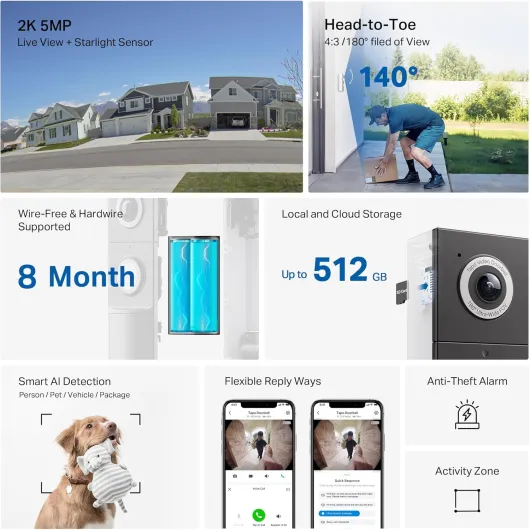
The Tapo D235 is basically a 2K (5MP) smart doorbell that you can run either on its internal battery or wired to your existing doorbell transformer (8–24V AC). In the box you get the doorbell itself, a plug-in chime, mounting plates, screws, anchors, and the usual paper instructions. No microSD card is included, so if you want local recording, you need to buy one separately (up to 512 GB supported). It’s IP66 rated, so it’s meant to live outside in the rain and cold without any drama.
The key specs that matter in real life are: 2K resolution, 180° ultra-wide view, full-color night vision with spotlight, and two-way audio. There’s a 10,000 mAh battery inside that Tapo claims can last up to 210 days, though that will depend a lot on how busy your front door is and which detection settings you choose. It records at up to 20 fps, which is enough for a doorbell; it’s not action-cam smooth but it’s fine to see who did what in front of your door.
On the software side, you manage everything through the Tapo app. You can choose between local storage (microSD in the doorbell) or Tapo Care cloud if you want extra features like longer history and easier remote access. The good point: basic AI detection (person, vehicle, pet, package) and notifications are free. This is very different from Ring and Nest, where the smart stuff usually sits behind a paywall. The D235 also supports Alexa and Google Assistant, so you can pull up the live view on an Echo Show or Google Nest Hub.
Overall, the product pitch is pretty clear: a mid-priced doorbell with high resolution, wide view, and no mandatory subscription. It doesn’t try to be the most high-end gadget on Earth, but it packs enough features to cover most people’s needs: motion alerts, talk to visitors, record to SD, and integrate with your smart home. If you’re okay with the Tapo app and don’t care about face recognition or ultra-fancy cloud features, it covers the basics and a bit more.
Pros
- 2K 5MP video with 180° view gives clear, wide coverage including doorstep parcels
- No mandatory subscription thanks to microSD local storage and free AI detection
- Flexible power options: long-life battery, wired, or both with battery backup and 24/7 recording when wired
Cons
- Tapo app is a bit clunky and some notification texts are awkward
- Smart display integration (Google/Alexa) is less polished than Ring/Nest and can be fiddly to set up
Conclusion
Editor's rating
The Tapo D235 is a practical, no-nonsense smart doorbell that focuses on the right stuff: clear video, wide coverage, flexible power options, and no forced subscription. The 2K image quality and 180° field of view make a real difference day to day, especially if people approach your door from the side or you often get parcels left on the doorstep. Add in full-color night vision, decent two-way audio, and free AI detection, and you end up with a doorbell that covers most people’s needs without bleeding your wallet every month.
It’s not flawless. The app could be smoother, some notification wording is weird, and integration with Google/Alexa isn’t as polished as Ring or Nest. If you obsess over tiny UX details or really want features like facial recognition and ultra-tight integration with a specific ecosystem, you might prefer to stay with the big brands. But if you’re like me and mainly want a solid doorbell that records reliably, lets you talk to visitors, and doesn’t lock the useful features behind a paywall, the D235 is a strong option.
I’d say it’s best for: people already using Tapo gear, anyone fed up with Ring/Nest subscriptions, and homeowners who want a mix of wired reliability and battery backup. Who should skip it? Those who absolutely need the slickest app experience, deep smart home tricks, or who don’t want to fiddle with settings at all. For everyone else, it’s a good value, no-drama choice that gets the job done and saves you money in the long run.