
Summary
Editor's rating
Is it good value for a 6-monitor kit?
Old-school look, functional layout
Build quality and how robust it feels
How it holds up and what I expect long term
Video, audio, and night vision in real life use
What you actually get in the box and what it can (and can’t) do
Does it actually solve the daily problems?
Pros
- Stable wired connection with one outdoor unit and six indoor 7-inch monitors
- Metal IP65 outdoor panel with decent day/night video and RFID card unlock
- Good value for multi-unit buildings with no subscriptions or cloud dependence
Cons
- No video recording, no smartphone app, and no remote access features
- Installation requires running 4-core cables, which can be time-consuming and may need a professional

Specifications
View full product page →| Brand | ANJIELO SMART |
A budget-friendly building intercom that actually works
I installed this ANJIELO SMART wired video door phone system in a small building with six flats and used it for about three weeks before giving my opinion. I’m not an installer by trade, just reasonably handy, so my view is more “normal user who reads manuals” than professional electrician. I wanted something simple: see who’s at the door, talk to them, and buzz them in if needed. No fancy app, no cloud, just a basic wired system that doesn’t rely on Wi‑Fi.
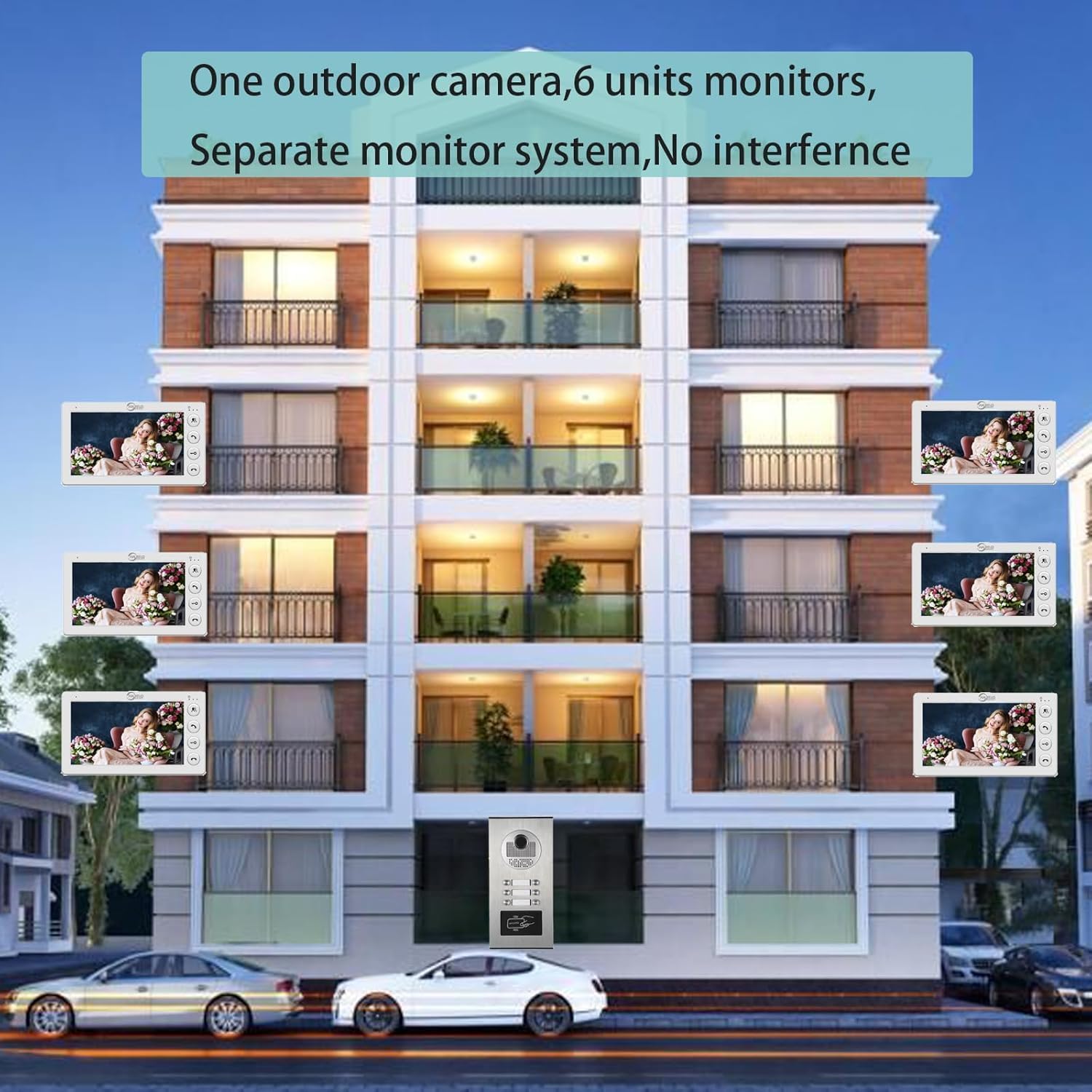
Right away, the first thing to know: this is a fully wired system. One outdoor camera panel, six indoor 7‑inch monitors. No wireless, no battery, everything runs off cabling and a power supply. That’s good for stability, but it also means you’re pulling cables through walls if the building isn’t pre‑wired. In my case, there was already an old intercom system, so I reused some of the existing conduits, which helped a lot.
My general feeling after a few weeks is that it’s a practical and fairly basic setup. It does what it says: video, audio, and door unlock. There’s no recording, no mobile notifications, no integration with smart home stuff. If you’re expecting something like a Ring or Nest with cloud features, that’s not what this is. Think more “classic apartment intercom, but with a screen and RFID cards”.
Overall, I’d say it’s decent for small buildings or a big house with many rooms, as long as you accept the wiring work and the slightly dated feel of the interface. It’s not perfect, and there are corners clearly cut to keep the price down, but in daily use it’s been reliable enough and the tenants quickly got used to it.
Is it good value for a 6-monitor kit?
For value, you have to remember this kit includes six 7‑inch monitors plus one outdoor unit. If you tried to build the same thing with some popular smart doorbells and separate indoor screens, you’d easily pay more, especially once you multiply by six. So purely on price-per-unit, it’s not bad at all. It targets small apartment buildings, shared houses, or large homes that want several stations, and in that niche it offers a lot of hardware for the money.
That said, the way it keeps the cost down is clear: no recording, no app, no cloud, no Wi‑Fi, fairly basic plastic on the monitors, and an old-school interface. If you only need one or two stations and you care a lot about remote access from your phone, you might be better off with a single smart doorbell plus one or two official screens from that brand. It will probably cost roughly similar and give you more modern features, just not six screens.
Where this system makes sense is if you specifically need multiple indoor stations in different flats or rooms and you want everything wired for reliability. For that use case, the price feels reasonable. Once installed, there are no ongoing fees, no subscriptions, no storage costs. It’s a one-off expense and then it just runs. You do have to factor in either your own time to install it or paying someone to pull cables and wire the monitors, which can eat into the “value” if the building isn’t already set up for it.
In short, I’d say the value is good if your priority is multi-unit wired access and stability, and just okay if you’re a tech person wanting lots of smart features. It’s not the cheapest thing on the market, but for a six-monitor kit with metal outdoor unit and RFID unlock, the price-to-function ratio is pretty solid.
Old-school look, functional layout
Design-wise, this system leans more “practical” than “stylish”. The indoor 7‑inch monitors are simple rectangular screens with fairly thick bezels and physical press buttons on the side or bottom (depending on how you mount them). They’re not ultra-thin tablets or anything like that, they look like older generation video intercoms you see in many European apartment blocks. In a modern, nicely decorated flat, they won’t win any style points, but they don’t look cheap to the point of being embarrassing either. I’d call them basic but acceptable.
The outdoor doorbell unit is more solid looking. It has an aluminium front in silver, with the camera at the top, IR LEDs around or near it for night vision, a speaker grill, mic hole, and the RFID area. The case is IP65, so it’s meant to handle rain and dust. I mounted it at the main entrance under a small awning, and it looks like a standard apartment door panel. It’s not super sleek, but it feels more like real “building hardware” than a plastic gadget. The buttons are clear, and visitors quickly understand where to press and where to speak.
One thing I liked is that the buttons are clearly labelled and tactile. Tenants didn’t need a tutorial: pick up the handset-style button, unlock button has a clear icon, and the monitor button lets you see outside. There’s no touch screen, which in this case is good, because touch screens in common areas tend to age badly and get grimy. Physical keys are easier to use for older residents too.
On the flip side, if you’re into minimalistic interiors and you want your tech to blend in, this system looks a bit dated. The UI graphics on screen are simple, almost like early 2000s menus. No fancy animations, no nice fonts, just functional icons and text. Personally, I’d rather have something that works than a pretty UI that crashes, but it’s worth knowing: this looks more like pro building equipment than a smart gadget. If design is a big priority for you, you might find it a bit meh.
Build quality and how robust it feels
The outdoor unit is the part I looked at most closely for materials, because it has to survive weather, knocks, and the occasional frustrated visitor jabbing the button. The front plate is aluminium and feels sturdy. It doesn’t flex when you press on it, and the buttons have a firm, clicky feel. The IP65 rating means it’s protected against dust and low-pressure water jets; I wouldn’t blast it with a pressure washer, but normal rain is fine. We had a few days of solid rain and some wind, and nothing got into the unit, no fogging on the lens, and it still worked like day one.
The indoor monitors are more obviously cost-controlled. They’re mostly plastic, including the casing and buttons. The plastic doesn’t feel premium, but it also doesn’t feel flimsy to the point where you think it’ll crack if you press a bit too hard. The screens are not glass-fronted like tablets; it’s more like the plastic front you see on older monitors. You’ll want to treat them normally and not slam them, but in a normal household or apartment, I don’t see them breaking easily.
Cabling is another part of the material story. The system uses 4-core wiring between the outdoor unit and each monitor. The kit I had didn’t include long cables for the whole installation (which is normal for this kind of product), so I had to buy appropriate cable separately. If you use decent quality cable and don’t skimp on it, the whole system feels solid once everything is mounted and screwed to the wall. The mounting brackets are metal and hold the monitors firmly; they don’t wobble once properly installed.
Overall, I’d say the materials are good enough for residential use, but clearly not luxury. Outdoor unit: pretty solid. Indoor units: basic plastic but functional. For the price range this sits in, that’s acceptable. If you’re installing it in a rough environment (public corridor with lots of abuse), you might want something even tougher, but for a standard small building or large home, I’d be comfortable with how it’s built.
How it holds up and what I expect long term
I’ve only had it running for a few weeks, so I can’t pretend to have a multi-year review, but there are a few things you can feel early on about durability. First, the outdoor unit feels like it’s built to stay on a wall for years. The aluminium case, the sealed design, and the IP65 rating all point to something that can handle typical European weather without drama. The buttons still feel the same after many presses, and the camera lens hasn’t shown any condensation or scratches yet. I’d still avoid direct sunlight all day if you can, just to protect the camera and plastics, but that’s true for almost any intercom.
Indoors, I don’t see much that could fail mechanically. The monitors have physical buttons, but they’re not mushy or loose, and they don’t feel like they’ll fall off after a few months. The screens don’t get hot, and the power adapter also stayed cool during use, which is a good sign. A lot of cheap gear runs very warm; this one doesn’t, which usually means less stress on components long term.
Where durability can go wrong with these systems is usually installation and cabling. If the cables are too thin, badly crimped, or running alongside strong electrical lines, you can get interference or failures. So the long-term reliability here will depend a lot on how carefully it’s installed. In my case, reusing existing conduits and using decent 4-core cable gave a stable result with no flicker or dropouts so far.
Based on the feel and first weeks of use, I’d expect this system to last several years without big issues in a normal residential setting. It’s not industrial-grade, but it doesn’t feel like a disposable gadget either. I’d put it in the “solid enough if not abused” category. If something is going to fail, I’d bet on the indoor screens or the power adapter before the metal outdoor panel, but that’s just from experience with similar products.
Video, audio, and night vision in real life use
In practice, the video quality is decent but nothing more. During the day, you can clearly see faces, clothing, and whether someone is holding a package. It’s not HD like a modern IP camera, but for a 1000TVL analog-style camera, it’s fine. The 92° viewing angle is wide enough to see the person and a bit of the surrounding area, but not the whole hallway. If someone stands too close, you mostly see their face and chest; step back a bit and you see more context. For recognising delivery drivers or visitors, it’s perfectly usable.
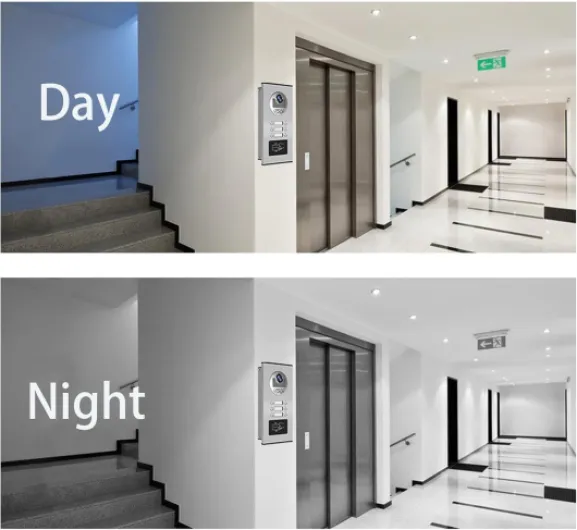
At night, the IR night vision kicks in. The image turns black and white, and as long as the person is within about 1–2 meters of the doorbell, you can still clearly recognise them. Beyond that, it gets grainier and darker, but you still see movement and shapes. We tested it with the building lights off and just a bit of street light: still usable, but obviously less sharp. If you expect CCTV-level image quality, you’ll be disappointed; if you just want to see who’s at the door, it gets the job done.
Audio is where I was a bit more picky. The two-way audio is clear enough to understand people, but the speaker on the outdoor unit isn’t very loud by default. We had to bump the volume up in the settings. With traffic noise nearby, visitors sometimes had to lean closer to the panel to hear us. Inside, the monitors’ speakers are okay, not great. You occasionally get some echo if people talk at the same time or stand really close to the mic outside, but nothing dramatic. For short “hello, who is it / I’ll open the door” conversations, it’s fine.
One strong point is that the wired connection is stable. No Wi‑Fi dropouts, no random disconnects. When someone presses the doorbell, the monitors ring right away and the video appears within about a second. Over the three weeks, we didn’t have any cases where the image froze or didn’t show up. Compared to some cheap wireless kits I’ve tried in the past, this is more reliable as long as the wiring is done properly. So overall, performance is solid for basic intercom use, just don’t expect modern IP camera quality or rich features.
What you actually get in the box and what it can (and can’t) do
Out of the box, you get one outdoor doorbell unit with the camera, speaker, mic, RFID reader, and call buttons, plus six 7‑inch indoor monitors. There’s also the power adapter and the basic mounting hardware. Mine came with a few RFID key fobs too, which is handy because it means people can unlock the door with a swipe instead of always needing someone to buzz them in. There’s no memory card, and the system doesn’t support video recording at all, so don’t expect any footage history.
The main specs that matter in practice: the camera is listed as 1000TVL/700 lines with a 1/3" CMOS sensor and about a 92° viewing angle. In normal daytime, that gives a clear enough image to recognise faces at the door from 1–2 meters away. It supports one door station and up to six monitors in this kit, and the brand claims you can go up to 12 in total if you get more units and wire accordingly. Audio is two‑way: you press to talk, the visitor replies, simple as that.
One important limitation: there’s no app, no Wi‑Fi, no smartphone connection. Everything happens on the indoor monitors. When someone rings, all or some monitors (depending on your wiring and settings) will ring and show the video. You can pick up from any monitor, talk, and unlock the door if you have an electric lock connected. For a small apartment building where people are usually home or at least nearby, that’s fine. For those who want off‑site control, this system is not the right fit.
In day‑to‑day use, the feature set is pretty straightforward: call, talk, open, and manual monitoring (you can press a button to see the camera feed without someone ringing). There are basic settings like ringtone, volume, and brightness, but don’t expect deep customisation or fancy menus. It’s closer to an old‑school intercom with a colour screen than a modern smart doorbell. Personally, I was okay with that because I mainly wanted reliability and shared access for six units, not tech toys.
Does it actually solve the daily problems?
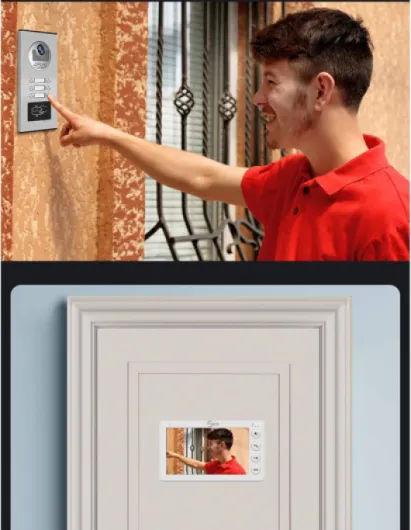
From a practical standpoint, the big question is: does this system make it easier to manage the entrance for six units? In my case, yes, within the limits of what it’s designed to do. Each flat has its own monitor, and they can answer independently. When someone rings, the monitors ring and show the visitor. You press one button to talk, another to unlock the door if you’ve wired it to an electric strike. For deliveries, that’s been a clear improvement over the old audio-only intercom, because people can see the courier and decide quickly whether to open or not.
The RFID card unlock is a nice bonus. We gave cards to a couple of residents who often forget their keys, and they can just tap the card on the outdoor unit to unlock the door. It’s not as flexible as a code keypad (you can’t just give a temporary code), but for regular users it’s handy. I tested several opens in a row and it responded consistently without lag. It’s a simple feature but it reduces the number of times people have to buzz each other in.
One downside in terms of effectiveness is the lack of recording and remote access. If someone rings while everyone is out, there’s no missed call log, no picture, no way to know who it was. For some people, that’s a dealbreaker. For this particular building, residents mostly wanted on-site control and weren’t too bothered about app features, so it was okay. But if you’re used to smart doorbells where you can answer from your phone at work, this will feel like a step back.
In everyday use, it reduces random door opening and gives a bit more control over who gets in. Tenants quickly got into the habit of glancing at the screen before pressing unlock, which is the main point of a video intercom. So while the system is basic, it’s effective at the core job: visual check + talk + unlock. Just don’t expect it to cover security camera duties or remote management.
Pros
- Stable wired connection with one outdoor unit and six indoor 7-inch monitors
- Metal IP65 outdoor panel with decent day/night video and RFID card unlock
- Good value for multi-unit buildings with no subscriptions or cloud dependence
Cons
- No video recording, no smartphone app, and no remote access features
- Installation requires running 4-core cables, which can be time-consuming and may need a professional
Conclusion
Editor's rating
Overall, this ANJIELO SMART wired video door phone system is a practical choice for small buildings or large homes that need multiple indoor stations and a single entrance. It’s not flashy, it doesn’t try to be a smart home hub, and the interface feels a bit old-fashioned, but the basics are covered: you see the visitor, you talk to them, and you unlock the door. The wired setup gives stable performance with no Wi‑Fi headaches, and the metal outdoor unit feels robust enough for long-term use. The RFID unlock is a useful extra for regular users who don’t want to mess with keys all the time.
It’s not for everyone though. If you want smartphone notifications, remote answering when you’re away, or video recording, this system simply doesn’t offer that. You also need to be ready for some cabling work, or pay someone to do it, which adds to the overall cost. The indoor monitors look a bit dated and are mostly plastic, but they work reliably once installed. I’d recommend this to landlords or owners of 4–6 unit buildings who want a simple, shared video intercom without monthly fees. If you live in a single flat and want fancy features and phone integration, you should probably skip this and look at a modern IP video doorbell instead.