
Summary
Editor's rating
Value for money: good overall, but watch the hidden extras
Design: looks good enough, screen is basic but practical
Battery life: very optimistic specs, real-world is more modest
Build quality and durability: feels robust, but signal is the weak link
Video, audio and wireless performance: good when conditions are right
What this thing actually is and how it works day to day
Pros
- Indoor 4.3'' monitor makes it easy to see and answer without using your phone
- 2K video with wide field of view and decent night vision for clear identification
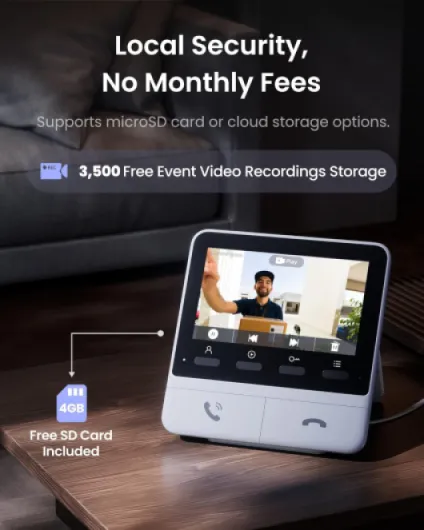
- Local microSD storage included and no forced subscription for basic features
- Good integration with SwitchBot locks, Alexa and RTSP/Home Assistant
Cons
- Wireless range between doorbell and monitor drops a lot with thick walls or long distances
- Battery life much lower than advertised if motion detection is used actively
- No cheap extra chime option – you need a second full monitor for another floor
- Monitor screen is low resolution and the chime only rings once, easy to miss in a noisy house

Specifications
View full product page →| Brand | SwitchBot |
A video doorbell that doesn’t force you on your phone all the time
I’ve been using the SwitchBot 2K Video Doorbell with the 4.3'' indoor screen for a bit now, replacing a basic wired chime. I mainly wanted something that let me see who’s at the door without having to grab my phone every time, and that didn’t force me into yet another monthly subscription. On paper, this one ticks those boxes: local microSD storage, battery-powered outdoor unit, and a proper indoor monitor that works like a classic intercom.
In everyday use, it feels like a halfway point between the usual Wi‑Fi smart doorbell (Ring, Eufy, etc.) and an old-school wired video intercom. You’ve got the smart stuff (app, Alexa, RTSP for Home Assistant, pairing with SwitchBot locks), but also a physical screen that rings and shows the video instantly. That’s honestly the main reason I kept it installed instead of sending it back.
It’s not perfect though. The wireless link between the outdoor unit and the indoor monitor clearly doesn’t like thick walls or long distances. If your entrance is far from where you’d plug the monitor, you’ll have to think a bit about where to place it, or maybe add a second monitor, which adds to the total cost. The app is also usable but a bit messy in some menus.
Overall, my first impression is pretty positive: the core functions (ring, video, audio, notifications) are solid, the 2K image is clean enough, and the local storage is a real plus. But you need to be aware of the distance and wall limitations, and the fact that some things feel a bit “version 1.0” on the software side. If you accept that, it does the job quite well.
Value for money: good overall, but watch the hidden extras
Price-wise, this sits in the mid-range of smart doorbells, but you have to remember you’re getting both the camera and a proper indoor monitor. If you compare it to a basic Wi‑Fi doorbell that just comes with a plug-in chime, it might look a bit pricey at first. But compared to classic wired video intercom kits, it’s actually pretty reasonable, especially considering you don’t need to run complex cabling unless you want constant power.
The big value point for me is local storage without forced subscription. You get a 4 GB microSD in the box, and you can go up to 512 GB if you want. Cloud storage exists as an option with a 30-day trial, but you’re not forced to pay to get basic features like event recordings or history. That’s honestly a relief compared to some brands that are basically useless without a paid plan.
On the smart home side, you also get decent value: Alexa support, RTSP for Home Assistant, and integration with the SwitchBot ecosystem (locks, etc.). If you already have SwitchBot gear, this makes more sense than mixing ecosystems. The monitor’s button that directly unlocks a SwitchBot smart lock is genuinely practical. So in that context, the price feels fair. You’re not getting luxury hardware, but you’re getting a fairly complete feature set.
Where the value drops a bit: if you need to cover multiple floors or rooms, the fact you can’t just add a cheap extra chime hurts. You need another full monitor, which isn’t cheap. Add a solar panel for power and you’re suddenly in a higher price bracket. For a small apartment or a compact house where one monitor is enough, I’d say good value for money. For a big house where you’ll end up buying extra hardware, you might want to do the math or look at more expandable systems.
Design: looks good enough, screen is basic but practical
From a design point of view, I’d say it’s pretty solid and fairly discreet. The outdoor unit is compact, not a big brick on your wall. It has a grey/black finish that doesn’t scream “cheap plastic”, and the button has a clear click, so people know they actually rang. The camera, IR LEDs and sensors are all flush on the front, so there aren’t a ton of gaps where dirt can build up. It feels more like a proper intercom than a random AliExpress gadget.
The indoor monitor is clearly built to look like a small intercom station. White matte plastic, 4.3'' LCD with a black frame, and a row of physical buttons underneath. No touchscreen here, and the resolution is low (480 × 272), so yes, you do see the pixels if you look closely. For me, for the distance you usually watch it from (1–2 meters), it’s fine. This isn’t meant to be an iPad, just a quick viewer to see who’s there and answer. The bigger plus is the physical buttons: answer, hang up, live view, quick messages, and door unlock. They all have a proper click and don’t feel mushy.
On the desk or shelf, the fold-out stand on the back works better than I expected. The rubber pads stop it sliding around when you press the buttons. On the wall, the included metal plate does the job; you can fine-tune the level because the holes are slotted. They also include a wedge for the outdoor unit to angle it about 15° if your door is recessed or on a side wall, which is actually useful in real life.
Where the design could be better: the monitor screen itself is clearly budget. Colors are a bit washed out and there’s no way to adjust brightness or contrast. Also, the chime only does a single “ding-dong” instead of a repeated melody, so if you’re far away or there’s noise (TV, cooking), it’s easy to miss it. You can change the tone and volume, but you can’t make it loop until answered, which would have been more practical in a larger home.
Battery life: very optimistic specs, real-world is more modest
The outdoor unit comes with a 5,000 mAh battery, and SwitchBot talks about up to 500+ days of battery life. In the real world, that’s basically the best-case scenario with very few events and motion detection almost off. If you actually use it as a security camera with motion alerts and frequent recordings, you can forget those numbers. Based on my use and what other users report, you’re more realistically looking at 1.5 to 2 months of battery life in a normal busy entrance.
To recharge, you’ve got a USB‑C port on the bottom. You don’t have to completely remove the doorbell if you’ve wired it, but if you’re only on battery, you’ll need to unlock it from the mount with the little pin they include. That part is secure (harder to steal), but a bit annoying if you need to do it every 6–8 weeks. A full charge from empty takes around 6 hours with a 5V/2A charger, which is acceptable but not fast.
The good news is you’re not stuck with battery-only use. You can power it continuously with low-voltage wiring from the monitor or via an external adapter, or you can add the optional solar panel. If you have some sun where your door is, the solar panel makes a lot of sense and basically removes the battery headache. If your entrance is shaded all day, you’ll have to choose between accepting regular recharges or going through the trouble of pulling a cable.
So, if you’re buying this thinking “I’ll just stick it with the adhesive and forget about it for a year”, that’s not realistic if you enable all the smart features. If you treat it more like a hybrid system and plan power accordingly, then the battery is fine as a backup and for short blackouts. It works, but the marketing numbers are clearly optimistic compared to real-world use.

Build quality and durability: feels robust, but signal is the weak link
Physically, the outdoor unit feels sturdy enough for everyday use. It’s IP65 (or IP66 depending on the listing), so it can handle rain, dust and general outdoor abuse. The housing is ABS plastic with a UV treatment, so it shouldn’t yellow too fast in the sun. The front is smooth and doesn’t have a lot of seams, which helps with cleaning and avoiding water getting stuck in weird corners. The mounting system with the slide-in bracket and security screw feels secure; it doesn’t wobble once installed.
There’s also a tamper switch on the back: if someone tries to pull it off the plate, it triggers a loud alarm and sends a push notification. That’s more of a deterrent than a real anti-theft system, but it’s better than nothing. The IR LEDs being 940 nm also means fewer visible components to attract attention at night. All in all, it feels like it will survive normal outdoor conditions: rain, cold, heat up to around 45–60°C as specified.
The indoor monitor is protected from the weather, of course. It’s just standard plastic, but the finish hides fingerprints and dust pretty well. The buttons feel like they’ll last; they don’t feel spongy or loose. The built-in stand and the metal wall plate both seem well thought out, nothing flimsy there. The microSD slot is on the side and easy to access without tools, which is handy if you plan to upgrade from the included 4 GB to something like 64 or 128 GB.
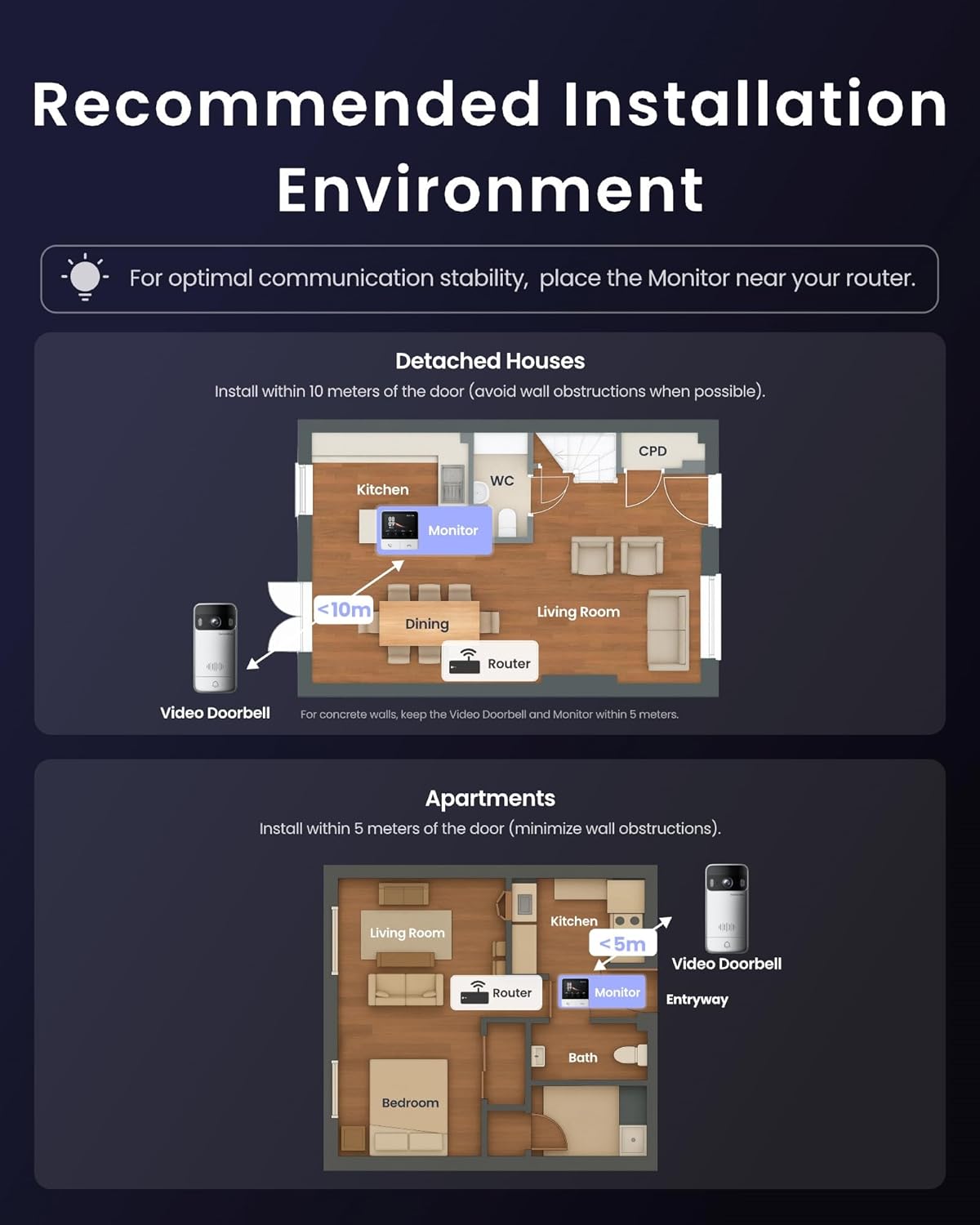
Where durability is less about physical build and more about design limits is the wireless range. In houses with thick stone or concrete walls, the signal between the doorbell and monitor is clearly the bottleneck. You might end up moving the monitor closer to a window or corridor just to keep a stable connection. Firmware updates can tweak things a bit, but they can’t magically fix physics. So in terms of hardware, I trust it to last, but if your layout is tricky, the weak point is not that it will break, but that it may not maintain a stable link at long distances.
Video, audio and wireless performance: good when conditions are right
On the performance side, the 2K video is genuinely decent. You get 2304 × 1296 resolution, which is enough to clearly recognize faces and see what parcels are on the ground. The 165° field of view covers pretty much the whole area in front of the door. The aspect ratio is 16:9, so you can see head-to-toe if you mount it at about 1.2–1.5 meters as they suggest. For a doorbell, I didn’t feel like I was missing detail. It’s sharper than the usual 1080p budget models I’ve tried.
At night, it switches to infrared or uses the spotlight for color night vision. The IR LEDs are 940 nm, so there’s no visible red glow, which is nice if you don’t want your doorbell to look like a mini CCTV at night. In total darkness, the black-and-white IR mode is clean enough up to a few meters. The color night mode kicks in if the spotlight is used; it’s handy if you want more context (clothing colors, etc.), but obviously it’s not going to look like daytime. For just checking who’s there, it’s absolutely fine.
Audio is one of the good points: two-way audio is clear on both sides. I could talk to the delivery guy without him going “what?” every two seconds. The built-in mic does a decent job of cutting background noise, and the speaker is loud enough. The doorbell itself can also act as a 100 dB siren if someone tries to rip it off, and that definitely gets your attention. The only small gripe: the chime on the monitor being just a single ding-dong, as mentioned before, which is a bit weak for bigger homes.
The real variable is the wireless link between the doorbell and the monitor. In a small flat or with light walls, it’s fine. In my tests with thicker walls, the range dropped fast. The “up to 100 m” they claim clearly means line of sight in an empty field. Once you add concrete or stone walls, you’re often forced to keep the monitor within about 5–15 m and ideally with not too many obstacles. If the signal is borderline, you’ll notice a bit of lag in the live view and sometimes delayed connection. So, performance is good, but only if you play by its rules on distance and placement.
What this thing actually is and how it works day to day
To keep it simple, the SwitchBot Video Doorbell is a battery-powered camera + doorbell button that you mount outside, and a mains-powered 4.3'' screen you keep inside. The two talk to each other via a proprietary wireless link (EdgeLink) and the monitor then connects to your Wi‑Fi and the SwitchBot app. So even if your internet is down, the monitor still rings and shows video, which is nice.
In daily use, when someone presses the button, a tone plays on the monitor, the screen turns on and you see the person in front of the door. From there you can talk to them, play a quick pre-recorded response, or, if you have a SwitchBot smart lock, unlock the door directly from the monitor. At the same time, your phone also gets a notification and you can answer from the app if you’re not home. Motion detection also works: it records to the microSD and can ping your phone when someone walks by.
Compared to something like a standard Ring doorbell, the big difference is this indoor monitor. If you often leave your phone in another room or on silent, it’s genuinely handy. In my case, the monitor lives in the hallway on a shelf, plugged into a wall socket. The cable is long enough to be flexible, and the built-in stand is actually useful; it doesn’t wobble when you press the buttons.
Where it’s less ideal: if you want to hear the chime on another floor, you can’t just add a cheap secondary chime. You have to buy a full second monitor, which is clearly more expensive. Also, the battery life is very dependent on how you use motion detection. If you treat it like a full-on security camera with lots of triggers, forget the marketing numbers and expect more like 1–2 months on battery unless you wire it or use the solar panel.
Pros
- Indoor 4.3'' monitor makes it easy to see and answer without using your phone
- 2K video with wide field of view and decent night vision for clear identification
- Local microSD storage included and no forced subscription for basic features
- Good integration with SwitchBot locks, Alexa and RTSP/Home Assistant
Cons
- Wireless range between doorbell and monitor drops a lot with thick walls or long distances
- Battery life much lower than advertised if motion detection is used actively
- No cheap extra chime option – you need a second full monitor for another floor
- Monitor screen is low resolution and the chime only rings once, easy to miss in a noisy house
Conclusion
Editor's rating
Overall, the SwitchBot 2K Video Doorbell with the 4.3'' screen is a practical choice if you want a smart doorbell that still behaves like a classic intercom. The image quality is good, night vision does the job, audio is clear, and the indoor monitor really changes day-to-day use compared to camera-only doorbells that force you onto your phone every time someone rings. Local storage without mandatory subscription is another big plus if you’re tired of monthly fees.
On the downside, the wireless link between the doorbell and the monitor is clearly the main limitation. In small or medium-sized apartments with normal walls, it’s fine. In big houses or with thick stone/concrete walls, you’ll have to place the monitor carefully and maybe accept that a second monitor is needed to cover another floor. Battery life is also less magical than advertised if you use motion detection a lot, so either plan for regular recharges or think about wiring or a solar panel.
If you live in a flat or a compact house, want something fairly simple to install, and like the idea of a physical screen instead of relying 100% on your phone, this is a solid option. If you have a large multi-storey house, thick walls everywhere, or you need lots of extra chimes in different rooms, you might be better off with a more traditional wired system or a different ecosystem that scales cheaper. It’s a good, no-nonsense package as long as you understand its limits.