
Summary
Editor's rating
Is it good value compared to Ring and the others?
Simple plastic brick, nothing fancy but it blends in
Battery life: good at first, but depends a lot on how busy your door is
Build quality, weather resistance, and long-term worries
Video, motion detection and app: how it behaves day to day
What you actually get in the box and what it really does
Pros
- Good 2K video quality with decent night vision for the price
- AI human detection and custom motion zones help reduce false alerts
- Wireless, easy installation with included indoor chime and USB‑C charging
Cons
- Battery life depends heavily on usage and may degrade after several months
- Alexa integration and smart home behavior are more limited than marketing suggests
- No corner mount bracket included, and no local storage (cloud subscription needed for recordings)

Specifications
View full product page →| Brand | Belleye |
A budget Ring alternative that actually works… mostly
I’ve been using this Belleye DB3 wireless video doorbell for a few weeks now as a budget alternative to Ring and similar big-name brands. I went in with low expectations because the brand is pretty unknown and the price is on the low side compared to the usual suspects. I just wanted something that let me see who was at the door, talk to them, and get alerts on my phone without paying a fortune in subscriptions.
Right away, the thing that stood out is that it’s fairly straightforward to set up if you’re used to basic Wi‑Fi gadgets. It connects only on 2.4 GHz, which is standard for this kind of device, and the app (Vicohome) is simple enough once you get used to it. It’s not the slickest interface I’ve seen, but it works. I had it on the wall and running in under 30–40 minutes including drilling.
In daily use, it does what it says on the box: you get 2K video, motion alerts, night vision, two‑way audio, and a chime you can plug in indoors. The quality isn’t on the same level as high-end systems, but honestly, for the price, it’s pretty solid. The weak spots are more on the long-term side: battery life depends a lot on your settings and how busy your street is, and the Alexa part is more limited than the marketing makes it sound.
So overall, it’s not perfect and there are a few trade-offs, but if you just want a simple wireless doorbell camera without spending too much, this one holds up better than I expected. Just don’t buy it thinking it will behave exactly like a full Ring ecosystem or a wired pro setup, because it won’t.
Is it good value compared to Ring and the others?
Price-wise, this Belleye DB3 sits clearly in the budget to mid‑range bracket. It undercuts Ring, Nest, and some of the big names, especially once you factor in ongoing subscription costs. The cloud storage subscription here is relatively cheap, and you don’t have to pay for a chime separately since it’s already in the box. That alone already makes it more attractive for someone who just wants a basic setup without too many extras or hidden costs.
Of course, you feel the price difference in a few areas: the app isn’t as polished, the Alexa integration is more limited than the marketing suggests (one reviewer thought all Alexa devices would chime, which didn’t work as expected), and long‑term battery performance is a question mark. There’s also no corner bracket included, so if your door is at an awkward angle, you might need to buy or DIY a mount, which adds a bit of hassle and possibly a bit of cost.
Compared to a Ring setup, you’re basically trading some ecosystem polish and brand reliability for lower upfront cost and decent core features. If you’re heavily invested in Alexa and want everything to work perfectly across multiple Echo devices, I’d say spend more and go for a better‑integrated brand. If you’re happy just having live view on your phone and a simple push notification when someone rings or walks up, this gives you that without draining your wallet.
So in terms of value, I’d call it good but not flawless. It’s clearly aimed at people who want a wireless doorbell camera that gets the basic job done and aren’t obsessed with having the fanciest app or deepest smart home features. If that’s you, the price-to-features ratio is pretty solid. If you’re picky about long-term reliability, seamless Alexa behavior, and premium build, then the savings might not be worth the compromises.
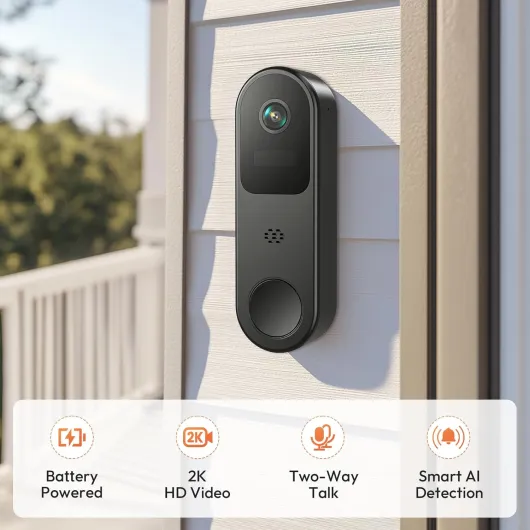
Simple plastic brick, nothing fancy but it blends in
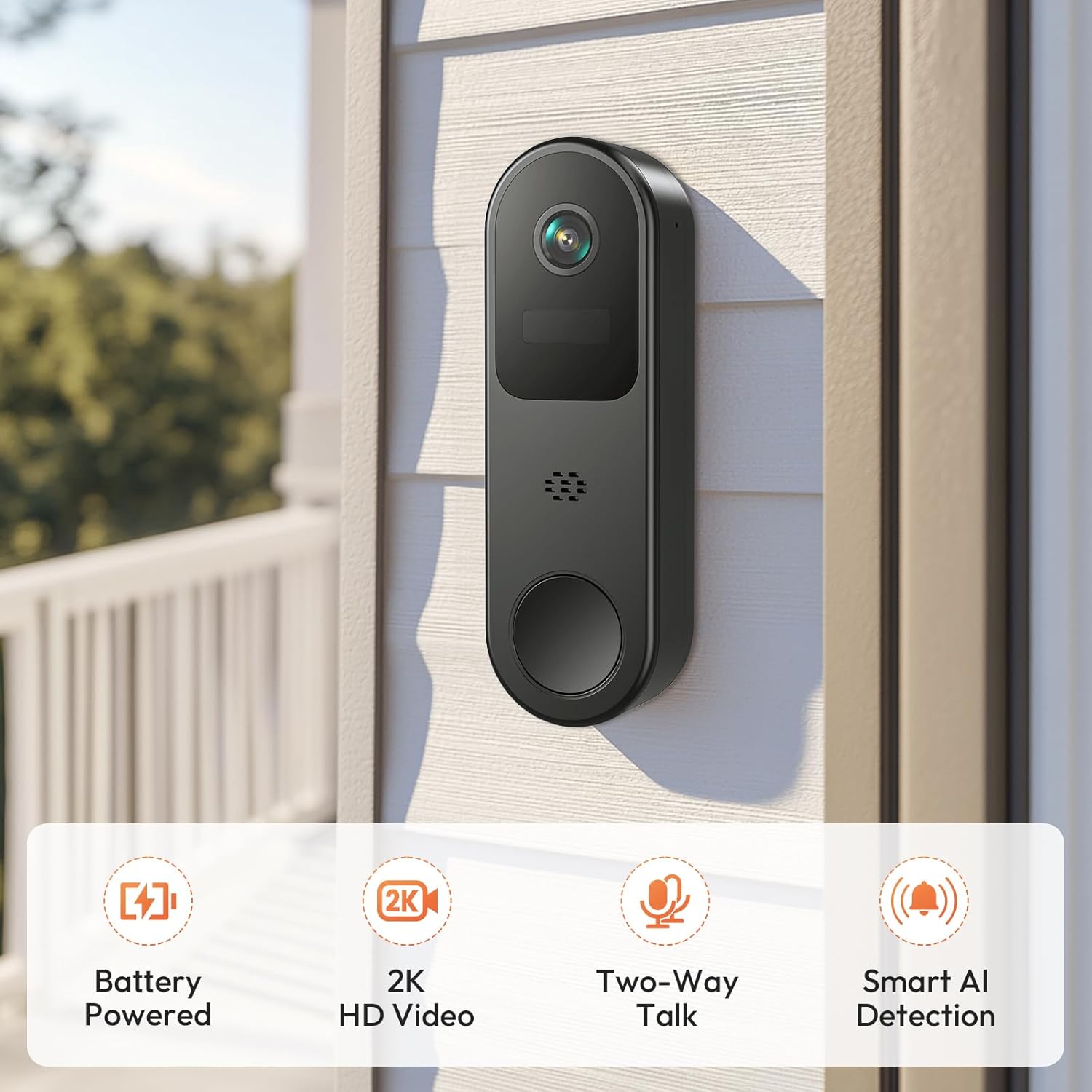
Design-wise, this is a straightforward black plastic doorbell. No metal, no premium feel, but it doesn’t look cheap from a distance either. It’s a tall, narrow rectangle (about 14.8 x 4.6 x 3 cm) with the camera up top, a light and sensor area in the middle, and the button at the bottom. The button ring lights up, which is handy at night so visitors actually see where to press. I’ve had a couple of deliveries and they all found it without asking.
The camera’s 155° viewing angle is wide enough to capture most of my porch and part of the street. If you mount it at around chest height next to the door, you see faces clearly and also get a decent view of packages left on the ground. If your doorway is recessed or angled, you’ll probably need to play with the height and angle, and this is where that missing corner bracket is a bit of a pain. I ended up slightly tilting the mount plate to get a better view of the path.
The body is rated IP66 waterproof, and so far, after a few rainy days, it’s holding up fine. No water in the lens, no condensation. The plastic is smooth and easy to wipe down. It doesn’t scream “expensive gadget” on the wall, which I actually like from a security point of view. It just looks like a regular modern doorbell, so it doesn’t attract too much attention.
In short, the design is functional and low‑key. If you want something that looks premium or super stylish, this isn’t it. But if you just want a black, discreet unit that doesn’t clash with most doors and gets on with the job, it does that well enough. My only real design complaints are the lack of angle mounting hardware in the box and the fact the indoor chime looks and feels a bit cheap, even though it works.
Battery life: good at first, but depends a lot on how busy your door is
The doorbell runs on a built‑in 4500 mAh battery, charged via USB‑C. The brand sells it as a long‑lasting battery, and at the start, it does feel that way. In my case, with motion sensitivity set to medium, human detection on, and around 10–15 events a day (deliveries, people walking by, my own comings and goings), I was on track for roughly 1.5–2 months of battery life. That’s pretty decent for a wireless doorbell at this price point, and I didn’t feel like I was charging it all the time.
But looking at the Amazon reviews, you can see a pattern: after several months, some users report the battery degrading and dropping to a few days of life. One person said they went from stable performance to needing a recharge every 5 days after around 6 months, and that recharge also took a long time. I obviously can’t confirm long‑term behavior yet, but it’s something to keep in mind. These lithium batteries do degrade, and cheaper units don’t always have great power management.
One thing is clear: your settings and environment matter a lot. If you live on a busy street with constant motion, or if you set sensitivity too high and keep all notifications on, the battery will drain much faster. The custom detection zones and human detection are there to help exactly with that: fewer false alerts means fewer recordings, which means better battery life. If you treat it like a CCTV camera pointing at a busy road, expect to charge it often.
Charging itself is straightforward: you take the unit off the wall (or bring a power bank to it if your setup allows), plug in the USB‑C cable, and wait a few hours. There’s no removable battery, so you can’t just swap in a spare. Personally, I’d say the battery is okay but not bulletproof: good when new and well‑tuned, but there’s a risk it will weaken over time, and you need to be ready to adjust settings or accept more frequent charges if your doorway is very active.

Build quality, weather resistance, and long-term worries
Physically, the Belleye DB3 feels light because it’s mostly plastic, but it doesn’t feel like it will fall apart in your hand. The housing clips onto the mounting plate firmly and there’s a security screw to stop someone just lifting it off. I’ve had it outside through a few rainy and windy days, and the IP66 rating seems legit so far: no fogging in the lens, no water getting into the button, and the chime inside hasn’t acted up either. For a low-cost unit, that’s reassuring.
Where I’m a bit more cautious is long‑term durability, especially around the battery and the button. On a lot of cheaper doorbells, the rubber around the button starts to wear or the click becomes less responsive after a year or two. I obviously haven’t had it that long yet, but given the materials, I wouldn’t be shocked if it shows some ageing over time. That said, if you’re paying budget money, you can’t really expect a 10‑year lifespan anyway.
On the electronics side, the Wi‑Fi connection has been stable on my 2.4 GHz network. I haven’t had random disconnects or needed to re‑pair it, which is a good sign. Some users are wrestling with the Alexa side, but that feels more like software integration than pure hardware durability. The camera itself boots quickly when you open live view, and it hasn’t frozen or needed a reset yet in my use.
Overall, I’d rate durability as acceptable for the price. It’s not built like a tank, but it doesn’t feel like a disposable toy either. If you want something you install once and forget for years, I’d lean toward a more established brand with better long-term track records. If you’re okay with maybe replacing it in a few years or dealing with a weakening battery down the line, this is fine. Just be realistic: it’s a Chinese-made budget unit, not a professional security system.
Video, motion detection and app: how it behaves day to day
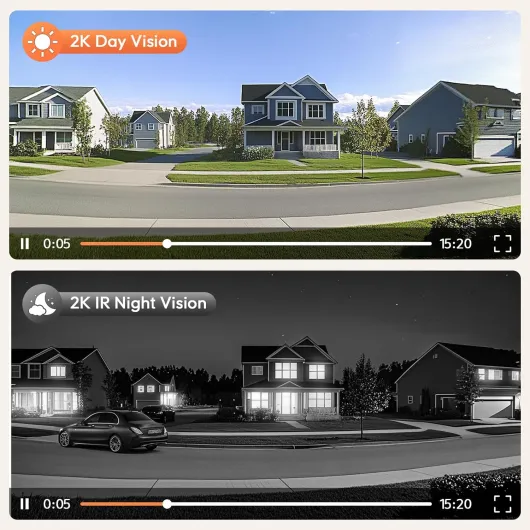
On the performance side, the 2K video is honestly decent. During the day, faces are clear, you can read package labels if you zoom in a bit, and the colors are okay. It’s not cinema quality, but it’s more than enough for security and checking who’s at the door. At night, the IR night vision kicks in and the image switches to black and white. You still see people clearly within a few meters, and movement is easy to spot. Beyond that, the image gets grainier, but that’s normal for this price range.
Motion detection is where the AI human detection and custom zones come into play. I set up a detection zone that covers my path and front step but cuts out most of the street. After that, false alerts dropped a lot. Before tweaking it, every passing car was pinging my phone. The AI is pretty good at spotting humans vs cars and pets, but it’s not perfect. I still get the odd alert for my neighbor’s dog if it gets close enough to the frame, but nothing crazy. Notifications usually hit my phone within a couple of seconds, which is fine for a doorbell.
Two‑way audio is usable but not amazing. I can hear visitors clearly as long as there’s not a lot of wind or road noise. They can hear me well enough to understand what I’m saying, but there’s a small delay and the sound is a bit compressed. For short exchanges like “leave the parcel by the door” or “I’ll be there in a second”, it’s perfectly fine. I wouldn’t use it for a long conversation, but that’s not really the point anyway.
The app (Vicohome) is pretty basic but does the job. Live view loads in a few seconds on my Wi‑Fi, I can scroll through recorded events, adjust motion zones, change sensitivity, and manage notifications. It’s not the smoothest app I’ve used and sometimes you feel a slight lag when loading the timeline, but nothing that makes it unusable. Overall, for a budget doorbell, the performance is solid enough, with the usual small compromises on audio and app polish.
What you actually get in the box and what it really does
Out of the box, you get the doorbell itself, a plug‑in indoor chime, a USB‑C cable, a basic tool kit (screws, wall plugs), and the user guide. No corner bracket, which one Amazon reviewer also complained about, and I agree that’s a bit annoying if your door frame isn’t flat or faces sideways. I had to improvise with a small wedge to angle it correctly. For a camera with a 155° viewing angle, a corner mount would have helped a lot.
The doorbell is fully wireless and battery powered with a 4500 mAh battery. That means no messing with existing doorbell wiring, which I personally like. You just mount it, connect it to your 2.4 GHz Wi‑Fi via the app, pair the chime, and you’re basically done. The chime plugs into a standard socket and you can set different tones and volumes. It’s loud enough for a small to medium house, but if you’re far away or have thick walls, you’ll wish you could use multiple chimes.
Feature-wise, you get 2K (1440p) video, IR night vision up to about 10 meters, AI human detection, custom motion zones, two‑way audio, and optional cloud storage with AES‑128 encryption. There’s no local SD card slot, so it’s cloud or nothing if you want recordings. The cloud subscription is cheaper than some big brands, but it’s still an extra cost you need to factor in. Without it, you’re basically using it as a live viewer with limited event history.
In practice, the main thing this doorbell offers is basic, affordable surveillance at your doorstep: you see who’s ringing, you can talk to them, and you get motion alerts that are mostly focused on people rather than cars or pets. If that’s your use case, it covers the essentials pretty well. If you’re expecting a full security system with deep smart home integration and multiple automation options, you’ll hit the limits fairly quickly.
Pros
- Good 2K video quality with decent night vision for the price
- AI human detection and custom motion zones help reduce false alerts
- Wireless, easy installation with included indoor chime and USB‑C charging
Cons
- Battery life depends heavily on usage and may degrade after several months
- Alexa integration and smart home behavior are more limited than marketing suggests
- No corner mount bracket included, and no local storage (cloud subscription needed for recordings)
Conclusion
Editor's rating
After living with the Belleye DB3 for a bit, my take is simple: it’s a decent budget video doorbell that covers the basics well, with a few rough edges you need to accept. The 2K video is clear enough, night vision works, motion detection with AI and custom zones helps cut down on useless alerts, and the included indoor chime is handy. Setup is straightforward if you’re a bit familiar with Wi‑Fi gadgets, and the app, while basic, does what you need.
Where it falls short is mostly on the long‑term and ecosystem side. Battery life can be good at first but may drop off after months of heavy use, especially if your doorway is busy. There’s no local storage, so you’re pushed toward cloud subscription if you want real recording history. Alexa compatibility exists, but it’s not as smooth or flexible as some buyers expect, and the lack of a corner bracket out of the box is a small but real annoyance for many door frames.
If you want a cheap, wireless doorbell camera that lets you see and talk to visitors and you’re okay with a few compromises, this is good value for money. It suits renters, small homes, or anyone who doesn’t want to invest in a full Ring or Nest ecosystem. If you’re looking for rock‑solid long‑term reliability, deeper smart home integration, and polished software, you’re better off paying more for a bigger brand.