
Summary
Editor's rating
Good if you’re already in the Blink ecosystem, less so if you’re starting from zero
Simple design that blends in, nothing fancy but practical
Battery life: solid on paper, decent in real use
Weather resistance is good, but software reliability is the bigger question
Video and audio: strong in daylight, mixed at night and under load
What you actually get and what they don’t tell you loudly enough
Pros
- Sharp 2K video with useful head-to-toe field of view
- Integrates well with existing Blink systems and Sync Module 2
- Good battery life on three AA lithium batteries and solid weather resistance
Cons
- Sync Module required and not included, raising real cost for new users
- Experience degrades after free cloud trial, with weaker notifications and local storage quirks
- Night vision is only average and worse than Blink’s own outdoor cameras

Specifications
View full product page →| Brand | Blink |
Nice upgrade on paper, but read the small print
I’ve been using Blink gear for a while (indoor cams and an older doorbell), so when this Blink Battery Doorbell 2K+ came out, I was curious. On paper it ticks a lot of boxes: 2K video, head-to-toe view, long battery life, weatherproof, and easy to install. In reality, it’s a mixed bag: the hardware is pretty solid, the software and subscription side is where things get a bit annoying.
I set it up as an add-on to an existing Blink system with a Sync Module 2 already in place. If you don’t already own a Sync Module, that’s the first thing to know: this package does not include it, and the doorbell is basically half a product without it. The listing does say it, but it’s very easy to skim past, especially if you’re used to other brands that include everything you need in one box.
Once it was on the wall, the first impression was quite positive: the video is sharp, the vertical field of view is wide enough to see packages on the floor, and the two-way audio sounds clearer than the older Blink doorbell. The device also handled bad weather without any drama, which matches the IP65 rating. So from a pure doorbell and camera standpoint, it does the job.
Where I started to get frustrated was with the Blink cloud trial, local storage through the Sync Module 2, and the way features seem to quietly downgrade once the free trial ends. If you expect to buy this, plug in a USB stick, and get full notifications and previews without ever paying a subscription, you’ll probably be disappointed. It works, but with caveats that you only really notice after a few days of proper use.
Good if you’re already in the Blink ecosystem, less so if you’re starting from zero
Value-wise, this doorbell sits in a weird spot. If you already own a Blink Sync Module 2 and maybe some other Blink cameras, this 2K+ doorbell is a nice, logical upgrade. You get better video than the older Blink doorbell, it integrates cleanly with your existing cameras, and you can reuse your existing local storage setup. In that case, the price of the add-on unit alone feels fairly reasonable, especially compared to some rivals that lock almost everything behind a subscription.
If you’re starting from scratch, it’s a different story. You need the doorbell, the Sync Module 2, and ideally a USB drive, plus you’ll probably be tempted by the cloud subscription after the free trial makes everything feel smooth. Once you add all that up, you’re in the same price range as other big-name doorbells that offer more transparent subscription policies, better night vision, and sometimes included chimes. The fact that some features (like motion notifications with thumbnails) seem to degrade without a sub makes the base price feel a bit misleading.
The Amazon rating of around 3.2/5 matches my impression: the hardware is decent for the money, but the experience is dragged down by support issues and the subscription/local storage mess. A couple of reviewers flat-out returned it after the free trial ended because it stopped working the way they expected. I don’t think it’s completely unusable without a subscription, but it definitely feels like Blink wants you on a monthly plan.
So in practice: if you’re already invested in Blink and just want a better doorbell with 2K video and head-to-toe view, the value is pretty solid. If you’re new to the ecosystem and hate subscriptions or confusing limitations, I’d say the value is only average. There are cleaner, more straightforward options out there where what you get without a subscription is clearer from day one.
Simple design that blends in, nothing fancy but practical
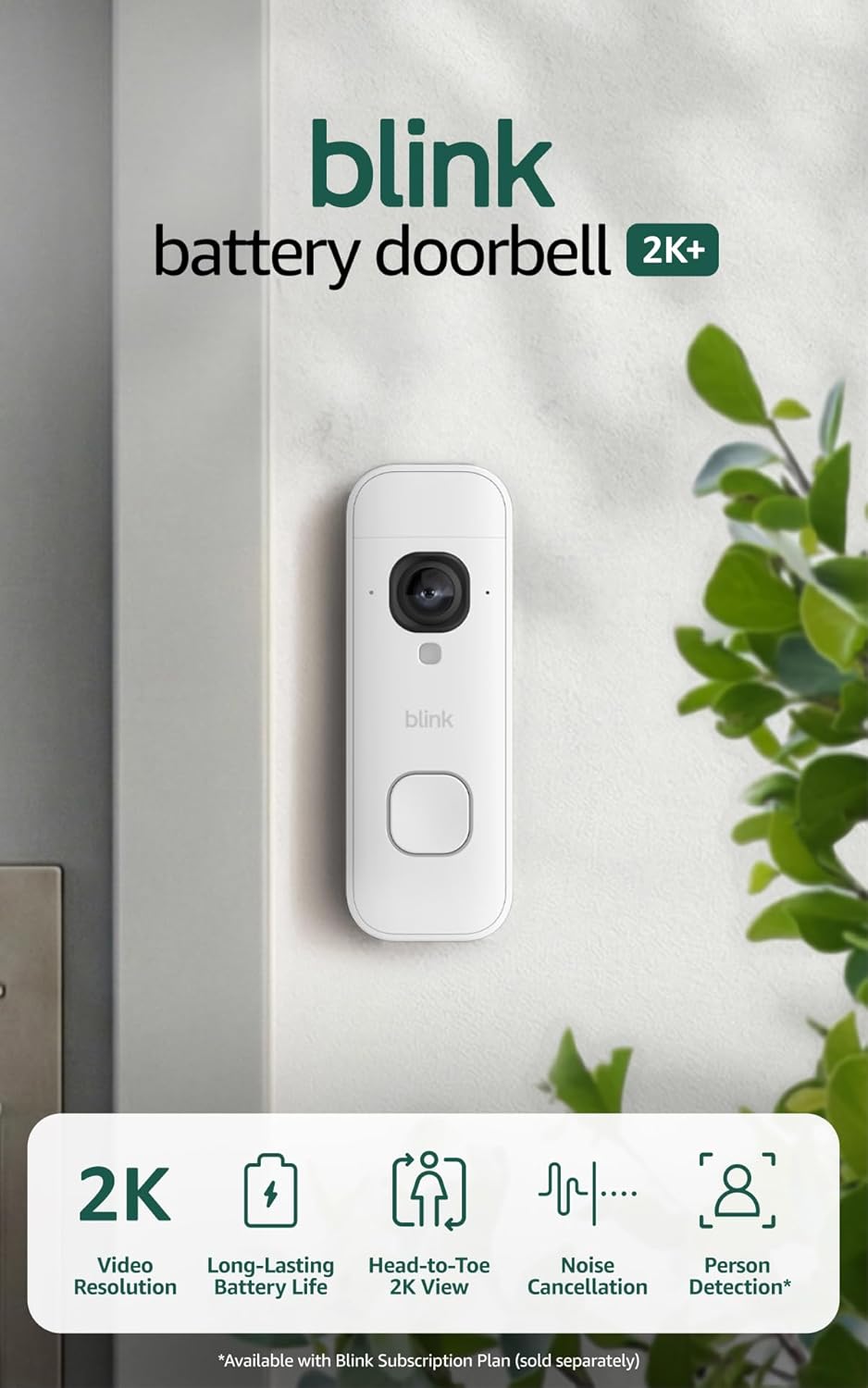
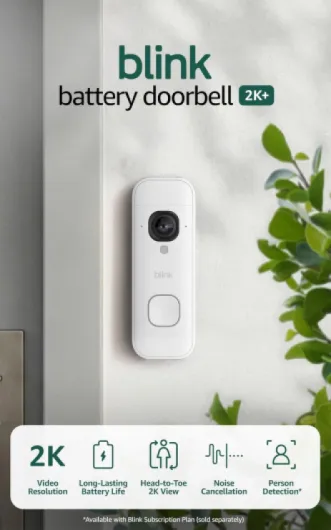
Design-wise, this doorbell is pretty standard Blink: clean, plastic, and very much in the “it disappears on your wall” category. It’s available in black or white; mine is white, which looks fine next to a standard UPVC door frame. Size-wise it’s 130 x 48 x 34 mm and weighs 113 g, so it doesn’t feel bulky or heavy when you’re handling it. Once mounted, it looks like a regular smart doorbell, not a big brick.
The front is dominated by the camera lens and a single button with an LED ring. There’s also a small recording indicator LED. The layout is simple and obvious: visitors know exactly where to press, and the LED feedback is clear enough that they realise the press has registered. No one stood there repeatedly jabbing the button like they do with some touch-sensitive doorbells that give no feedback.
The mounting system is straightforward. The included drill template and wall mounting kit are basic but work. You screw the plate into the wall, clip the doorbell onto it, and that’s it. The doorbell removal tool is a small plastic key that you’ll probably lose if you’re not careful, but it does make it harder for someone to just walk up and yank the unit off the wall. It’s not high-end security, but it’s better than nothing.
In terms of overall look and feel, it’s very much “functional plastic gadget.” If you’re expecting metal housing or something that feels premium in the hand, this isn’t it. But for a battery doorbell that’s going to live outside in the rain, I’d rather have something light and easy to replace than a heavy chunk of metal. The design gets the job done, blends in, and doesn’t scream for attention, which for a doorbell is actually what I want.
Battery life: solid on paper, decent in real use
Blink advertises up to 21 months of battery life on the three AA lithium batteries with default settings. As usual, that number is under very light use: few motion events, no constant live view, and fairly mild temperatures. In real life, with a busy front door and a few tweaks to the settings, expect less, but it’s still better than a lot of cheaper doorbells that chew through batteries every couple of months.
In my case, with motion detection on, person detection active, and a couple of live views per day, the projected battery life dropped to something closer to 8–12 months according to the app’s estimates. That’s still pretty good. After a few weeks of use, the battery percentage barely moved, so I’m not worried about it dying every few weeks. The lithium cells also handle the cold better than standard alkaline batteries, which matters if you live somewhere that hits freezing in winter.
Swapping batteries is simple: you pop the doorbell off the mount with the little tool, open the back, and change the three AA cells. No weird proprietary pack, just standard lithium AAs. On the downside, they’re not rechargeable, and Blink specifically says to use lithium, not rechargeables. So over time, you’ll be buying replacement batteries rather than just charging a pack. It’s not the end of the world, but it’s an ongoing cost to keep in mind.
If you’re coming from a wired doorbell cam that never needs charging, this is obviously more maintenance. But compared to other battery-powered options, the Blink 2K+ sits on the better side of the battery-life range. As long as you don’t crank all the settings to max sensitivity and spend all day in live view, it should get you through many months without much fuss. Just don’t expect the full 21 months unless your front door is basically a quiet back alley.

Weather resistance is good, but software reliability is the bigger question
Physically, the doorbell holds up well. It’s rated IP65, which means it’s protected from dust and from low-pressure water jets, so regular rain is not a problem. I had it mounted in a fairly exposed spot with no porch roof. It went through heavy rain and some windy days without any leaks, fogging, or random shutdowns. The plastic body didn’t fade or warp in the short term, and the button still feels firm and clicky after repeated presses.
The operating temperature range is listed as -20°C to 45°C. I didn’t hit the extremes, but it handled a cold snap and a warm sunny day without acting weird. No random reboots, no frozen video. Blink has been doing outdoor cameras for a while now, and you can feel that the basic hardware side is mature. If you install it properly with the included mount and don’t kick it, it should physically last.
The weaker part of “durability” here is actually the software and how the device behaves once you step outside the ideal use case. Several users report that after cancelling the free cloud trial, their doorbell stopped recording properly, or stopped sending push notifications for motion, or had issues with Sync Module 2 USB storage. I saw a milder version of this: things were smooth during the trial, and then after switching fully to local storage, notifications felt less reliable and the overall experience was less polished.
So while the hardware seems durable, the long-term reliability of the experience depends heavily on Blink’s software updates and how they choose to treat non-subscribers. That’s the part that worries me more than the plastic shell or the IP rating. If Blink keeps changing how local storage and notifications work, you might end up with a device that physically works fine but feels half-crippled unless you pay for the subscription. From a pure “will it survive outside?” angle, I’d give it a good score. From a “will it behave consistently over a couple of years without forcing you into a subscription?” angle, I’m less confident.
Video and audio: strong in daylight, mixed at night and under load
On the performance side, the big upgrade over the older Blink doorbell is the 2K resolution and the head-to-toe 1:1 aspect ratio. In daylight, the image is genuinely sharp: you can see faces clearly, read logos on jackets, and generally make out small details without having to zoom in too much. The colours are decent and don’t look washed out like some cheaper 1080p cameras. Compared to my older Blink doorbell, this one reacts faster and the image looks noticeably clearer.
The wide vertical field of view is genuinely useful. I can see a person’s face and the package on the ground in the same frame, which didn’t always happen with my previous doorbell that was more horizontal. For basic security and just checking if parcels arrived, it works well. Motion detection with person detection turned on cuts down on random alerts from cars or trees, as long as you don’t position it facing a busy street directly.
At night, it’s a bit less impressive. The colour night mode holds on for a while if there’s some ambient light from a street lamp or porch light, but once it flips to black and white IR, it’s only okay. Faces are still visible, but the clarity drops compared to Blink’s dedicated outdoor cameras. If you want serious night monitoring for a car or a driveway, I’d pair this with a separate Blink outdoor cam and maybe an IR floodlight. For just seeing who’s at the door at night, it’s fine but not great.
Two-way audio is better than older Blink generations. I could hear visitors clearly and they could hear me without me needing to shout, and the noise cancellation keeps most background hum down. There is still a small delay, like every Wi‑Fi doorbell, but it’s acceptable. The bigger headache is that when the system is writing to local storage and your Wi‑Fi is a bit weak, there can be a small lag before the live view loads. It’s not unusable, but it’s not instant either, especially compared to wired solutions. In short: daytime performance is strong, nighttime is okay, and audio is decent for normal use.
What you actually get and what they don’t tell you loudly enough
Out of the box, you get the Blink Battery Doorbell 2K+ unit, three AA Energizer lithium batteries, a mounting kit with screws and anchors, a doorbell removal tool, and a drilling template. No chime, no Sync Module, no USB drive. So if you’re starting from scratch, factor in the cost of at least the Sync Module 2, and possibly some sort of chime solution if you don’t want to rely only on your phone and Alexa devices.
The camera shoots in a square-ish 2K resolution (1920 x 1920) with a 1:1 aspect ratio and a 140° x 140° field of view. In practice, that means you see from head to toe and also packages on the floor, which is genuinely useful. The frame rate tops out at 24/25 fps, which is fine for a doorbell; it’s not sports footage, but motion looks smooth enough that you can easily see who’s there and what they’re doing.
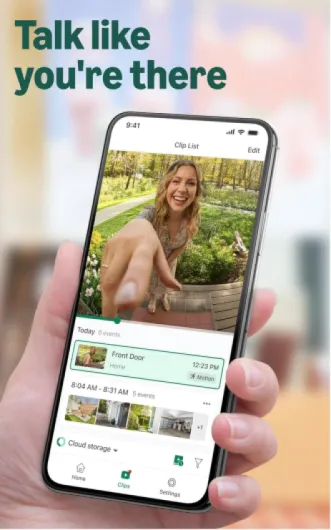
Features-wise, you get person detection, motion alerts, night vision that starts in colour and then flips to black and white when it’s really dark, and two-way audio with noise cancellation. All of this is controlled through the Blink Home Monitor app over 2.4 GHz Wi‑Fi. The app is okay: not pretty, but functional. If you already have other Blink cameras, the new doorbell basically drops in and behaves like the others, which is one of the main reasons to pick it over competitors.
The catch is the whole cloud vs local storage situation. During the free trial, you get the full experience: clip recording, motion notifications with thumbnails, and everything feels smooth. Once you cancel or the trial ends, you can still record to USB via the Sync Module 2, but some stuff drops off. Several users (and I noticed the same) report that motion push notifications without a subscription become unreliable or disappear, and thumbnails are gone. So on paper you “can” use it without a subscription, but in practice it feels like a downgrade that pushes you toward paying monthly. That’s the part I really don’t like about the overall package.
Pros
- Sharp 2K video with useful head-to-toe field of view
- Integrates well with existing Blink systems and Sync Module 2
- Good battery life on three AA lithium batteries and solid weather resistance
Cons
- Sync Module required and not included, raising real cost for new users
- Experience degrades after free cloud trial, with weaker notifications and local storage quirks
- Night vision is only average and worse than Blink’s own outdoor cameras
Conclusion
Editor's rating
Overall, the Blink Battery Doorbell 2K+ is a decent upgrade over the older Blink doorbell and fits nicely if you’re already using Blink cameras. The 2K video is sharp in daylight, the head-to-toe view is genuinely practical, and the two-way audio is clear enough for normal doorstep chats. Battery life with the three AA lithium cells looks solid, and the IP65 rating plus the operating temperature range suggest it will physically survive outside without drama.
The problems are mostly on the software and ecosystem side. The fact that this package doesn’t include a Sync Module makes it a bit of a trap for new users, and the way the experience changes once the free cloud trial ends is frustrating. Reports of missing push notifications, limited USB recording behaviour, and the need to constantly fiddle with settings after cancelling the trial make it feel like the product is quietly pushing you into a subscription. Add in the average night vision compared to Blink’s own outdoor cams, and it’s not a perfect solution.
If you already own a Sync Module 2 and other Blink gear, and you mainly want a sharper, wider-view doorbell cam that matches your existing system, this is a reasonable buy. If you’re starting from zero, hate subscriptions, or want rock-solid local-only functionality, I’d think carefully and maybe look at alternatives. It gets the job done, but it comes with strings attached that aren’t obvious in the headline specs.