
Summary
Editor's rating
Value for money: where it shines and where it cuts corners
Design and build: plastic but not flimsy
Battery life and charging in real use
Durability and weather resistance so far
Performance: video quality, motion alerts and app experience
What you actually get and what it really does
Pros
- 2K video quality with clear image day and night
- Local SD card recording plus a basic free cloud option (no forced subscription)
- Easy installation with both adhesive and screw mounting, battery powered (no wiring)
Cons
- App is clunky and live view can take a few seconds to connect
- Battery needs recharging roughly every 3–4 weeks with regular use
- Viewing angle and mounting options are limited, no built-in tilt adjustment

Specifications
View full product page →| Brand | KAMEP |
A cheap way to see who’s at the door without a subscription
I’ve been using this KAMEP wireless video doorbell (model Bell J4SN) for a couple of weeks on my front door, mainly to keep an eye on deliveries and to avoid missing couriers. Before this, I used a basic wired chime and occasionally a Ring doorbell at a family member’s house, so I had a rough idea of what to expect from a "smart" doorbell. I picked this one because of the 2K resolution, battery power, and especially the promise of SD card storage and a free cloud option, so no forced subscription.
In daily use, it does what you buy it for: you get motion alerts, you can see who’s at the door, and you can talk to them from your phone. It’s not perfect, there’s a slight delay and the app feels a bit basic compared to Ring, but for the price it’s pretty solid. If you’re not obsessed with having the fanciest app and you just want a simple camera on the door, it gets the job done.
What stood out to me after a few days was how straightforward the install was and the fact I didn’t have to touch any wiring. Stick or screw the plate on, pair it with Wi‑Fi via the CloudEdge app, and you’re basically done. The indoor chime is also plug-and-play, which is handy for family members who don’t use the app. No technical knowledge required, just a bit of patience with the app pairing.
Overall first impression: decent product for the money, clearly not as polished as the big brands, but you’re also not locked into subscription fees. If you want a budget-friendly way to cover a door or gate and you’re okay with a slightly clunky app and some lag when connecting live, it’s worth considering. If you expect instant connection and super slick software, you might be annoyed by a few things.
Value for money: where it shines and where it cuts corners
Price-wise, this KAMEP doorbell sits in the budget to lower mid-range segment, clearly cheaper than a Ring or Nest setup once you factor in subscriptions. That’s really its main selling point: no mandatory subscription, plus the option to record to a microSD card. If you add a 64 or 128 GB card, you can store a decent amount of motion clips without paying anything extra per month. The free cloud option (6-second clips, 7-day loop) is short, but it’s still a nice bonus if you just want quick evidence of who came by.
What you sacrifice for the lower price is mostly on the software and polish side. The app is less intuitive, the live view can be slow to connect, and the interface is a bit rough compared to the big brands. The camera lens isn’t as wide as some competitors either, so you don’t get as much coverage, especially vertically. Also, you don’t get fancy features like advanced person detection, package detection, or super seamless smart home integration beyond basic Alexa support.
That said, for someone who just wants to see who is at the door, talk to them, and have recordings stored locally, it offers good value for money. The video quality is solid, night vision is usable, and installation is easy enough that you don’t have to pay an electrician. If you’ve had issues with Ring or similar devices dropping Wi‑Fi or missing motion events, this one might actually behave more consistently in some setups, based on the reviews and my own tests.
If you’re very picky about app experience, instant notifications, and integration with a whole smart home ecosystem, you’ll probably be happier spending more on a higher-end brand. But if you’re budget-conscious and hate subscriptions, this hits a nice middle ground: some compromises, but also some real savings over time. In my view, the value is pretty solid for a secondary door or a back door, and still acceptable for a main door if you’re okay living with the quirks.
Design and build: plastic but not flimsy
The doorbell itself is a rectangular grey unit, fairly slim and not too tall, so it doesn’t look ridiculous on the door frame. It’s very obviously made of plastic, but it doesn’t feel overly cheap in the hand. The front has the camera at the top, then the PIR sensor and the button. The button is clear enough for visitors to understand where to press, which sounds basic but some smart doorbells mess that up with weird designs.
It’s rated IP66 waterproof, and so far it’s handled a few days of rain and some wind without any issues. I didn’t see any condensation inside the lens or any sign of water creeping in. I wouldn’t bash it with anything, but for normal outdoor use it looks fine. The plastic casing doesn’t flex or creak when you press it, and the back plate clips in securely. There’s also a small security screw at the bottom so someone can’t just slide it off easily, which is reassuring if your door is close to the street.
The viewing angle is 166°, which in practice gives you a decent field of view horizontally, but it’s not ultra-wide like some of the expensive models. You see the person at the door clearly, but you don’t necessarily see the floor right under the camera. If you often get parcels left right at the doorstep, you might wish it had a second downward camera or a wider vertical angle. One of the Amazon reviewers mentioned that, and I agree: it would be handy to see packages better.
On the downside, the design is pretty basic: no adjustable tilt in the camera itself. You mount the plate flat and that’s it. If your door is in a weird recess or you need to angle it away from a wall or a hedge, you’ll have to improvise with wedges or buy an angled mount. It’s also only available in grey, so if you care about matching your door hardware, you don’t have many options. Overall, the design is functional, discreet enough, and feels solid enough for the price, but don’t expect fancy materials or clever mounting options out of the box.
Battery life and charging in real use
The manufacturer claims the built-in rechargeable battery can last around 15 days to 1 month, which is a pretty wide range. In my case, with motion alerts on, a couple of live checks per day, and a moderate number of visitors, the battery dropped from 100% to around 55% in just under two weeks. So I’d say in a normal household with regular deliveries and some motion, you’re realistically looking at around 3–4 weeks between charges. If your door is very busy or faces a street with lots of motion triggers, expect less.
Charging is done via the included USB cable. You have to take the doorbell off its mount to plug it in, which is a bit annoying but standard for a lot of battery models. If your door is high or awkward to reach, that’s something to think about. I charged it overnight using a regular phone charger and it went from around 20% to full by morning without any issue. There’s no removable battery pack like on some higher-end models, so you can’t just swap a spare in; when it’s charging, you’re without a camera unless you have a second unit.
The app does show the battery level, and you can get alerts when it’s getting low, which helps avoid surprises. I checked the battery status a few times and it seemed accurate enough, not jumping up and down randomly. One nice point: the device doesn’t seem to drain a lot when idle; most of the consumption clearly comes from motion events and live viewing. If you really want to stretch the battery, you can lower motion sensitivity or limit notifications, but then you also lose some of the usefulness.
Overall, the battery life is acceptable but not mind-blowing. It’s fine if you’re okay with taking it down once a month or so for a charge. If you’re expecting 3–6 months like some marketing claims from other brands, this isn’t at that level. For the price, I’m okay with it, but heavy users or people who travel a lot might find the frequent charging a bit tiresome.
Durability and weather resistance so far
I haven’t had this doorbell for months yet, so I can’t pretend to know how it will age over years, but I can share what I’ve seen so far and compare it to other budget cameras I’ve used. The IP66 rating is reassuring on paper, and in reality it has already gone through several rainy and windy days without any water getting into the lens or the speaker. The image stayed clear, no fogging, and the button still clicks properly even when wet. That’s already better than some cheap no-name cameras I’ve tried in the past that fogged up after the first heavy rain.
The plastic body doesn’t feel fragile. I pressed and twisted it a bit while mounting and didn’t hear any creaks or see any bending. The mount plate locks in fairly tight, and the security screw at the bottom keeps it from being easily lifted off. If someone really wants to steal it, they probably can with tools, but that’s true for most doorbells. For normal use, it feels secure enough. The indoor chime is super light and plasticky, but it just sits in a socket, so that’s fine.
One thing I did notice is that being battery powered, it will obviously be more sensitive to extreme temperatures than a wired model. I haven’t had it in very cold weather yet, but based on other battery cameras I’ve used, I’d expect battery life to drop in winter. The casing itself doesn’t show any signs of UV damage yet, but it’s too early to say how it will look after a full summer of direct sunlight.
My overall impression: for a product made in China at this price point, the durability feels decent. It doesn’t scream "premium", but it doesn’t feel like a disposable gadget either. If you treat it normally and don’t bash it, I don’t see a reason it wouldn’t last a few years. Just be ready for the usual battery wear over time; after a year or two, you can expect the battery to hold a bit less charge, like with any rechargeable device.
Performance: video quality, motion alerts and app experience
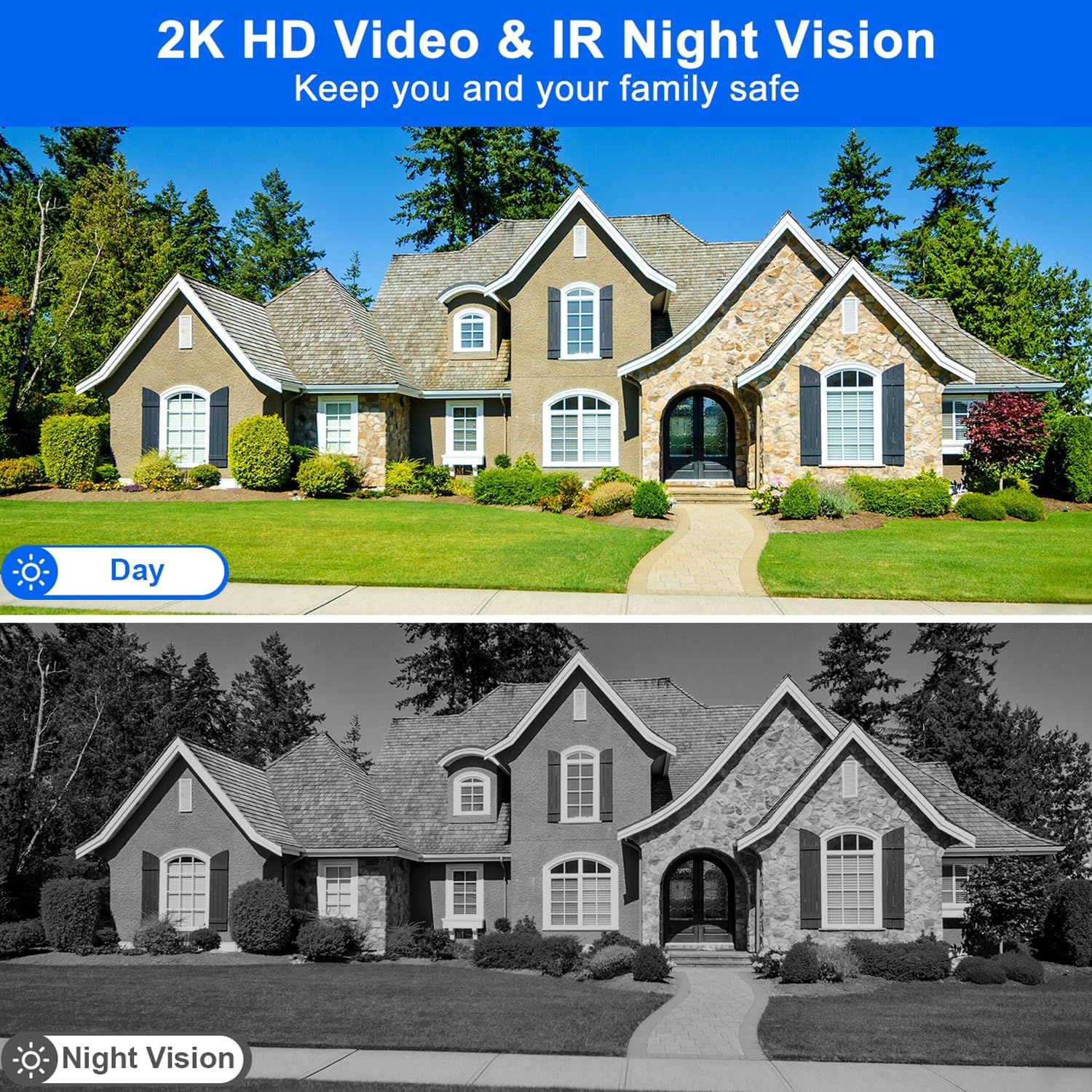
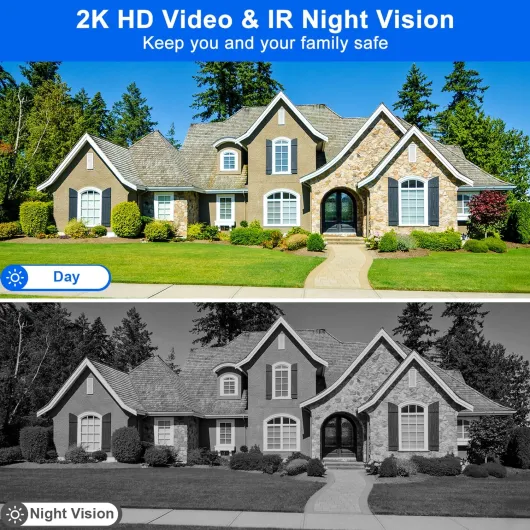
On the performance side, the big point is the 2K video quality. During the day, the image is clear and sharp enough to easily recognise faces and read logos on jackets or vans. It’s not cinema-grade, but for a doorbell it’s more than enough. The 1440p resolution does make a difference compared to older 720p or 1080p budget cameras I’ve used; zooming in on someone’s face or a parcel label is a bit clearer. At night, the IR night vision kicks in and you get a black-and-white image that’s still quite usable up to the advertised 10 meters or so. Faces are still identifiable as long as there’s not a bright light behind them.
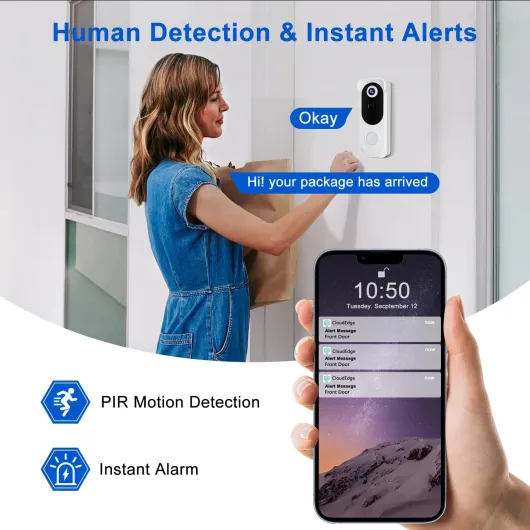
Motion detection is handled by a PIR sensor, and in my tests it picked up people coming up the path reliably. Out of the box, it was a bit too sensitive, triggering on passing cars and even sometimes on strong light changes. After setting a custom detection area in the app and lowering the sensitivity, it calmed down and became more useful. So expect to spend 10–15 minutes tweaking those settings, otherwise your phone will constantly ping. Once tuned, it did a good job of alerting me when someone actually came to the door or when a parcel was dropped.
The weak spot is the connection delay when you open the live view or answer a call. On my 2.4 GHz Wi‑Fi (decent router, good signal at the door), it usually takes 2–4 seconds to connect to live video. Sometimes it’s quicker, sometimes it spins for 5 seconds. That doesn’t sound huge, but when a courier rings and is in a hurry, you can easily miss the short window to talk to them. Compared to a Ring on the same network, this one is clearly a bit slower and less consistent. Notifications do arrive, but the actual live connection is where you feel it’s a budget device.
The app, CloudEdge, is functional but not very polished. The interface is a bit clunky, some settings are buried, and the notification sounds don’t integrate as smoothly with iOS/Android as the big brands. It works, you can see recordings, tweak zones, and check battery, but don’t expect a slick experience. In short: video quality and motion detection are pretty solid for the price, but the app and live-view speed are the main compromises.
What you actually get and what it really does
Out of the box, you get the doorbell camera, a wireless indoor chime, a short charging cable, mounting hardware (screws and anchors), some sticky pads, and a small manual. No SD card included, which is normal at this price, but worth noting. The camera is 2K (1440p), with a 166° wide angle, PIR motion detection, night vision up to about 10 meters, and it runs on a built-in rechargeable battery. It connects only on 2.4 GHz Wi‑Fi, not 5 GHz, so if your router is set to 5 GHz only you’ll have to tweak that.
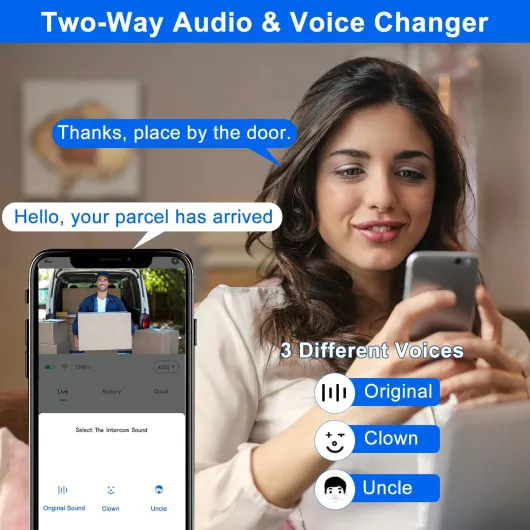
Function-wise, you’ve got three main things: motion alerts, doorbell press alerts, and live view with 2-way audio. There’s also the option to record to a microSD card (up to 128 GB) or use their free basic cloud service, which stores 6-second clips in a 7-day loop. That free cloud is short and limited, but for quick checks it’s fine. If you care about keeping longer history, just put in an SD card and set it to record motion events.
In practice, the motion detection is fairly sensitive, but you can adjust the zones so it doesn’t trigger every time a car passes in the street. This is important, otherwise your phone will buzz all day. The app (CloudEdge) lets you draw areas to ignore, which helps a lot if your door faces a busy road. When the bell is pressed, your phone rings via the app and the chime rings inside the house, so even if no one has their phone on them, you still get a normal doorbell sound.
My honest take: as a package, it’s pretty complete. It doesn’t feel like a toy, but you can tell it’s a budget product in the way the app behaves and the slight delay when connecting to live view. Still, all the core features of a modern doorbell camera are there: decent video, motion alerts, 2-way audio, night vision, and flexible storage. If you’re coming from nothing (just a standard bell), it’s a clear upgrade. If you’re coming from Ring or Nest, you’ll feel the difference in polish, but you may appreciate not paying a monthly fee.
Pros
- 2K video quality with clear image day and night
- Local SD card recording plus a basic free cloud option (no forced subscription)
- Easy installation with both adhesive and screw mounting, battery powered (no wiring)
Cons
- App is clunky and live view can take a few seconds to connect
- Battery needs recharging roughly every 3–4 weeks with regular use
- Viewing angle and mounting options are limited, no built-in tilt adjustment
Conclusion
Editor's rating
After using the KAMEP Bell J4SN video doorbell in real conditions, my conclusion is simple: it’s a practical, budget-friendly option with a few rough edges. The 2K video is clear, the night vision does the job, and motion alerts work once you’ve tuned the zones and sensitivity. The big plus is the storage flexibility: you can run it on a microSD card without paying anything monthly, and there’s even a basic free cloud service for short clips. For people who hate subscriptions, that alone makes it interesting.
On the downside, you feel the lower price in the app and responsiveness. The CloudEdge app is usable but not very polished, and there’s a noticeable delay when connecting to live view or sometimes when answering a call. The viewing angle is decent but not huge, the camera isn’t angle-adjustable out of the box, and the battery will likely need charging every 3–4 weeks in a normal household. None of these are deal-breakers, but they’re things to be aware of.
Who is it for? It suits someone who wants a simple, affordable way to monitor a door, gate, or back entrance, doesn’t want to deal with wiring, and prefers local storage over monthly fees. Who should skip it? People who want a very slick app, instant connections, deep smart-home integration, or who are used to the Ring/Nest ecosystem and don’t want to downgrade on the software side. Overall, I’d rate it as a solid, no-frills choice that gets the core job done without draining your wallet.