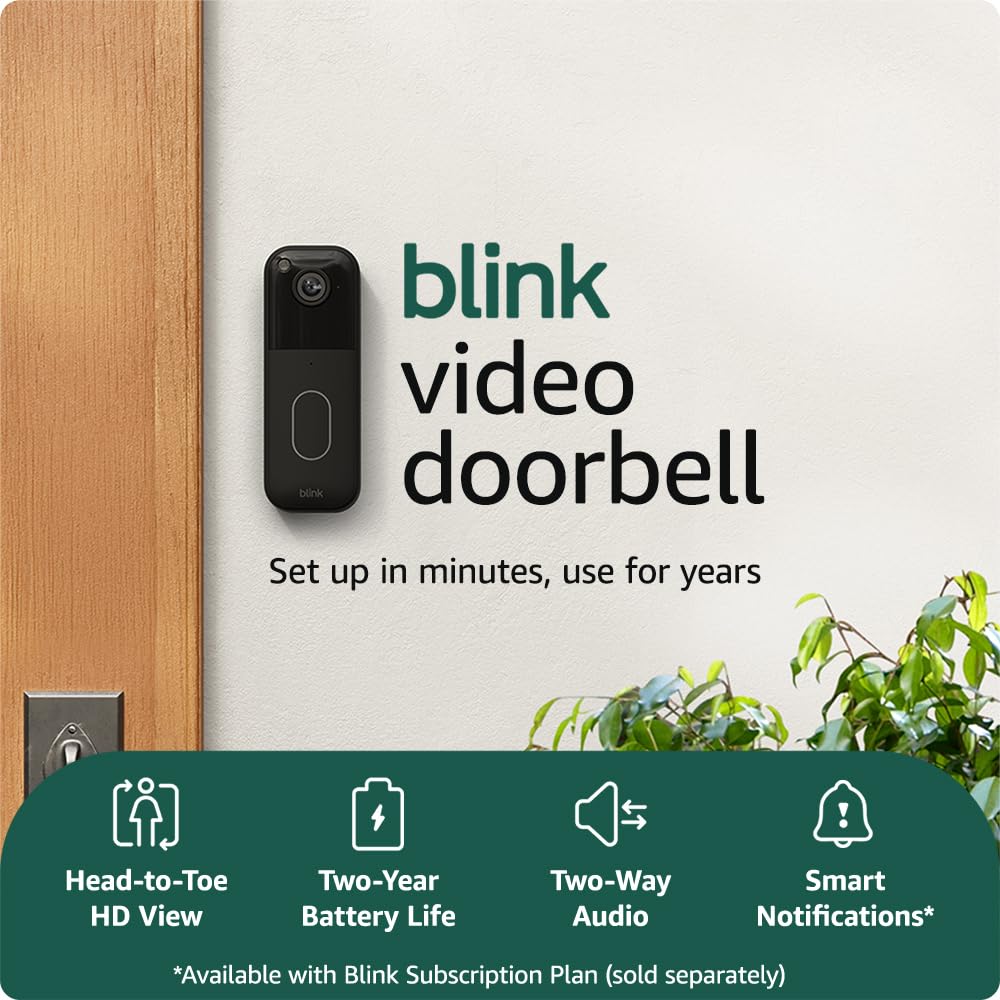

Summary
Editor's rating
Is it good value or should you just go Ring instead?
Design and build: simple, slightly plasticky, but it fits in
Battery life promises vs reality
Weather resistance and long-term reliability
Video, motion detection and Alexa: how it behaves day to day
What you actually get and how it all works together
Pros
- Head-to-toe HD view makes it easy to see both visitors and parcels right at the door
- Simple, mostly wireless setup with batteries and included Sync Module Core
- Good value for money compared to bigger brands like Ring, especially if you already use Alexa
Cons
- Cloud features and long-term storage require a subscription after the free trial
- Plastic build and design feel basic, not premium
- Armed/disarmed system logic is confusing at first and easy to misconfigure

Specifications
View full product page →| Brand | Blink |
A budget-friendly smart doorbell that mostly gets the basics right
I’ve been using this Blink Video Doorbell System (newest gen, black, with Sync Module Core) for a bit now, and I’ll be straight: it’s a good, no-nonsense option if you want to see who’s at your door and talk to them from your phone, without spending Ring-level money. It’s not perfect, and you can tell where they’ve cut some corners, but for the price, it mostly does what you actually need day to day. No fireworks, but it gets the job done.
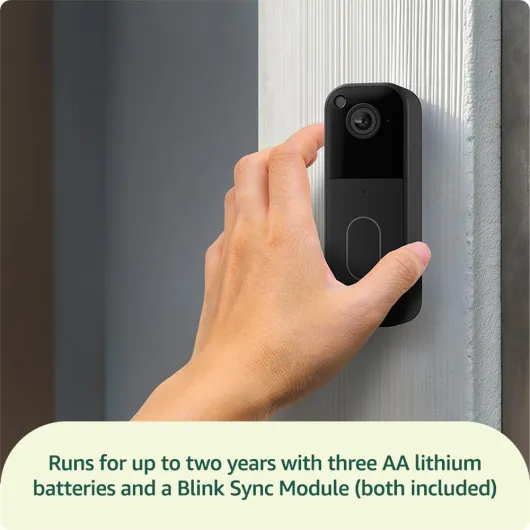
What pushed me to try it was the combo of battery power, Alexa support and the included Sync Module. I didn’t want to mess with wiring or a separate chime, and I already have Echo devices at home. The promise of up to two years on three AA lithium batteries sounded a bit optimistic, but even if it lasts one full year in real life, that’s still decent for a wireless doorbell that does video, motion detection and two-way talk.
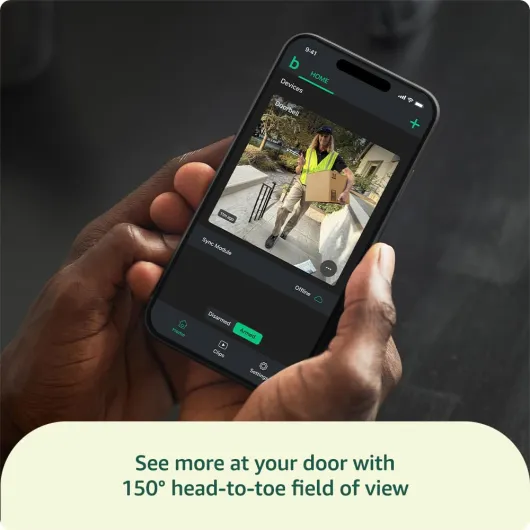
Out of the box, the setup really is quick. The app walks you through pairing the doorbell and the Sync Module, and as long as your Wi-Fi isn’t terrible at the front door, it all comes together in under half an hour, including actually screwing it to the frame. The head-to-toe view is noticeable immediately: you see people from feet to head and you see parcels dumped right under the door, which is something older, more narrow cameras often miss.
So overall, first impression: good value, a bit of a learning curve with Blink’s “systems” and arming logic, and you have to accept that most of the nicer smart features and cloud storage are locked behind a subscription. If you’re okay with that and your Wi-Fi is solid, it’s a pretty solid doorbell for everyday use.
Is it good value or should you just go Ring instead?
In terms of value for money, this Blink kit sits in a nice spot. You get the doorbell plus the Sync Module Core, batteries, mounts, and a free 30-day cloud trial for less than many competing systems charge for the doorbell alone. The video quality is decent, the motion detection is usable once tuned, and the Alexa integration works well enough. For someone who just wants a cheap, wireless video doorbell that works with Echo devices, it’s a strong option.
The catch is the subscription angle. After the free trial, if you want cloud recording, you’re looking at a monthly fee (Blink Basic per device or Blink Plus for multiple devices). The prices are relatively low compared to some competitors, but it’s still another subscription in your life. If you don’t pay, your options are limited with this specific kit, because the Sync Module Core doesn’t give you the local USB storage that the Sync Module 2 does. So from a value perspective, I’d say: hardware is good value, but they’re clearly nudging you towards paying monthly.
Compared to Ring, Blink is usually cheaper up front and the subscription is also a bit cheaper, but Ring often has slightly better polish in the app and ecosystem, plus more accessories. On the flip side, if you already have other Blink cameras, this doorbell fits in nicely with the same app and systems. The armed/disarmed concept is a bit clunky but once set up, it’s fine, and you can run multiple zones on one account without losing your mind.
So, is it worth it? If you want something budget-friendly, wireless, and integrated with Alexa, and you’re okay with at least a basic subscription, yes, it’s good value. If you’re dead set on avoiding any subscriptions and want local recording out of the box, then this exact bundle is less attractive – you’d either need a different Blink kit with Sync Module 2 or a different brand that leans more on local storage. But for most casual users who just want to know who’s at the door and talk to delivery drivers, the price-to-features ratio is pretty solid.
Design and build: simple, slightly plasticky, but it fits in
The design is basic but fine. The black version I tried looks cleaner than the white one in my opinion, especially on darker frames or brick. It’s a slim rectangle, nothing flashy, with a camera at the top and the button below. If you’re expecting some fancy metal finish or premium feel, this isn’t it. It’s light and clearly plastic, but for something that just sits by the door, that’s not a huge issue for me.
The included corner/wedge mount is actually more useful than it looks. A lot of people’s doors are set back or have awkward angles, so being able to tilt it around 25 degrees helps you see visitors and parcels better instead of staring straight into a wall or a hedge. The mounting plate and screws are straightforward, and the drill template is handy if you want to be precise. I fixed it into a uPVC frame with no drama. It sits fairly snugly on the plate; it doesn’t feel like it will just fall off, but it’s also not some heavy-duty anti-theft design. If someone really wants to rip it off, they probably can.
One thing to keep in mind: the camera uses a very wide, fish-eye style lens with a 1:1 aspect ratio (1440 x 1440). So the live view and recordings look like a big square with curved edges. Some people hate that look, but it’s the trade-off for seeing top to bottom and side to side. You can see a lot – your doormat, your parcels, and people’s faces – but it’s not as natural-looking as a regular 16:9 video.
Build-wise, it’s rated IP65, so it can handle rain and dust. I’ve had it through some very wet and windy days and it stayed working. Occasionally you get raindrops on the lens, which is just life with any outdoor camera. The housing doesn’t feel fragile, though again, it’s clearly plastic, not metal. For the price point, I’d say the design is practical more than pretty: it blends in, doesn’t scream “expensive gadget,” and the form factor is compact enough that it fits on narrow frames without looking ridiculous.
Battery life promises vs reality
Blink advertises up to two years of battery life on three AA lithium batteries, which sounds great on paper but obviously depends a lot on how busy your front door is and how you configure the settings. In practice, with standard quality (around 960x960 or 1440x1440 depending on what you choose), 10-second clips, reasonable motion sensitivity, and a few live views per day, I’d expect something closer to 9–18 months instead of a full two years. Still, that’s respectable for a wireless video doorbell.
The doorbell runs on non-rechargeable lithium AAs, which is both good and bad. Good, because they handle cold weather better and hold charge for a long time. Bad, because you can’t just plug it in to recharge like some other brands; you’ll have to buy new lithium cells when they die. Regular alkaline AAs are not recommended and won’t last nearly as long. So there is an ongoing small cost there, even if it’s not massive.
Battery life is also very sensitive to your Wi‑Fi quality and motion settings. If the doorbell struggles to connect, or if you have motion detection firing constantly because you didn’t set zones, the batteries will drain faster. Likewise, if you crank the resolution to the highest, increase clip length, and keep checking live view all the time, you’ll chew through them. The app does give you a basic battery status, but it’s not ultra precise – more like “OK / Needs replacement soon” than a percentage meter.
Personally, I’m fine swapping batteries once a year or so if it means I don’t have to run wires or drill more holes. But if you hate the idea of dealing with batteries at all, you might prefer a wired doorbell or a system with built-in rechargeable packs. For what this Blink is trying to be – a simple, wire-free doorbell – the battery situation is decent, just don’t expect the marketing numbers if your door is busy or you’re playing with live view all the time.
Weather resistance and long-term reliability
On the durability side, the doorbell is IP65 rated, which basically means it’s fine with rain and dust. I’ve had it out in proper nasty weather – heavy rain and wind – and it kept working. Occasionally you get a bit of water spotting on the lens, which slightly blurs the image until it dries or you wipe it, but that’s just how cameras behave outdoors. The plastic body doesn’t feel premium, but it doesn’t feel flimsy either. It’s light, which is actually nice for mounting on weaker surfaces like uPVC frames.
The operating temperature range is quoted as -20° to 45°C (-5°F to 113°F), so in theory it should handle most climates unless you live somewhere really extreme. Lithium batteries also tend to handle cold better than regular ones, so that helps. I haven’t noticed any weird behaviour in colder nights or hot daytime, but I also don’t live in a place that regularly hits the extremes of that range.
For software and security updates, Blink says it will receive updates for at least four years after it’s last sold as new. That’s decent for a budget device. It means you’re not buying something that’s obsolete in a year. Whether they keep adding features or mostly just security patches is another question, but at least you’re not left completely hanging too quickly.
One thing to mention: while the doorbell attaches fairly securely to the mounting plate, it’s not some high-security, anti-tamper fortress. If someone really wants to steal it, they probably can pry it off, just like most consumer doorbells. The good news is that clips are stored in the cloud (if you’re on subscription) so if someone does something stupid and then rips it off, you still have the footage. Overall, I’d rate durability as pretty solid for the price – not bulletproof, but fine for regular home use.
Video, motion detection and Alexa: how it behaves day to day
In daily use, the video quality is solid for the price. The head-to-toe HD view is genuinely useful. You can see packages right up against the door and full body shots of visitors, which older, more narrow doorbells often mess up. During the day, the image is sharp enough to recognise faces and read logos on jackets or vans if they’re not too far away. It’s not security-guard-level detail, but perfectly usable for normal home use. At night, the infrared night vision kicks in. Faces are a bit flatter and grainier, but still identifiable at typical door distance.
The motion detection is where you need to spend a bit of time in the app. Out of the box, if your door faces a busy street or a lot of movement, you’ll get more alerts than you want. The good thing is you can create activity zones by greying out parts of the image you don’t care about, like the road or a tree that waves around in the wind. Once I did that, the false alerts dropped a lot. There are also privacy zones, so if your camera sees a neighbour’s window, you can block that area from both alerts and recording, which is handy for not being that annoying neighbour.
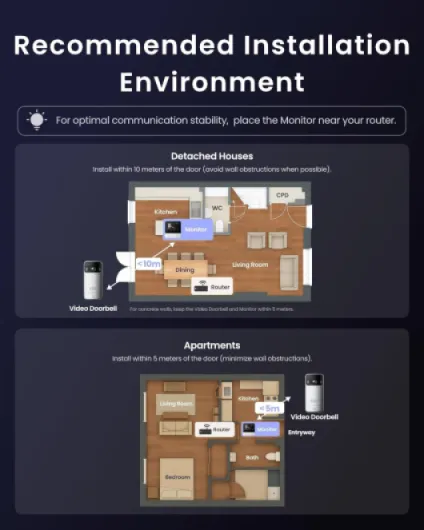
Latency-wise, when someone presses the button, my phone notification usually shows up within a few seconds. Pulling up a live view through the Blink app or Alexa (like “Alexa, show me the front door”) also takes a couple of seconds, because the Sync Module has to wake the doorbell and start the stream. If your Wi-Fi is weak at the door or the Sync Module is too far away, this delay can stretch or the stream can fail. That’s where some of the bad reviews come from, I think. With a decent router and the Sync Module placed reasonably close, it’s usable and consistent.
Integration with Alexa is straightforward. Once linked, you can have your Echo devices announce motion or doorbell presses, and you can show the live feed on an Echo Show. There’s a small delay, but nothing too annoying. One weird thing is Blink’s “armed/disarmed” system – you only get motion notifications when the system is armed, which feels odd for a doorbell. I just leave the doorbell system armed all the time, and that solves it, but it’s something you have to learn early on or you’ll think motion alerts are broken.
What you actually get and how it all works together
In the box, you get one Blink Video Doorbell, one Sync Module Core, three AA lithium batteries, mounting plate, screws and anchors, a corner/wedge mount, USB-C cable and power adapter for the Sync Module, plus a little plastic removal tool. So you’re not forced to buy extra bits just to get it on the wall. That’s nice compared to some brands that nickel-and-dime you for mounts and wedges.
The doorbell itself connects to your 2.4 GHz Wi‑Fi, but the trick is that it mostly sleeps to save battery. The Sync Module sits inside the house, plugged in, and acts as the middleman that wakes the doorbell up when motion is detected or when you open the app or ask Alexa to show the camera. If either your Wi‑Fi at the door is poor or the Sync Module is too far away, you’ll get delays, missed events, or failed live views. So placement matters more than people think.
On the software side, everything goes through the Blink Home Monitor app. That’s where you arm/disarm the system, tweak motion zones, change clip length, resolution, and so on. This is also where things get slightly confusing at first: Blink uses the concept of “systems” or “zones” that share a Sync Module and arming status. For example, you might have a “Doorbell” system that’s always armed, and an “Indoor” system that only arms at night. If you forget to arm the doorbell’s system, you won’t get motion alerts, only button-press alerts. Once you understand that, it’s fine, but it’s not super intuitive out of the box.
Storage-wise, you get a 30-day free Blink Plus trial, so your clips go to the cloud for that period. After that, you either pay monthly, or you look at local storage options (which in this bundle you don’t really get, since that needs a Sync Module 2 and USB drive). So this specific kit is basically geared toward people who are okay with some kind of subscription if they want to keep clips for more than a short time. If your plan is “no subscription ever,” you’ll probably feel a bit limited after the free month ends.
Pros
- Head-to-toe HD view makes it easy to see both visitors and parcels right at the door
- Simple, mostly wireless setup with batteries and included Sync Module Core
- Good value for money compared to bigger brands like Ring, especially if you already use Alexa
Cons
- Cloud features and long-term storage require a subscription after the free trial
- Plastic build and design feel basic, not premium
- Armed/disarmed system logic is confusing at first and easy to misconfigure
Conclusion
Editor's rating
Overall, the newest gen Blink Video Doorbell System is a solid, practical choice if you want a wireless video doorbell that doesn’t cost a fortune and plays nicely with Alexa. The head-to-toe view and decent HD quality mean you actually see what matters – faces and parcels – and the night vision is good enough for typical front-door distances. Setup is quick, the Sync Module Core keeps battery use under control, and once you’ve dialed in motion zones, notifications are pretty sensible.
It’s not perfect. The app’s “armed/disarmed systems” concept is a bit confusing at first, the hardware feels plastic rather than premium, and the whole thing is clearly built around getting you onto a subscription if you want proper cloud storage and extra features like person alerts and extended live view. The claimed two-year battery life is optimistic unless your door is very quiet, but even a year or so between battery changes is acceptable for most people.
I’d say this is ideal for: renters, people who can’t or don’t want to mess with wiring, and anyone already in the Blink/Alexa ecosystem looking for a cheap way to add a doorbell cam. If you hate subscriptions, want local storage out of the box, or care a lot about premium build and the slickest app experience, you might be happier looking at other options or at least a Blink bundle with Sync Module 2. For everyday home use on a budget, though, this Blink doorbell does the job well enough to recommend.