
Summary
Editor's rating
Is it worth the money once you add the extras?
Small, discreet, and mostly practical
Battery life: marketing vs reality
Weather, build, and how safe your footage actually is
Video, motion detection, and app: how it behaves day to day
What you actually get (and what you don’t)
Pros
- Clear 2K video with wide 160° field of view and decent night vision
- AI person detection and core features work without a paid subscription
- Stable app with fast notifications and useful two-way audio
Cons
- Real-world battery life closer to 1–2 months than the advertised 180 days
- Local storage on the device can be stolen unless you use a hub or cloud
- No hub or indoor chime included, extras add to the true overall cost

Specifications
View full product page →| Brand | Tapo |
A cheap way to get a smart doorbell… with a few catches
I’ve been using the Tapo D205 as my main doorbell for a while now, and I’ll be straight: it’s a pretty solid budget option, but it’s not magic. If you expect 6 months of battery and zero add-ons, you’re going to be disappointed. If you just want to see who’s at the door, talk to delivery drivers, and not pay a monthly fee, it does the job quite well for the price.
I came from a more expensive doorbell (Eufy-style setup) that started acting up with charging and slow notifications. The D205 felt like a downgrade on paper, but in daily use it actually reacts faster and the app is more stable. The downside is that some of the stuff that sounds great on the box — like the 180‑day battery and local storage — has some real-world limits you only notice after a couple of weeks.
What pushed me to try this one is the combination of 2K video, no mandatory subscription, and Tapo’s ecosystem. I already had Tapo plugs and a camera, so adding the doorbell into the same app made sense. Setup was quick, and the app is honestly one of the better ones I’ve used for smart home stuff. The notifications are fast, and the “phone call” style ring when someone presses the bell is actually very handy.
If you’re looking at this and thinking “cheap Ring alternative with no monthly fees”, that’s roughly accurate, as long as you accept that you might end up buying the Tapo hub and maybe the solar panel to fix its weak points. On its own, it’s decent and usable; with the add-ons, it starts to feel like a more complete setup. Just don’t expect miracles from the battery or the built-in SD storage.
Is it worth the money once you add the extras?
On price alone, the Tapo D205 sits in a nice spot. It’s cheaper than a lot of the big-name doorbells like Ring or Nest, and you’re not forced into a subscription to unlock basic features. The fact that AI person detection works without a fee is a big plus. For someone who just wants something simple, with 2K video and no monthly bills, it looks like a good deal on paper.
But you have to look at the real cost. Out of the box, you don’t get a hub, you don’t get a chime, and you don’t get an SD card. If you want safer storage (hub + SD card) and less hassle with battery (solar panel), you’re quickly adding another chunk of money on top. Even then, it usually still comes out cheaper than many premium competitors, but the gap is smaller than it first appears. If you already own Tapo gear and maybe a hub, then the value goes up a lot because you’re reusing what you have.
In daily use, the value feels fair. You get good video quality, fast notifications, stable app, and no forced subscription. The weak points — battery life being closer to 1–2 months than 6, and the storage-on-device risk — can both be fixed, but only with extra purchases. So I’d say it’s good value if you go in with eyes open and budget for at least a microSD card or a hub, and maybe a solar panel later.
If you’re on a tight budget and don’t mind recharging every month or two and relying on the SD card in the unit, it still makes sense. You just accept the compromises. If you want a more polished, all-in-one feel with chimes and better hardware, you might want to look higher up the price range. For the average person who wants something pretty solid that gets the job done without a subscription, the D205 hits a decent balance.

Small, discreet, and mostly practical
Design-wise, the Tapo D205 is pretty compact: about 14 cm tall, 4.6 cm wide, and 3 cm deep. It’s a slim black rectangle, nothing flashy, and honestly that’s what I prefer for a doorbell. It doesn’t scream “expensive gadget”, which is good if you don’t want to attract attention. The camera lens is at the top, and the round button with an LED ring is at the bottom. People instantly understand it’s a doorbell, so no confusion there.
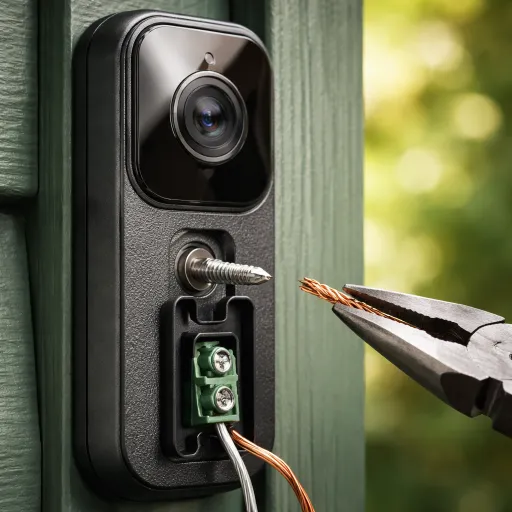
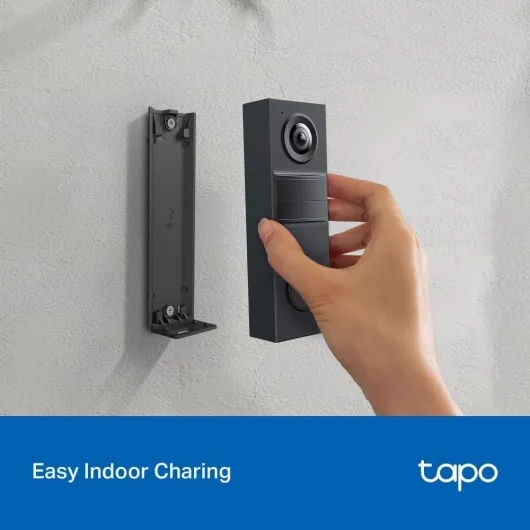
The mounting system is simple: a bracket that you screw into the wall or door frame, then the doorbell clips onto it, and you lock it with a tiny security screw underneath. I like the idea of the security screw, because it makes it harder to just yank the unit off. In practice, that screw is tiny and easy to drop. One Amazon reviewer said to put a towel under it while installing, and I agree — I nearly lost it in gravel the first time. It would be nice if they included a spare screw or two.
Once installed, it sits fairly close to the wall and doesn’t look silly. The 160° field of view is wide enough that I can see people from head to toe when they stand on my doorstep, plus a good chunk of the sides. That’s helpful if you get packages left on the ground. The LED ring around the button is clear at night, so visitors can see where to press. The unit is IP54 rated, which means it can handle rain and dust. Mine has been through some pretty wet days and hasn’t shown any signs of moisture issues.
If I compare it to something like a Ring doorbell, it looks a bit more basic and “plastic”, but it’s lighter and blends in better. No fancy materials, no metal trim, just a straightforward plastic shell. It’s fine for what it is. The only design downside for me is that you need to remove the whole unit to charge it, which means dealing with that small screw every time if you don’t use a solar panel. Not a big drama, but a small annoyance you feel after the third or fourth charge cycle.
Battery life: marketing vs reality
The battery story is where you need to manage your expectations. On paper, Tapo says up to 180 days of battery life from the 5,200 mAh battery. In real life, unless you live in the middle of nowhere with no motion and barely any button presses, you’re not seeing 6 months. With a normal amount of activity — a few motion detections per day, the odd live view, some bell presses — you’re more likely looking at 1–2 months, maybe 6 weeks like one Amazon reviewer mentioned.
In my usage, with a moderate amount of traffic, I saw the battery drop from 100% to mid‑80s after about a week. That lines up with others saying around 6 weeks total. That’s not terrible, but it’s nowhere near what the box suggests. You can stretch it a bit by lowering the sensitivity, reducing the recording length, and not constantly checking the live feed, but then you’re trading battery for security and convenience.
Charging itself is easy enough: you unscrew the small security screw, slide the doorbell off the mount, plug it in via cable, and wait a few hours. It goes from low to full in around 3–4 hours, which is fine. The main annoyance is having your doorbell offline during that time, and having to fiddle with that tiny screw again. If you’re forgetful or busy, you’ll probably let it run too low and then rush to charge it when someone misses you at the door.
Honestly, if you plan to keep this long term and your door gets a decent amount of traffic, I’d consider the Tapo solar panel almost part of the real cost. With the solar panel plugged in, the battery drain slows right down during sunny days, and you don’t have to keep taking it down. Winter performance will obviously be weaker, but even then it should reduce how often you charge. So my view is simple: battery life is okay but oversold in the marketing. It’s usable, but not “set and forget” unless you help it with a panel or very light usage.
Weather, build, and how safe your footage actually is
In terms of durability, the D205 feels like decent mid-range plastic. It doesn’t feel premium, but it also doesn’t feel like it will fall apart at the first knock. It’s rated IP54, which means it’s protected against dust and splashes/spray. Mine has handled rain, wind, and temperature changes without any weird behaviour like fogging or water inside the lens. The button still clicks properly, and the LED ring works fine after bad weather.
The mounting bracket holds the unit firmly. You can’t just pull it off without undoing the security screw. That said, if someone really wants it, a bit of force and a tool will probably get it off the wall. It’s a plastic smart doorbell, not a safe. This ties into a key point: if you use only the microSD card inside the doorbell for storage, a thief could just take the doorbell and your recordings with it. One Amazon reviewer called this out, and they’re right. If you care about security footage, this is a real weakness of local-only storage on the device.
The way around that is to either use Tapo Care cloud storage, or buy a Tapo hub and put a microSD card in the hub instead. The hub sits inside your house, so even if someone steals the doorbell, your recordings are safe. This obviously adds cost, but from a durability and security point of view, it’s a smarter setup. I went the hub route because I’m not a huge fan of yet another subscription.
Overall, I’d say the D205 is physically tough enough for normal outdoor use and daily presses, but don’t treat it like a hardened security device. Think of it as a consumer gadget that can live outside. It survives the elements, but your data security really depends on how you set up storage. If you just slap a card in the doorbell and forget it, you’re accepting that risk. With a hub or cloud, the durability story becomes a lot more reassuring.
Video, motion detection, and app: how it behaves day to day
On the performance side, the D205 is better than I expected for the price, but it’s not perfect. The 2K (1440p) video is genuinely clear enough to see faces, number plates close up, and small details like logos on jackets. During the day, the image is sharp and colours are decent. At night, it switches to night mode and you still get a usable picture, though it’s more grainy and you lose some detail like any budget camera. For identifying who’s at the door, it’s more than good enough.
The motion detection and AI person detection are the interesting bits. You can set zones and sensitivity in the app, and you can tell it to focus on people rather than every car or tree movement. In my case, there’s a fair bit of foot traffic. With person detection on and the zone narrowed down, I get a manageable number of alerts. It’s not perfect — sometimes it still triggers on a dog or a shadow — but it’s better than basic motion-only systems. The nice part is that Tapo doesn’t charge you extra for the AI detection on this model, which is rare these days.
Notification speed is actually one of the stronger points. When someone presses the doorbell, my phone rings like a call within a second or two, and I can open the live view and talk. Using Wi‑Fi and decent broadband, I rarely miss people unless my phone is in another room. Two-way audio is clear enough; there’s a bit of delay, but not so much that conversations feel awkward. I’ve told delivery drivers where to leave parcels many times without issues. Sound from the doorbell’s speaker is okay, not super loud, but people can hear you if they’re standing in front of it.
The one weak spot is the frame rate: 15 fps. You notice it if someone moves quickly across the frame — movements look a bit less smooth than on 25/30 fps cameras. For a doorbell, that’s not a big deal, because you mostly care about people standing still or walking slowly to your door, but it’s worth mentioning. Also, if your Wi‑Fi signal at the door is weak, you’ll get some lag and lower quality. So you really want decent coverage outside. Overall, the performance is solid for the price: not fancy, but stable, responsive, and reliable enough for daily use.

What you actually get (and what you don’t)
Out of the box, the Tapo D205 is pretty barebones: you get the doorbell unit itself, the mounting bracket, and the screws. That’s it. No hub, no indoor chime, no SD card. So if you’re expecting a full kit with a plug-in chime like some brands include, this is not that. The box is clear enough, but it’s easy to miss the “no hub in box” detail if you don’t read carefully. You can still use it fine without the hub, but some things are less convenient.
The doorbell connects directly to your Wi‑Fi and then to the Tapo app. For chimes, you’ve got a couple of options: use an Echo Dot or Google Nest speaker as a chime, rely on phone notifications only, or buy a Tapo hub separately. I ended up pairing it with an Echo Dot, and it works, but it’s not as instant or loud as a dedicated chime in my experience. If you live in a bigger place or have people without smartphones at home, the lack of included chime is a bit annoying.
On the feature side, you get 2K (1440p) video, 160° field of view, motion detection, AI person detection, two-way audio, and night vision. All the typical stuff you’d expect from a modern video doorbell is there. Storage-wise, you can either pay for Tapo Care cloud storage or stick a microSD card (up to 512 GB) into the doorbell itself. Or, if you buy a Tapo hub separately, you can save recordings there instead, which is safer.
In practice, the product feels like a good entry point into the Tapo ecosystem rather than a fully loaded kit. It’s aimed at people who don’t want subscriptions and don’t mind a bit of DIY and extra purchases if needed. If you want something “install once and forget”, this isn’t that out of the box. You’ll probably tweak settings, think about storage, and at some point look at the hub or solar panel. But as a starting point, the core is there and it works.
Pros
- Clear 2K video with wide 160° field of view and decent night vision
- AI person detection and core features work without a paid subscription
- Stable app with fast notifications and useful two-way audio
Cons
- Real-world battery life closer to 1–2 months than the advertised 180 days
- Local storage on the device can be stolen unless you use a hub or cloud
- No hub or indoor chime included, extras add to the true overall cost
Conclusion
Editor's rating
The Tapo D205 is a practical, budget-friendly video doorbell that does most of the basics right. The 2K video is clear, the 160° field of view covers a lot, and the app works reliably with quick notifications and handy two-way audio. The fact that AI person detection is included without a subscription is a big plus compared to some rivals. For simple things like talking to delivery drivers, checking who rang when you’re out, and keeping an eye on the doorstep, it works well.
Where it falls short is mostly around battery and storage. The advertised 180 days of battery life is optimistic; with normal use you’re more realistically in the 4–8 week range. And if you only use a microSD card in the doorbell itself, someone could steal the unit and your recordings in one go. Both problems are fixable with a Tapo hub and a solar panel, but that adds to the overall cost. It’s still usually cheaper than the big-name competitors, but not by as much as the bare price suggests.
I’d recommend this to people who already use Tapo devices, or anyone who wants a no-subscription, decent-quality doorbell and is okay with a bit of DIY and the odd recharge. If you want something truly “install and forget”, with long real-world battery life and everything in one box including chime and secure storage, you might want to spend more elsewhere. For the price though, it’s a pretty solid option as long as you understand its limits and maybe plan for a hub or solar panel down the line.