
Summary
Editor's rating
Value for money: cheaper than Ring, but with a few strings attached
Plastic, simple, and a bit easy to overlook in white
Battery life: strong on paper, good in practice if you tune your settings
Build, weather resistance, and long-term use
Video, motion detection, and Alexa: decent, but very Wi‑Fi dependent
What you actually get and how it’s supposed to work
Pros
- Good video quality with wide head-to-toe view and decent night vision
- Strong battery life potential if you tune motion zones and settings properly
- Affordable system with Sync Module included and tight Alexa integration
Cons
- Setup and app logic (armed/disarmed, zones) can be confusing at first
- Performance and audio quality are very dependent on strong, stable Wi‑Fi
- Cloud storage requires a paid subscription after the free trial

Specifications
View full product page →| Brand | Blink |
A budget-friendly smart doorbell that mostly does what it says
I’ve been using the Blink Video Doorbell System (the white one with the Sync Module Core) for a little while now, and I’ll be straight: this is not the slickest or most polished doorbell on the market, but for the price it’s pretty solid. It’s the kind of product where you need to know what you’re getting into: a battery-powered, Wi‑Fi‑dependent doorbell that leans heavily on the Blink ecosystem and, if you want cloud storage, a subscription. If you accept that, it can work well.
Out of the box, you get quite a lot: the doorbell itself, the Sync Module Core, batteries, mounting kit, corner mount, and the usual cables. No need to buy some extra hub straight away, which I liked. I installed it on a uPVC door frame like one of the reviewers and had a similar experience: once it was up and talking to my Wi‑Fi and the Sync Module, it did the job without constant drama.
It’s not perfect, though. Setup is advertised as super easy, but in reality it depends a lot on your patience and your Wi‑Fi. If your router is far from the door or your signal is weak, you’ll probably swear at it at least once. Also, the way Blink uses “armed/disarmed” is a bit confusing if you only have the doorbell and no other cameras. You can easily think it’s all working fine while it’s actually not sending motion alerts because the system is disarmed.
Overall, I’d describe it as a good value, slightly nerdy doorbell: if you’re okay tweaking zones, schedules, and putting the Sync Module in the right place, it delivers decent video, long battery life, and tight Alexa integration. If you want true plug‑and‑play with zero thinking, you might get frustrated.
Value for money: cheaper than Ring, but with a few strings attached
When you look at what you pay versus what you get, the Blink Video Doorbell System sits in a good value spot, especially compared to Ring and Google Nest. You’re getting a doorbell, a Sync Module Core, batteries, mounts, and a working app ecosystem for less than many competitors charge for just the doorbell. For someone who wants basic smart doorbell features without spending a fortune, it makes sense.
However, there are some cost angles that are easy to miss. First, cloud storage: after the free 30‑day Blink Plus trial, you need a subscription if you want to keep clips in the cloud. Prices are roughly in the low single digits per month for one device and higher for multiple devices (Blink Basic vs Blink Plus). Not crazy, but it adds up over a couple of years. If you refuse to pay a subscription, you’ll either have to live with no cloud storage or buy a separate Sync Module 2 and add a USB drive to store clips locally, which is extra money and extra faff.
Then you’ve got battery costs. The three AA lithium batteries aren’t ruinous, but they’re not free, and you’ll be replacing them from time to time. The two‑year claim is optimistic, so I’d mentally budget for new batteries at least once a year in normal use. Still, that’s cheaper than doorbells that need wired power or proprietary battery packs.
Where the value really shows is if you plan to stay in the Blink ecosystem. If you already have or plan to add Blink indoor or outdoor cameras, the subscription for multiple devices and the shared app, schedules, and zones make more sense. If this is your only camera and you hate subscriptions, the value drops a bit. Overall, I’d rate value as pretty strong for most people, with the caveat that you should go in knowing about the subscription and battery angle so you’re not annoyed later.
Plastic, simple, and a bit easy to overlook in white
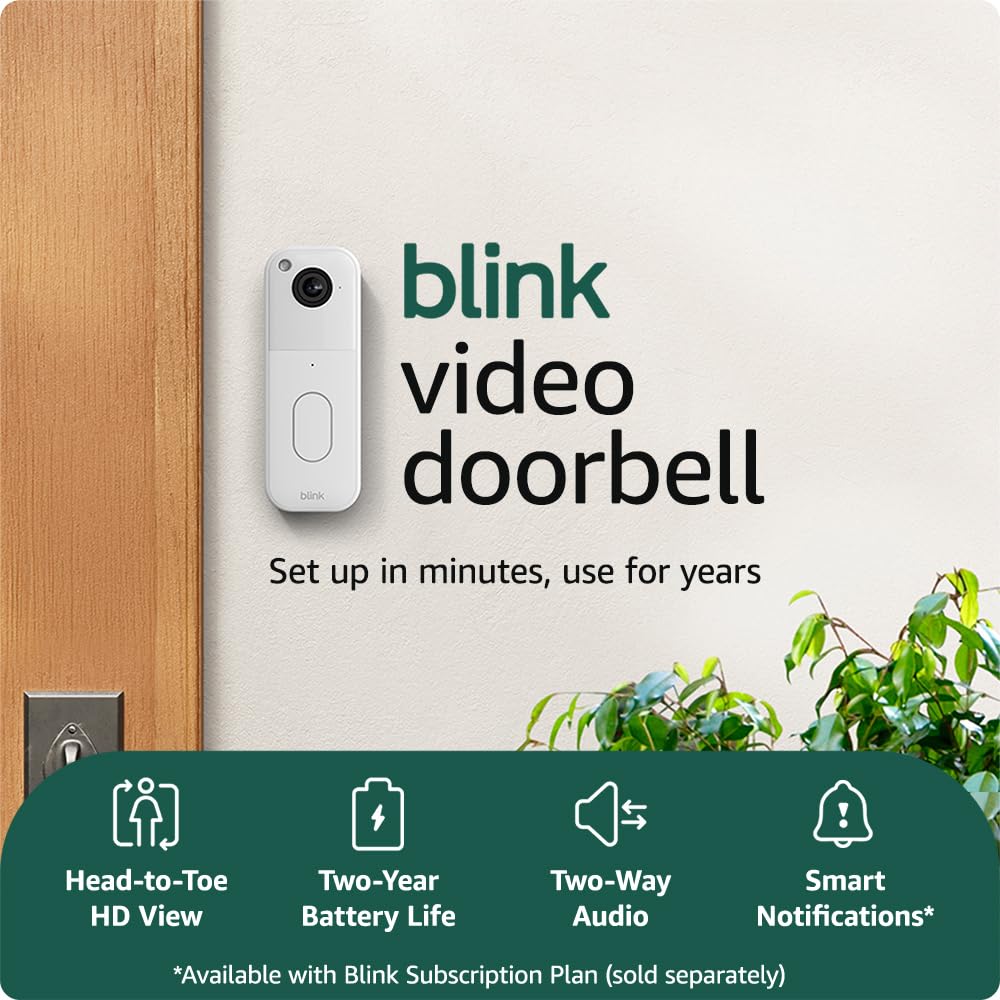
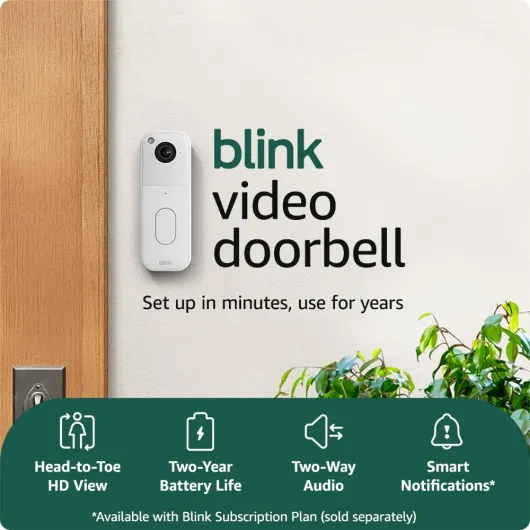
Design-wise, the Blink doorbell is pretty straightforward. It’s a slim white rectangle with a big round button and a camera at the top. It doesn’t scream “high-end tech”; it just looks like a generic smart doorbell. Personally, I don’t mind that, but if you’re hoping for something that looks premium on your front door, this isn’t it. The plastic shell feels light but not flimsy, and once it’s screwed into the frame with the wall plate, it sits fairly solidly and doesn’t wobble.
One thing I noticed, and that lines up with the Amazon review, is that the white version on a white door frame can almost disappear. Guests sometimes ignore it and go for the old door knocker because they don’t really notice the button. If you’ve got a white door and you want people to actually press the thing, I’d honestly consider the black version just for contrast. It’s a small detail but in daily use it matters more than you’d think.
The included corner mount is a nice touch. If your doorbell is right up against a wall or you want a better angle down your path, that mount helps point the camera a bit more towards the action. The lens itself is a clear fisheye style, which gives a wide view but can distort faces a bit. You get a big view of the doorstep and your parcels, which is the main goal, but nobody is going to look flattering in the preview.
The Sync Module Core is a small black box that just sits on a shelf or plugs in near your router. It’s not pretty, but it’s tiny enough that you forget about it after a day. No flashy lights apart from a status LED, and the USB‑C power cable is short but fine if it’s near a socket. Overall, the design is functional and low-key: not ugly, not fancy, just “there”. It gets the job done but doesn’t add any style points to your front door.
Battery life: strong on paper, good in practice if you tune your settings
Blink pushes the “up to two-year battery life” claim pretty hard, and that’s technically possible but only if your setup is quite gentle: low to moderate motion, standard quality, short clip lengths, and a system that’s not constantly waking up. In normal use with a few daily visits and some motion alerts, the battery drain is actually quite reasonable, especially thanks to the Sync Module Core helping the doorbell sleep most of the time.
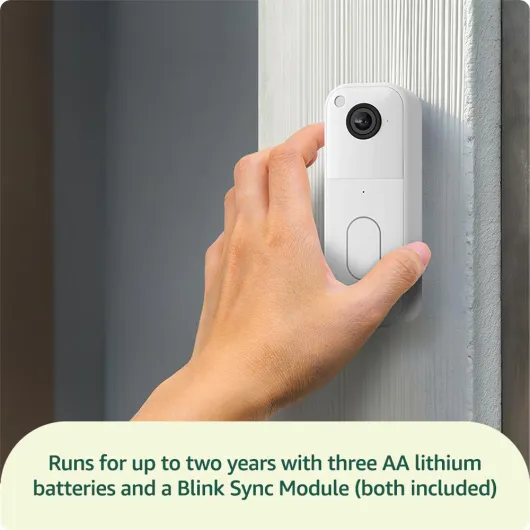
The key thing is that it uses three AA lithium batteries (not standard alkaline, and not rechargeable by default). That means replacements cost a bit more, but they handle cold weather better and hold charge longer. One Amazon reviewer mentioned rechargeable batteries not lasting, and that lines up with what I’d expect: this device is really designed for proper lithium cells, not cheap rechargeables. If you try to save money on batteries, you’ll probably end up changing them more often and getting annoyed.
In practice, how long they last will depend heavily on how you configure things. If you:
- Leave the system armed 24/7
- Use high video quality and long clip times
- Have a busy street in view with lots of motion
- Constantly check live view
then don’t expect anything close to two years. You might be looking at something like 6–12 months, which is still not terrible but very different from the marketing. On the other hand, if you properly set motion zones, keep clip length reasonable (10–15 seconds), and don’t hammer live view all day, the drain is slow enough that you don’t think about it often.
Overall, I’d say battery life is a strong point as long as you respect the limits of a battery doorbell. It’s not infinite, and the two-year figure is optimistic, but compared to some competitors that chew through power in a few months, this one is on the better side. Just budget for proper lithium AA replacements every so often and don’t expect miracles if your front door is basically on a main road.
Build, weather resistance, and long-term use
On durability, the Blink doorbell looks and feels like a typical plastic smart home gadget, but the IP65 rating is reassuring. That means it’s protected against dust and low-pressure water jets, so rain, splashes, and general outdoor grime shouldn’t be a big problem. Mine has been through some wet and windy days, and like one reviewer mentioned, the worst I’ve seen is a few drops of water on the lens, which is normal for any outdoor camera.
The operating temperature range is -20° to 45°C (-5°F to 113°F). So unless you live somewhere truly extreme, it should cope fine with winter and summer. Lithium batteries handle cold better than basic alkaline ones, so that helps keep it going when it’s freezing. The housing doesn’t feel ultra tough like some industrial cameras, but for a front door in a normal residential setting, it’s good enough. It doesn’t flex or creak when you press the button, and once mounted properly, it doesn’t feel like it’ll fall off with a bit of wind.
In terms of long-term support, Blink says the device will receive software security updates for at least four years after it’s last sold as new. That’s decent for this price bracket. It means you’re not buying something that will be abandoned in a year. The two‑year limited warranty is standard, nothing special, but at least it’s not just 12 months. Where things feel weaker is customer support: one reviewer mentioned being cut off from chat after waiting 20 minutes, which doesn’t inspire confidence if you’re unlucky and hit a hardware or account issue.
So, durability overall: physically and weather-wise, it seems solid for typical home use, and the official temperature and IP ratings back that up. The plastic build won’t impress anyone, but it doesn’t feel like it’ll fall apart either. The weak link is more on the service side — if something goes wrong, you might need patience dealing with support. If you’re okay with that risk at this price, it’s acceptable.
Video, motion detection, and Alexa: decent, but very Wi‑Fi dependent
On performance, I’d split it into three parts: video quality, motion/notifications, and Alexa integration. For video, the 1440 x 1440 resolution is perfectly fine. On “standard” quality, clips are clear enough to see faces and read parcel labels if the person is close. It’s not cinema-level, but for a doorbell it’s more than enough. Night vision is okay: grainy as expected, but you can still clearly see who’s at the door and what they’re doing. The fisheye look gives you a big field of view, so you can see people from head to toe and parcels on the ground.
Motion detection is where you need to spend some time with the app. Out of the box, if your door is near a road or a path, you’ll probably get too many alerts. The good news is the activity zones actually work. You get a grid over the image, and you can tap to grey out areas you want to ignore, like the pavement or a tree. After setting zones carefully, I got reliable alerts only when someone actually came up to the door, not every time a car went past. The privacy zones are useful if your camera points towards a neighbour’s window; it simply blocks that region from recording and triggering.
Notifications are generally quick on the phone, but you’re still dealing with a battery device that has to wake up. There’s typically a short delay between someone walking up and you getting the alert or the live view starting. Most of the time it was acceptable, but I can see why one user complained about Alexa taking up to 20 seconds to react. If your Wi‑Fi or Sync Module placement isn’t great, that delay gets worse and the whole thing feels sluggish. So this is very much a tune it or suffer type of product.
Alexa integration is decent. You can say “Alexa, show me the front door” and it’ll bring up the live feed on an Echo Show. Again, not instant, but workable. You can also get Alexa announcements like “There is motion at the front door,” which I found genuinely useful once I was confident I’d cut down false alerts. Where it falls short is the audio and two-way talk quality through Alexa and the app: it works, but there can be echo, interference, and some lag, especially if your connection is not great. It’s fine for quick “leave it by the door, thanks” conversations, but not for long chats.
What you actually get and how it’s supposed to work
The Blink Video Doorbell System here is the full kit: doorbell plus Sync Module Core. That’s important, because the doorbell alone behaves differently. With the Sync Module, the idea is that the module sits indoors on power and uses a low‑power signal to wake the doorbell when needed, so the doorbell can stay asleep most of the time and save battery. Then, when motion is detected or someone presses the button, it wakes up, connects to Wi‑Fi, and streams the video to your phone or Alexa device.
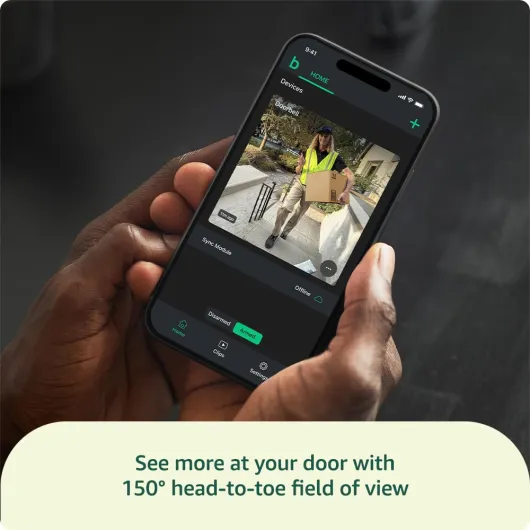
Specs-wise, you’re getting 1440 x 1440p video at 30 FPS with a 1:1 aspect ratio and a 150° field of view. So it’s more of a square, head‑to‑toe view rather than a narrow rectangle. There’s infrared night vision, two‑way audio, and an IP65 rating, so it should handle rain and typical UK/European weather. Power is from three AA lithium batteries (non‑rechargeable), and Blink claims up to two years of battery life with default settings and the Sync Module in play. Realistically, that will drop if you have a busy street, high video quality, and long clip lengths.
The system is built around the Blink Home Monitor app on iOS/Android/Fire OS. You can arm/disarm the system, set motion zones, adjust clip length, sensitivity, and so on. Out of the box you get a 30‑day free trial of the Blink Plus subscription, which stores clips in the cloud. After that, you either pay for a plan or you accept that you won’t have cloud storage unless you upgrade the Sync Module to the version that supports local USB storage (Sync Module 2, not included here).
In daily use, the doorbell is mainly about three things: motion alerts, doorbell press alerts, and on‑demand live view. All three work, but there’s some lag depending on your network, and the whole thing is clearly designed with “good Wi‑Fi and a patient setup” in mind. So on paper it’s a well-thought-out budget system, but in practice you really feel the trade-offs compared to pricier brands like Ring or Google Nest, especially around responsiveness and the app’s slightly clunky logic.
Pros
- Good video quality with wide head-to-toe view and decent night vision
- Strong battery life potential if you tune motion zones and settings properly
- Affordable system with Sync Module included and tight Alexa integration
Cons
- Setup and app logic (armed/disarmed, zones) can be confusing at first
- Performance and audio quality are very dependent on strong, stable Wi‑Fi
- Cloud storage requires a paid subscription after the free trial
Conclusion
Editor's rating
The Blink Video Doorbell System is a solid budget smart doorbell that does most of the basics well, as long as you’re willing to put a bit of time into setup and tweaking. Video quality is good enough to clearly see faces and parcels, night vision is usable, and the wide head‑to‑toe view is practical. The Sync Module Core helps a lot with battery life, and if you take motion zones seriously and don’t go crazy with live view, you can get very decent runtime out of those three AA lithium batteries.
On the downside, this is not completely plug‑and‑play. The app’s “armed/disarmed” logic can be confusing if you only have a doorbell, Wi‑Fi quality at your front door really matters, and delays with Alexa or two-way audio can be annoying. Cloud storage after the free trial requires a subscription, and customer support doesn’t sound great based on some user feedback. So it’s not the most polished experience on the market, but the price reflects that.
I’d recommend this to people who want a cheap but capable smart doorbell, are okay with fiddling a bit in the app, and either already use Blink cameras or don’t mind a small monthly subscription. If you want something ultra-smooth, with near-instant responses and top-tier support, or if your Wi‑Fi at the front door is weak, you’re probably better off looking at higher-end options from Ring or Nest and paying more upfront.