
Summary
Editor's rating
Is it worth the money compared to Ring, Nest and others?
Looks, build quality and how it handles the weather
Battery life: real-world numbers vs the marketing claims
How it holds up over time and in everyday use
Video quality, motion detection and app responsiveness
What you actually get in the box and how it works day to day
Pros
- No monthly subscription needed, with free basic cloud and SD card support
- 2K video and clear night vision that make faces and parcels easy to see
- Simple wireless installation with included chime and decent battery life
Cons
- App and overall polish are basic compared to Ring/Nest
- Only supports 2.4 GHz Wi-Fi and mainly Alexa integration
- Free cloud clips are very short (around 6 seconds), SD card almost mandatory for full coverage

Specifications
View full product page →| Brand | ieGeek |
A cheap Ring alternative that actually holds up
I put this ieGeek wireless doorbell camera on my front door because I didn’t feel like paying a monthly fee to Ring or Nest. I’ve been using it daily for a while now, and overall it does what I wanted: I see who’s at the door, I get motion alerts, and I didn’t have to run any cables or pay a subscription. It’s not perfect, but for the price it’s pretty solid.
What pushed me to try it was the combo of 2K video, battery power and the fact that basic cloud storage is free. I just wanted something simple: see parcels, check who rang while I was out, and shout at delivery drivers when they pretend to knock. In that sense, it gets the job done. The app is fairly clear, pairing worked after a couple of tries, and the chime inside the house saves me from relying only on phone notifications.
It’s definitely more “practical gadget” than fancy smart-home centrepiece. The build feels decent, the image is good enough to see faces and packages, and the PIR detection works once you tweak the sensitivity. You can tell it’s not a premium product when you look closely at the plastic and the app translations, but honestly, that doesn’t really matter once it’s on the wall and doing its thing.
If you’re expecting the polish and tight ecosystem of Ring or Nest, you might find a few rough edges here and there. But if your main goal is cheap, wireless, no subscription and clear enough video, this is a realistic option. That’s basically how I use it: a practical tool, not some fancy toy to show off.
Is it worth the money compared to Ring, Nest and others?
Price-wise, this sits in the budget to mid-range segment, and that’s where it makes the most sense. You get 2K video, battery power, an included chime, free basic cloud storage and SD card support, all without a monthly fee. If you compare it to a Ring or Nest setup where you pay a subscription on top, the cost difference adds up over a year or two. If you’re trying to keep running costs low, that’s the main selling point here.
Of course, you give up some polish. The app is more utilitarian, the design is more basic, and the smart-home integration is mostly Alexa only. If you live inside the Amazon ecosystem, that’s fine. If you’re into Google Home or Apple HomeKit, this isn’t the best match. Also, the free cloud clips are only 6 seconds, which is a bit short if you want full context. An SD card solves that, but it’s an extra purchase you should budget for.
Compared to other cheap brands on Amazon, this one feels more consistent. The image is clearly better than the rock-bottom 1080p models, and the motion detection options (zones, humanoid detection) are a step up from the very basic stuff. It’s still not at the level of the big names in terms of UI and ecosystem, but you’re paying quite a bit less and not signing up for any monthly plan. For a lot of people, that trade-off is totally fine.
If you want the smoothest experience, deep smart-home integration and don’t mind subscriptions, go Ring or Nest. If you mainly want a no-fuss, no-subscription doorbell that covers the basics well and keeps costs down, this ieGeek is good value. It’s not perfect, but for what you pay, it’s hard to complain too much as long as you’re aware of its limits.
Looks, build quality and how it handles the weather
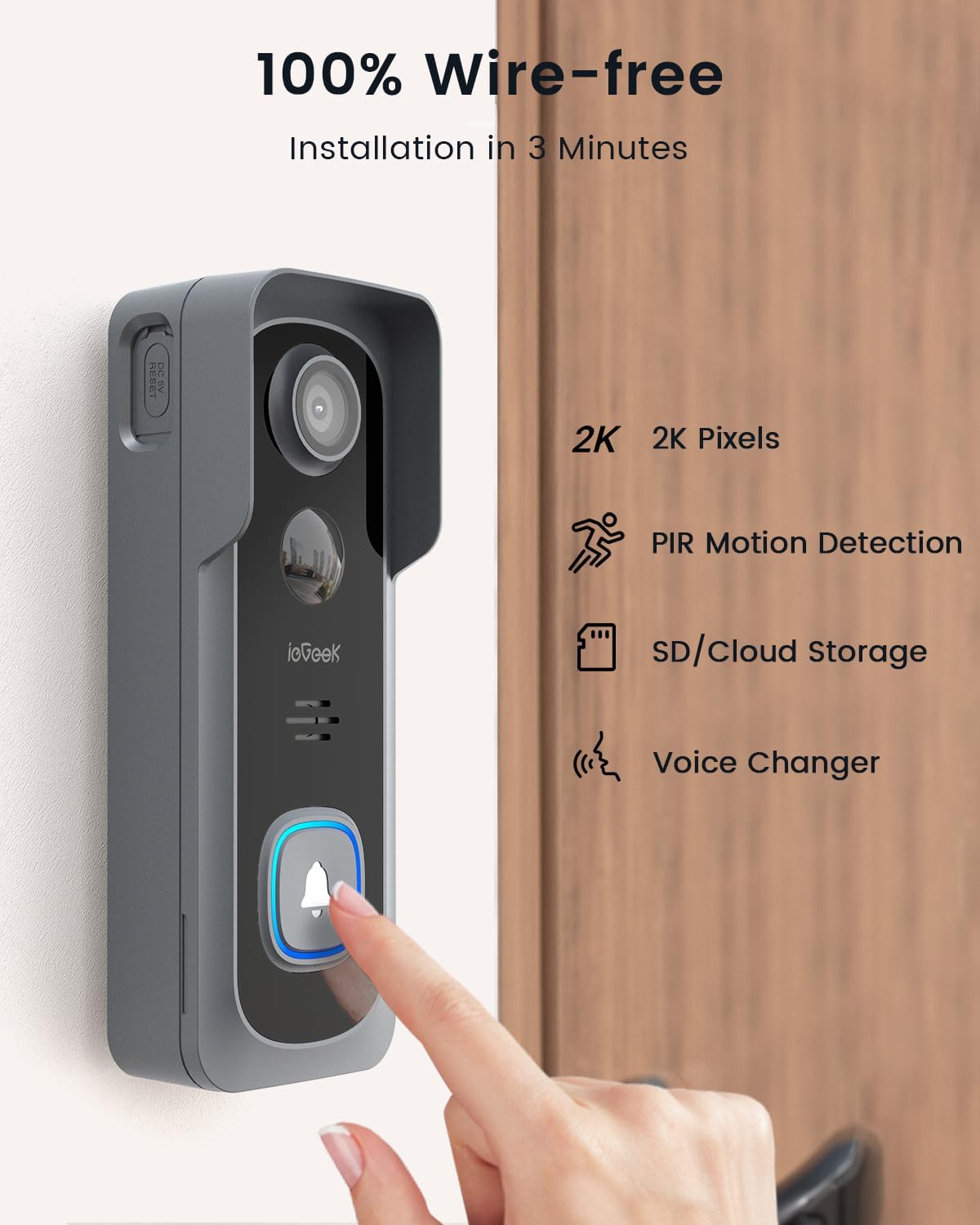
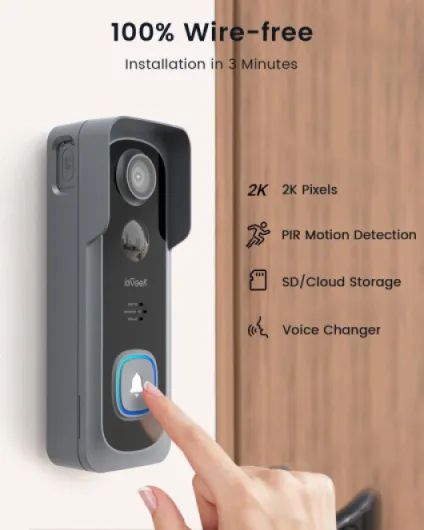
Design-wise, it’s not going to win any beauty contests, but it looks clean and neutral enough on the door. The grey/black combo is discreet, and it doesn’t scream “cheap gadget” from the street, which I appreciate. The size is reasonable: big enough to have a decent button and camera, small enough not to dominate the door frame. The button has a clear click and lights up, so visitors understand where to press even in the dark.
The body is plastic (ABS), which you can feel when you hold it. It doesn’t feel premium, but it also doesn’t feel flimsy or hollow. Once it’s mounted, you don’t really notice the material quality anymore. The mounting plate uses a simple latch system so you can slide the doorbell off to charge it. That mechanism is actually quite handy. It’s tight enough that you’re not constantly worried it’ll fall off, but still manageable when you need to remove it. There’s a little security screw if you want extra peace of mind against casual theft.
In terms of weather resistance, it’s advertised as waterproof. In practice, it’s been through rain and wind without any issue. No fogging inside the lens, no weird condensation. I wouldn’t mount it where it gets a constant direct jet of water, but for normal front-door exposure it holds up. The plastic cleans easily with a damp cloth; mine picked up a bit of dust and spider webs after a few weeks, but nothing serious.
One thing to keep in mind: there’s no fancy slim metal design like on some pricier models, so if you’re obsessed with aesthetics, you might find it a bit basic. For me, it’s fine: it’s a tool, not decor. From the pavement, it just looks like any other smart doorbell. Functionally, the design works: clear camera placement, obvious button, status LED you can actually see, and a form factor that fits most door frames without weird gaps.
Battery life: real-world numbers vs the marketing claims
The doorbell has a 5200 mAh rechargeable battery, and the brand claims up to around 2–3 months of use depending on how often it’s triggered. In practice, it really depends on how busy your front door is and how aggressive your motion settings are. With medium sensitivity, about 15–20 motion events per day, and a couple of live views, I saw roughly 15–20% battery drop per week. That lines up with about 5–6 weeks per charge in my case, which I can live with.
Charging is done via the port on the unit. You need to slide it off the mounting plate and bring it inside. With a normal USB charger, a full charge from around 15–20% to 100% took me roughly 3–4 hours. Not super fast, but you only do it every month or two, so it’s not a huge deal. The app shows the battery level clearly, and you can set alerts when it goes below a certain threshold (for example 20%), so you don’t wake up one day with a dead doorbell.
Battery life is very sensitive to your settings. When I first installed it, I left sensitivity high and allowed all motion. The door faces a small street, and it was triggering constantly. In that scenario, the battery burned a lot faster, and I could tell it wouldn’t even last a month. After I tightened the detection zones and lowered sensitivity, the drain went down noticeably. So if you’re seeing poor battery life, the first thing to do is tweak the motion settings, not blame the battery straight away.
Compared to wired solutions you obviously have the hassle of recharging, but you avoid any cabling headache. Compared to other battery doorbells in the same price range, I’d say the ieGeek is decent but nothing special. It’s not the longest-lasting battery I’ve ever seen, but it’s consistent and doesn’t seem to degrade quickly, at least over the first months. If you expect to charge it once every 4–8 weeks depending on traffic, you’ll be in the right ballpark.
How it holds up over time and in everyday use
In terms of durability, this feels like a solid mid-range device. The plastic doesn’t creak, the button still clicks properly after a lot of presses, and the mount hasn’t loosened. I’ve had it through rain, wind and some temperature swings, and nothing has cracked or discoloured so far. The lens hasn’t scratched, and the night vision LEDs still behave like day one. It’s obviously not military-grade, but for a front-door gadget, it holds up fine.
The main long-term concern with these things is usually battery health and whether the seals keep water out. So far, no sign of moisture inside the unit or fogging on the lens, even after heavy rain. The rubber covers over the ports still sit tight. A couple of users online say they’ve had theirs running for multiple years without a big drop in battery life, which lines up with the feeling that the battery isn’t cheap garbage. After several charge cycles, I didn’t notice any sudden drop in performance either.
One small thing: because it’s plastic and fairly light, a strong knock (ladder, big parcel, kids messing around) will shake it more than a metal, hard-wired unit. The mounting plate is fine, but if you don’t tighten the screws well into something solid, it can wobble. So it’s worth taking five more minutes during installation to make sure it’s firmly anchored. Once that’s done, it stays in place.
As for software durability, the app is basic but stable. No constant crashes on my phone, and firmware updates haven’t broken anything so far. The notifications keep coming, the clips keep recording. I’m not expecting big new features in the future, but as long as it keeps doing the basics reliably, I’m fine with that. Overall, I’d say durability is good for the price: not bulletproof, but clearly not disposable junk either.
Video quality, motion detection and app responsiveness
The 2K video quality is honestly better than I expected at this price. During the day, faces are clear, you can read parcel labels if they’re not too far, and the 130° field of view covers my entire porch plus a bit of the path. It’s not cinema-level sharp, but for security and parcel checks, it’s more than enough. Night vision is solid: the IR LEDs light up the area nicely, and you can still recognise faces within a few meters. It does switch to black-and-white at night, which is normal for this kind of device.
Motion detection is handled by a PIR sensor with adjustable sensitivity and zones. Out of the box, it was way too sensitive for me – it was picking up people walking on the pavement several meters away. After dropping the sensitivity and drawing a smaller detection area in the app, I got it down to roughly 3–4 meters in front of the door, which is what I wanted. Once tuned, it triggers mainly for people actually coming towards the house, not random traffic. You still get the odd false alert (cat, big van light reflections), but it’s manageable.
On the app side, notifications arrive fairly quickly. On home Wi-Fi, the delay between motion and notification is usually 1–3 seconds. On mobile data, it can stretch to around 5–8 seconds depending on your signal, which is normal. Opening the live view takes a couple of seconds; there’s a small buffer, but nothing that makes it unusable. The doorbell-to-phone audio has a bit of lag (around a second), so you need to speak slowly and let the other person finish before talking again, but it’s fine for basic conversations with delivery drivers.
The only real annoyance performance-wise is that if your Wi-Fi signal is weak near the door, you’ll notice it immediately: choppy video, delayed notifications, or the clip not loading. This isn’t unique to this model, but worth pointing out. You might need a Wi-Fi extender if your router is far from the front door. Overall, for the price, video and detection performance are pretty solid, as long as you put in the initial effort to tune the sensitivity and make sure your Wi-Fi is decent.

What you actually get in the box and how it works day to day
Out of the box, you get the doorbell unit, an indoor chime, mounting plate, screws, a little drill template, and a charging cable. No SD card included, which is normal at this price but still worth noting. The unit itself is fairly compact (about 15 cm tall) and light, so you don’t need heavy-duty fixings. I installed it on a PVC door frame without issues. The chime just plugs into a socket inside and pairs with the doorbell after a bit of button pressing.
The doorbell connects to 2.4 GHz Wi-Fi only, so if you’ve split your router into 2.4 GHz and 5 GHz networks, make sure you know which is which. On my first try it failed to pair because my phone was stuck on the 5 GHz SSID. Once I forced it onto 2.4 GHz, pairing took maybe two minutes. After that, the app showed the battery level, live view, history of motion events and rings, all in a simple calendar-like list. Nothing fancy, but clear enough.
In day-to-day use, the main routine is simple: motion happens, you get a push notification, you tap it and you see a short clip or live feed. When someone presses the bell, the indoor chime rings and your phone pops up a call-style alert. You can talk back through the app. There’s also AI “humanoid” detection and custom detection zones, which help cut down on cars and random movement in the street, but you need to spend 10–15 minutes tweaking those at the start.
For storage, you’ve got two options: basic free cloud (short 6-second clips, 7-day loop) and microSD card up to 128 GB. I started with just the free cloud and it was fine for basic use, but you quickly feel the 6-second limit when someone hangs around a bit longer. Adding an SD card gives you more continuous coverage without paying a fee. Overall, the feature set is pretty complete for the price, just not as polished as the big brands.
Pros
- No monthly subscription needed, with free basic cloud and SD card support
- 2K video and clear night vision that make faces and parcels easy to see
- Simple wireless installation with included chime and decent battery life
Cons
- App and overall polish are basic compared to Ring/Nest
- Only supports 2.4 GHz Wi-Fi and mainly Alexa integration
- Free cloud clips are very short (around 6 seconds), SD card almost mandatory for full coverage
Conclusion
Editor's rating
Overall, the ieGeek wireless doorbell camera is a practical, budget-friendly option if you want video at your front door without signing up for monthly fees. The 2K video is clear enough to recognise faces and parcels, the night vision does its job, and the motion detection becomes reliable once you take the time to tune sensitivity and zones. Battery life is decent, around 4–8 weeks depending on how busy your front door is, and recharging isn’t a huge hassle thanks to the slide-off mount.
It’s not the slickest product on the market: the plastic build is basic, the app is functional rather than pretty, and the free cloud clips are short. You also need to be okay with 2.4 GHz Wi-Fi only and mainly Alexa integration. But if your priorities are low upfront cost, no subscription, and simple wireless installation, it gets the job done and feels like good value. I’d recommend it to renters, people who don’t want to touch wiring, and anyone who just wants to see who’s at the door and record short clips without ongoing costs. If you’re picky about design, want deep smart-home features, or expect flawless polish, you’re better off spending more on Ring, Nest or similar.